

ChatGPT Pro: allowance preserved, Chat and Work move closer
6 November update: three Pro tiers, Ultrafast and the displayed €510 price. What changes for usage allowances and what businesses should consider.

Pro 100, 200 or 500: What has changed?
OpenAI’s pricing overview lists Pro 100 at US$100, Pro 200 at US$200 and Pro 500 at US$500 per month. These numbers identify subscription tiers. They do not represent a number of messages or completed tasks.
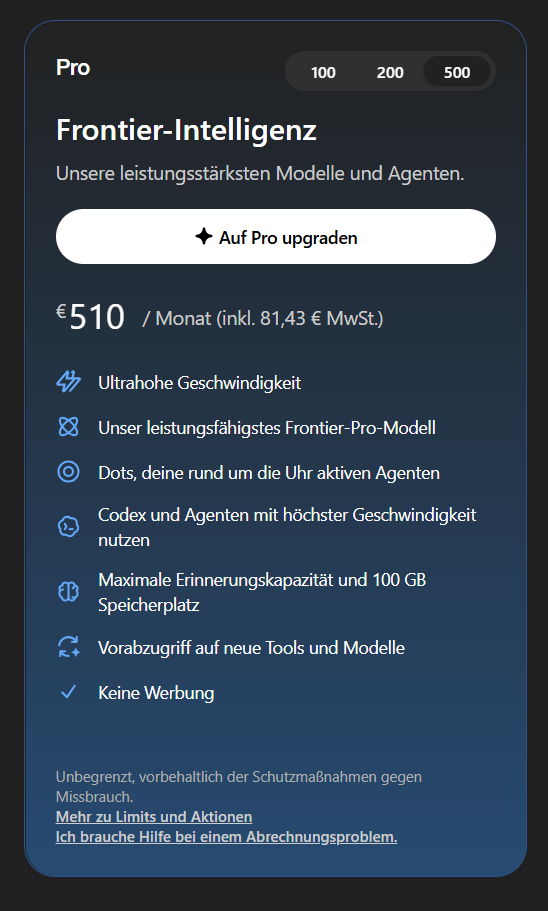
The German Pro 500 pricing screen supplied to us shows €510 per month including €81.43 VAT. This is the price in that specific display. The final price shown in the individual account is what matters when subscribing.
According to OpenAI’s explanation of the Pro tiers, Pro 100 and Pro 500 receive twice their previous Work and Codex allowance. For Pro 200, the previously lower allowance is brought up to the higher level. Subscribers already on that higher allowance keep it. Existing subscribers do not need to cancel and subscribe again.
Ultrafast: Less waiting, more allowance used
Pro 500 provides access to Ultrafast for GPT-6 Astra and GPT-6.1 Sol. For Astra in Codex, OpenAI reports token output up to eight times faster than Standard. Included allowance is charged at eight times the Standard rate. Purchased credits are charged at six times the rate. Source: OpenAI’s speed documentation.
Faster text or code output does not automatically make an entire project eight times faster. Preparation, questions, checks and implementation still take time. Shorter waits can nevertheless make a noticeable difference when we work through many small steps together.
The highest speed is therefore not the only consideration. We would use Ultrafast where waiting actually holds up the workflow. For work that runs in the background anyway, a more economical mode may be appropriate. A higher subscription tier cannot replace a clear brief and a review of the result.
What the pricing card promises and what it does not imply
The displayed Pro 500 card also lists Dots as always-active agents, 100 GB of storage, extensive memory, early access to new features and no advertising. These are different capabilities: storage is not a compute allowance. Memory does not replace complete project documentation. And an agent still needs clear responsibilities and suitable access permissions.
For businesses, the practical questions are which tasks recur, where time is actually saved and how reliable the results are. Those answers help determine whether 100, 200 or 500 fits the work. The new choice does not oblige existing Pro 200 subscribers to upgrade.
The original announcement of 1 November
OpenAI will not implement the announced reduction in the Pro 200 allowance. According to an email to subscribers available to our editorial team, the previous allowance for Work and Codex remains in place from 29 October. The company cites user feedback as the reason for reversing the change announced in its 29 September email.
The same message outlines a second development: Chat and Work are to come together in ChatGPT, with usage across ChatGPT and Codex counted against a shared allowance. These are related announcements, but they answer different questions: how much usage is included and how the tools are organised.
What stays the same for Pro 200
Subscribers addressed by the message keep their previous Work and Codex allowance. The planned reduction is cancelled. The email does not give a new fixed number of messages, tasks or hours and does not promise unlimited Work or Codex use.
That distinction matters for people using the tools for sustained projects. An unchanged allowance preserves the existing basis for planning. It does not mean that every task consumes the same amount or that all restrictions disappear.
From a conversation to a finished task in one place
OpenAI plans to test a unified Chat and Work experience with a small group over the coming weeks. Feedback from that group will inform a wider release. The announcement therefore does not mean that every account already has the new interface.
The intended workflow connects discussing an idea with carrying it out. Users will be able to bring in files and plugins, ask for a website or presentation and have tasks performed on the web. They should be able to review and steer the work as it progresses. Codex will remain a separate area in the ChatGPT desktop app, according to the email.
One allowance for ChatGPT and Codex
The message also announces a gradual move towards shared usage across plans. ChatGPT and Codex activity will count towards one allowance. Model choice and task complexity affect consumption: more advanced models and demanding tasks can use more of it.
For example, a brief editing request and a software change involving files, tools and checks need not have the same cost in usage. That is an illustration of the principle, not a conversion formula. OpenAI’s pricing and usage documentation also explains that task complexity affects consumption and that API prices are separate from subscription usage.
There is an explicit exception in the subscriber email: unlimited Instant use is included in the plan and will not count towards this allowance.
Checking usage and reaching the limit
Under Settings → Usage, users are to see their remaining total allowance and its reset time. If it is exhausted, the email lists three options: wait for the reset, upgrade the plan or purchase credits to continue using the relevant features. None of those options should be confused with a requirement to buy additional credits.
For day-to-day work, the account’s usage display is more useful than estimating capacity from the length of a prompt. Keep an eye on the remaining allowance before starting a long task and choose a model that fits what the task needs.
Our view: a smoother workflow still needs clear decisions
Bringing discussion and execution closer together can reduce handovers between tools. The real benefit depends on whether the resulting work is useful and reviewable. A website still needs suitable content, a presentation still needs a clear argument and software changes still need checks.
Our approach remains the same: define the result, provide the relevant context and review what the tools produce. We help businesses identify practical uses for AI and fit them into existing work. Talk to us about a concrete task.
Sources and status of this article
First published: 1 November 2026. Updated: 6 November 2026. The original analysis is based on OpenAI’s email “Deine Pro-Nutzung und eine einfachere Art zu arbeiten”, supplied to our editorial team. The update draws on the official pricing overview, Pro tier explanation, Ultrafast documentation linked above and the documented German pricing screen. The conclusions about business use are our analysis. Availability and personal limits should be checked in the individual account.