

ChatGPT or Claude? Both, and why that makes sense
Four years of AI development, two very different assistants and a principle proven in agency work: neither operates without checks by the other.

It is just after eleven at night. The office lights are off, yet work continues. On one computer, an AI agent has spent hours rebuilding a website: migrating content elements, writing Twig templates and publishing packages. The next morning, a second agent from a different manufacturer will review every change and find what the first overlooked. Only then will a person inspect the work and decide.
In brief: ChatGPT and Claude can support different tasks in agency work. This article explains the foundations, strengths and limits of both systems. A practical look at the Bauwissen app shows how development through dialogue works. Checklists help with selecting tools and checking results.
What artificial intelligence really is, and what it is not
The term “artificial intelligence” is misleading because it sounds like thinking. Technically, ChatGPT and Claude are large language models: systems trained on enormous quantities of text to predict which word is likely to follow those already present. That apparently simple ability produces something remarkably powerful. A system that can continue language at this level can summarise, translate, argue and program.
Three characteristics follow directly from this design. Understanding them explains ninety per cent of AI discussions:
- Language models do not know things; they have learned patterns. They can therefore sound convincing while being wrong. Specialists call this hallucination; confident guessing might be a more fitting description.
- They are not databases. Anyone needing current facts must provide them through research, a document or web search. This is why “facts from a person, wording from the machine” works so well.
- They have nevertheless become agents. The crucial development of the last two years is action rather than better wording. Modern models operate tools, execute code, open browsers, check their own results and work on a task for hours.
AI does not replace knowledge or responsibility. It replaces typing, routine work and, increasingly, entire steps between an idea and a result.
The 2026 model landscape: more choice than you might think
When people say “AI” today, they usually mean one of a handful of systems. Alongside OpenAI with ChatGPT and Codex and Anthropic with Claude, major players include Google with Gemini, Meta with openly available Llama, Europe's Mistral and xAI with Grok. A growing number of open models can also run on your own hardware, which is relevant wherever data must stay within an organisation.
All major providers now follow the same pattern: model families in different sizes. Small and fast for everyday tasks, medium for standard work and large for complex assignments. Since GPT-5.6, OpenAI's tiers have been called Luna, Terra and Sol. Anthropic uses Haiku, Sonnet and Opus, supplemented since June 2026 by the new Mythos class with Claude Fable 5 at the top. Price differences are substantial: the smallest and largest models often differ by a factor of fifty.
For businesses, this creates an inconvenient but liberating truth: “Which AI is best?” has no stable answer. The leader changes from month to month. The providers' characteristics are more stable, and a working method can be built around those.
Four years in fast-forward: two routes to the same destination
01The development
From conversation to workflow.- 01Ask
Ask questions and assess the answers.
- 02Draft
Prepare text, images and code.
- 03Execute
Use tools across several work steps.
- 04Review
Check results against requirements and sources.
In November 2022, OpenAI put an experiment online that attracted a hundred million users within two months. At the time, ChatGPT could handle text. Nothing more: no images, web search or tools. What followed may have been the fastest product evolution in technology history.
OpenAI delivered annual milestones: GPT-4 understood images and passed examinations, GPT-4o brought together language, images and sound, and the o-series introduced models that visibly reason before answering. With GPT-5, model selection disappeared behind a system that decides how much reasoning a question deserves. As Codex expanded, AI arrived in editors and terminals as an agent.
Anthropic, founded in 2021 by former OpenAI employees, took a different route: safety first, spectacle second. Claude 1 and 2 remained niche products. Claude 3 brought the breakthrough in 2024 with a three-tier model family. Computer Use followed, allowing a model to operate a screen, mouse and keyboard, then Claude Code for the command line and models that stay focused on a task for many hours. Since May 2025, Claude has been hard to overlook for automating long, complex rebuilds, while people seeking the fastest tool in the editor often choose Codex.
It is striking how the two routes converge. The showman learned care; the safety researcher learned speed. In 2026, a single benchmark point separates the leading models. In everyday use, temperament separates them.
Strengths and weaknesses: ChatGPT
After a year and a half of daily work with both systems, a clear picture has emerged for us. First, ChatGPT, which in agency work primarily takes the form of Codex, the coding agent in Visual Studio Code:
- Exceptionally fast on clearly defined tasks: analyse a bug, write a fix and commit it, often within minutes.
- The best everyday image generation: every blog cover image we use is created here.
- Strong in the terminal and infrastructure: Composer, Git and publishing packages on Packagist are handled confidently.
- Creative breadth: many variants, unusual approaches and fast brainstorming.
- A huge ecosystem: projects, team features and integrations in every direction.
- A tendency to take shortcuts on long tasks, completing the visible part while leaving edge cases.
- Unilateral decisions: it sometimes increases a version number without being asked or “cleans up” something nobody wanted cleaned up. Our chats are full of “Stop, no version bump!”
- German copy often sounds translated: correct, but lacking voice.
- Fine visual work, especially CSS, can be surprisingly slow. A six-pixel margin-top once took us nine attempts.
Strengths and weaknesses: Claude
Claude is our second main tool, used in chat, as Claude Code in the terminal and as a desktop agent operating browsers and applications:
- Endurance: it stays on course for hours, completes lists in full and honestly reports what remains open.
- German copy with attitude and voice: this blog is written and maintained by Claude, including editorial maintenance.
- Tool use beyond code: controlling browsers, operating back ends, organising files and connecting systems.
- Thorough review: it finds edge cases, security gaps and the question nobody asked.
- Transparency: it states assumptions and asks about contradictions rather than glossing over them.
- Slower on small jobs: the other tool is faster for a three-line fix.
- Image generation is practically absent, so another tool is needed.
- Caution can be irritating: it asks once too often where “just do it” would have been expected.
- The ecosystem is younger and some integrations still require manual work.
These are two temperaments: a fast, inventive sprinter with a tendency to take shortcuts, and a persistent, conscientious distance runner inclined to ask questions. That difference is exactly why we do not choose just one.
The four-eyes principle: two AIs reviewing each other
02Working together
Draft. Cross-check. Decide.- 01Brief
A person defines the goal, context and boundaries.
- 02Implement
Model A develops a draft, code or a concept.
- 03Cross-check
Model B reviews the result against the brief.
- 04Approve
A person tests, evaluates and decides what is released.
Correction needed? Return to implementation with the review findings.
At Agentur Zentral GmbH, neither model works unchecked. The process is always the same: one implements, the other reviews, and a person provides the brief at the start and decides at the end. What sounds bureaucratic is, in practice, the single biggest quality improvement in using AI.
The effect rests on a simple observation. Two models from the same provider make similar mistakes because their training is similar. Two fundamentally different architectures rarely overlook the same thing. When Codex rebuilds half the theme overnight, Claude reads the diff in the morning and reliably finds the two places where the sprinter took a shortcut. Conversely, Codex identifies where thoroughness in Claude's concepts becomes unnecessary complexity.
A recent example: one assistant suspected security gaps in a login article on this blog and recommended hardening measures. Checking the source code showed that half the recommendations were already implemented. The article was corrected before a reader saw the false claim. The four-eyes principle checks claims as well as code.
Workshop report: a web app develops through dialogue
03From the workshop
Code becomes an application.// Bauwissen: shortened code example
function offeneAufgaben(baustelle) {
return tasks
.filter(t => t.ort === baustelle)
.filter(t => !t.erledigt);
}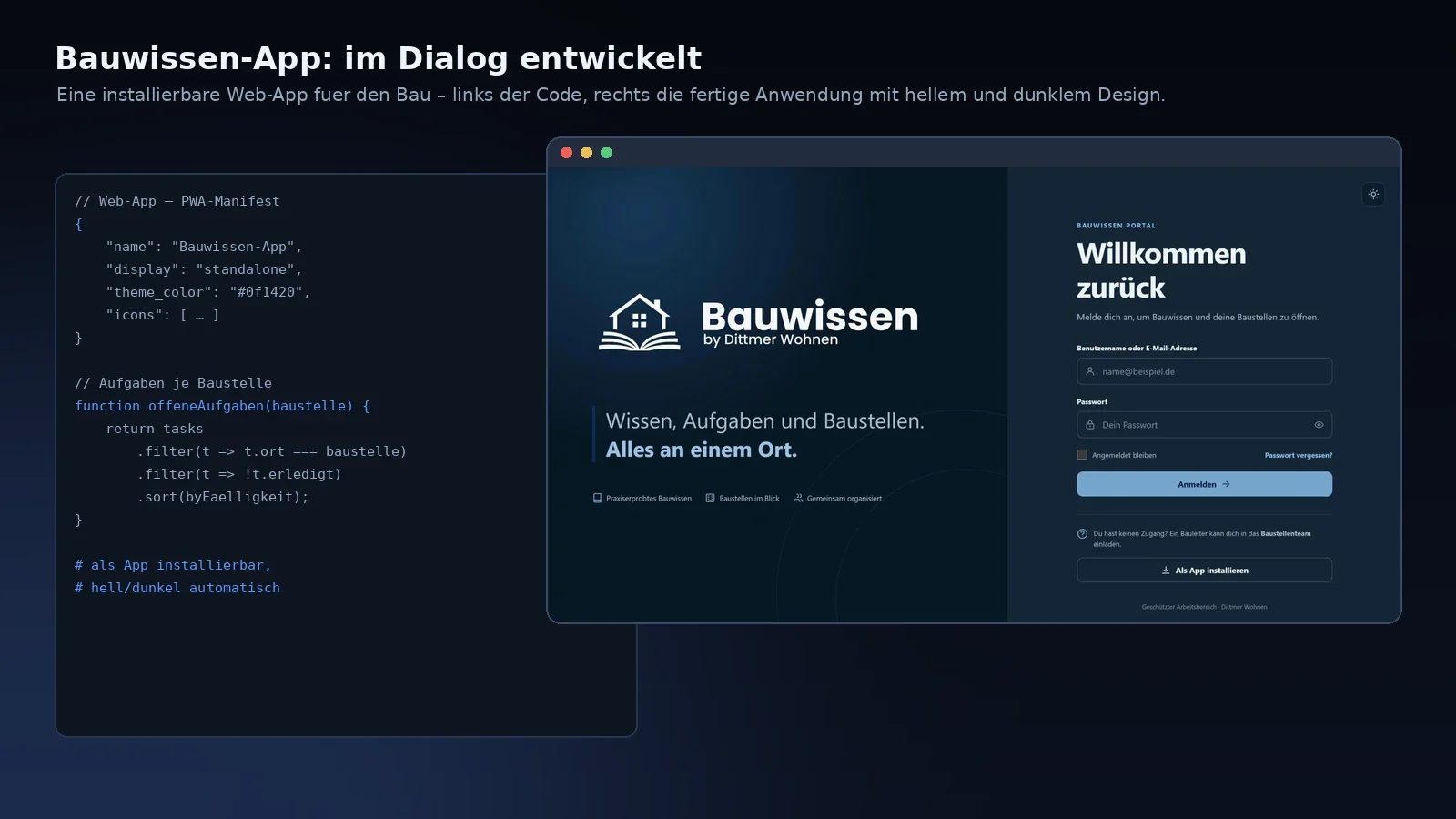
The second example shows the expanded scope: the Bauwissen app, a protected construction portal bringing knowledge, sites, tasks, appointments and materials together. It is installable as a smartphone app, with light and dark designs, team invitations and an editor enforcing clean HTML.
Its development story is remarkable. The app was not specified in advance but shaped through dialogue. The history reads like a workshop: “Icons rather than images.” “The categories don't fit; please make them for private homebuilders.” “Remove this function completely; nobody will maintain it on a private building site.” More than 150 such responses produced a product in a few days that matched a real need, rather than a requirements document written six months earlier.
For our clients, the practical implication is clear. Agentur Zentral GmbH now builds more than websites. We develop web apps, from booking systems to knowledge portals such as the Bauwissen app, and custom software extensions where the standard falls short. The process is the same as for the theme: clear briefing, AI-assisted implementation, independent review and human approval. What once failed on budget is now a matter of weeks.
AI in an agency: from SEO to GEO
What does all this mean for an agency's core business of visibility? The discipline has doubled. Traditional search engine optimisation is now joined by Generative Engine Optimization (GEO), the art of appearing in AI answers when nobody reads ten blue links.
Each follows its own rules, but they share a foundation:
- Content that answers questions directly, with the question as the heading and the answer in the first paragraph.
- Structured data so machines understand who is speaking and what the business stands for.
- Original substance: figures, examples and experience. AI systems cite what they cannot find elsewhere.
- Technology without obstacles: loading speed, accessibility and clean semantics remain fundamental.
AI has also changed production. Research, drafts, metadata, image concepts and infographics now take a fraction of the time, following the same process as this blog: facts first, machine-generated wording, a second model's review and a human decision. Producing an article like this in a morning rather than a week is no longer exceptional. Getting it right remains a craft.
Where things are heading
AI predictions age faster than milk, but a few trends are stable enough to describe:
Agents will become everyday tools. The shift from question-and-answer tools to independently working systems is well under way. Tasks will be delegated rather than dictated. Scheduled runs, night shifts and handovers between agents will become as ordinary as cron jobs are today.
Multiple models instead of a single ecosystem. The four-eyes principle will spread because it measurably reduces errors. Tools orchestrating models from different providers are the logical next stage.
Prices fall and expectations rise. What today requires a flagship model will be handled by a mid-range model in eighteen months. The bottleneck shifts decisively from access to competence: briefing, reviewing and taking responsibility cannot be purchased as a subscription.
Regulation becomes concrete. The European AI Act introduces phased obligations, from transparency to labelling. Anyone documenting which tools they use and how will avoid having to reconstruct that information later.
The boundary remains. Language models guess brilliantly. Responsibility, taste, client relationships and the decision about what should be built remain human, with no competitor in sight for the foreseeable future.
Checklist: which tool for whom?
04Agency experience · July 2026
The right tool for the task.Long development tasks
ClaudeQuick fixes and terminal work
ChatGPTGerman copy and concepts
ClaudeImage generation and moodboards
ChatGPTIndependent code review
ChatGPT + ClaudeBrowser and back-office workflows
ClaudeBrainstorming and creative variants
ChatGPTWeb applications from scratch
ChatGPT + Claude
To finish, the question clients ask most often, answered through practical rules of thumb:
- For a business getting started: choose one model, define a specific use case such as proposal copy or meta descriptions, measure for four weeks and then expand.
- For copy with voice, particularly German, brand language and attitude: try Claude first.
- For images, fast research and variants: ChatGPT.
- For development: both. Short fixes and terminal work go to Codex; long rebuilds and reviews to Claude Code.
- For anything involving customer data: first clarify which information may enter which tool. Use data-processing agreements and team plans; avoid public free accounts.
- From the first serious use: apply the four-eyes principle. No AI output goes out unchecked, whether code or text.
- Always: name a person who remains accountable. AI scales work, not responsibility.
You do not have to take this route alone. That is precisely why we are here. Agentur Zentral GmbH has used AI productively for years as a documented workflow with review steps, from consulting and websites to web apps and software extensions.
Conclusion: use both, with checks
ChatGPT or Claude? After four years of development, thousands of chat messages and two rebuilt products, our answer is clear: the question is framed incorrectly. Both models are outstanding at different kinds of work. The sprinter provides speed, ideas and images; the distance runner brings endurance, care and language. Using both and having them review each other delivers something neither offers alone: speed with a safety net.
The deeper change lies in the division of work. People decide what should be created and what quality is required. AI supports implementation and the review of individual steps. This blog and our web applications show how new workflows can develop.
Frequently asked questions
Short answers to common questions about ChatGPT, Claude and using AI in business.
Which is better: ChatGPT or Claude?
Both take turns leading benchmarks. Their characteristics are more stable: ChatGPT excels in speed, images and ecosystem; Claude in endurance, language and thoroughness. Often the best answer is both, with mutual review.
What does business use cost?
Chat subscriptions are around €20 to €30 per user per month, with professional tiers above that. More important than subscription costs is the time spent on briefing and review, which is saved several times over elsewhere.
Are my data safe there?
In team and business plans with a data-processing agreement, inputs are not used for training. Customer data should still enter only tools whose use has been clarified. Particularly sensitive information stays out entirely or is handled by local models.
Does AI replace the agency or developer?
It replaces work steps, not responsibility. Briefing, quality judgements, product decisions and client relationships remain human. What changes is that a small team can now accomplish work that previously required a large one.
What is the four-eyes principle with two AIs?
One model implements, a model from another provider reviews independently and a person approves. Because different architectures make different mistakes, the cross-check reliably finds what implementation overlooked.
Can Google tell that copy was created with AI?
Usefulness is assessed, not origin. Superficial mass-produced content loses; well-researched and checked content wins, increasingly within AI answers themselves through GEO.