Read stock-photo licences: use, sharing and evidence
Use free and paid stock images with traceable evidence: Germany/EU context, original provider conditions and a deliberately limited documentation helper.

A stock photo is selected for a homepage. Months later, the same file is proposed for an advertisement, customer brochure and product offered for sale. The file has not changed, but the uses differ. The original selection does not establish permission for every later application.
This guide explains a systematic licence review for businesses in Germany within a European context. Sources were checked on 9 November 2026. Provider conditions can change and depend on the contract. The terms applicable to the particular acquisition matter. Examples are editorial teaching cases rather than individual legal advice.
1. Describe the use before searching
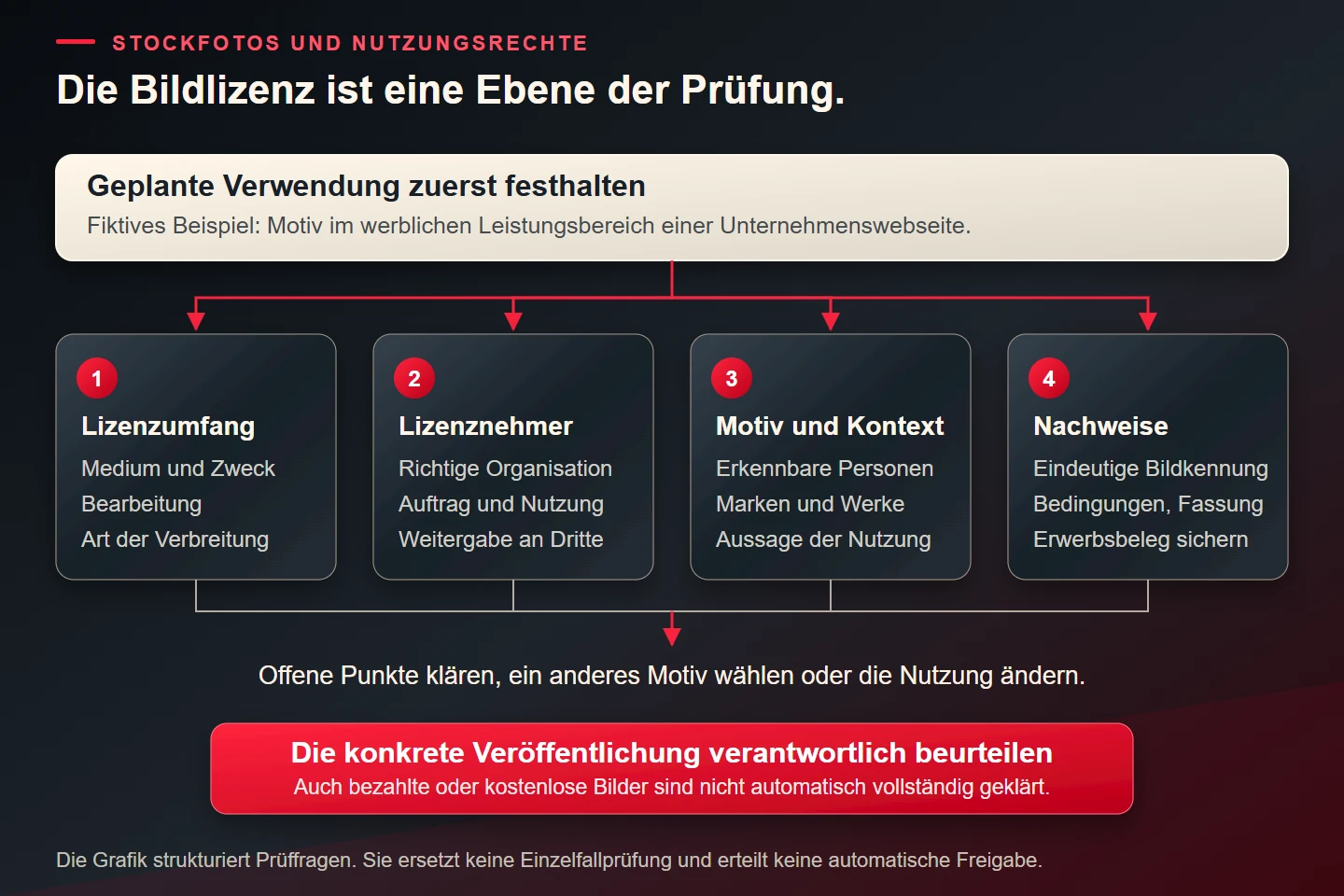
Start with the application rather than the most attractive image. A public service page, paid advertisement and poster for sale serve different purposes. Record who intends to use the image and for which offer.
Describe planned editing too. Keeping a straightforward crop differs from a montage implying that a person recommends a product. Text placed over a portrait can also substantially change its meaning.
A fictional trade business might initially plan a background image on its own service page and a crop for a company newsletter. Later use on calendars for sale is explicitly outside that first description.
This description is an organisational tool, not an automatic legal decision. It provides the information against which the actual licence can be examined.
Include the expected handover. An agency may produce a final page without handing over an independently usable source file. Establishing that distinction early makes the later contract review more focused.
2. Separate permission from possession
Downloading an image gives you a copy. Permission does not follow from possession alone. Under section 31 of Germany's Copyright Act, usage rights can be limited in territory, time or subject matter.
An invoice may document acquisition without containing every condition. Conversely, a general licensing page may not establish which arrangement applied to the particular downloaded file.
Connect the image identifier, licence evidence and applicable terms. A collection of pictures and a separate collection of unidentifiable receipts will be difficult to assess later.
Licence administration concerns the connection between acquisition and subsequent use. Other affected rights require separate attention. Collecting download receipts must not be mistaken for complete review of every publication issue.
Keep business ownership understandable as well. Someone inheriting the media collection should be able to identify whose project the acquisition concerned without reconstructing a former employee's personal browsing history.
3. Do not read a label as complete permission
| Label | Further question |
|---|---|
| Free | Which conditions and excluded uses apply? |
| Royalty-free | What use does this particular licence cover? |
| Standard licence | Which boundaries does this provider define? |
| Extended licence | What additional rights are actually granted? |
| Editorial | Which context is allowed and which promotion excluded? |
| Exclusive | Which rights are excluded for which other parties? |
The table is a review aid rather than a universal definition across platforms. Similar plan names can contain different contractual permissions. Choosing from the label alone is insufficient.
Distinguish the licence from the subscription too. An account may enable downloading while other provisions define the actual scope. Review the relationship rather than assuming the payment arrangement answers every usage question.
4. Read original conditions for free providers
The general Unsplash licence permits broad free use, including commercial applications. It also contains boundaries concerning matters such as unmodified sales and competing image services. This concerns that general licence, not automatically every differently licensed offering on the platform.
The Pexels licence overview describes free use and editing alongside exclusions, including certain unmodified resale and implied endorsement by depicted people or brands. “Free” does not replace reading the conditions.
The fictional business should therefore not approve an image solely because search results group it with free pictures. Identify the actual source, file and relevant rules together.
A search-result preview is weak as sole evidence. It may be shortened or describe a different item. Use a traceable original source.
Do not silently group every asset from a provider under one rule. A platform can offer different collections or arrangements. Identify the terms attached to the particular acquisition rather than extending a familiar licence to unfamiliar content.
5. Review paid arrangements just as carefully
Payment does not automatically remove restrictions. The Adobe Stock licensing overview, for example, distinguishes licence types and additional editorial restrictions. That demonstrates why one blanket rule for paid stock would be inappropriate.
The retrieved German Adobe Stock additional terms carry a revision date of 17 June 2024. They include provisions for customers, employees and different subscription arrangements. Compare them with the agreement governing an actual acquisition.
Read definitions, exclusions and references alongside the highlighted permissions. A contractual term such as customer or business may have a narrower meaning than the team initially assumes.
When asking about an additional use, describe it precisely. A general answer to “Can I use this commercially?” may be too broad for a particular resale or customer transfer.
Keep provider explanations in their proper role. An overview can help identify a relevant issue while the complete contractual documentation establishes the applicable detail. Save the material needed to understand that relationship.
6. Distinguish editorial restrictions from a company blog
A company blog is not automatically an allowed setting for every editorially licensed photograph. The particular licence and publication context matter. Calling a promotional service page a blog does not transform its purpose.
Adobe describes editorial restrictions separately from ordinary commercial use. Such an image requires review of context, editing and required attribution. A more expensive licence does not necessarily resolve every additional restriction.
In the teaching case, establish whether the image promotes a service or reports on a particular public-interest event. The same photograph may require different analysis in a different setting.
Record the context in the evidence. “Used in the blog” says little about the statement actually communicated through image and copy.
Also examine surrounding calls to action. A photograph embedded beside a direct product endorsement may convey a different message from the same photograph within a factual account of an event.
7. Review depicted material separately
The Unsplash terms explicitly distinguish the broad image licence from certain rights involving identifiable people, brands and works appearing in images. Additional permission may depend on how an image is used.
This distinction affects selection. A prominent company logo may introduce unnecessary additional questions for a neutral illustration. A portrait should not casually be transformed into a personal recommendation of your own service.
Review the final combination of image and wording. A small caption change can alter the message more than a new crop. Assess the publication actually intended.
When clearance remains unclear, a different image may be a more practical choice. That is an editorial decision about effort and suitability, not a blanket legal conclusion about the original.
Keep evidence of any relevant additional review linked to the asset. A comment buried in an unrelated message becomes difficult to interpret after the person responsible leaves the project.
8. Identify the correct licensee
An agency may work for itself, for a client or under an organisational arrangement. These roles are not interchangeable. Record whose licence is involved and who may subsequently use the image.
Related companies do not automatically share every right. Nor should an image move from one customer project to another without assessment.
Clarify the intended allocation before downloading. Acquisition and handover can then be organised accordingly. Reconstructing an old personal account afterwards is harder.
In our example, the trade business receives traceable evidence for its own project. The agency preserves supporting records and documents the files delivered. The legal arrangement must fit the provider's terms.
Do not substitute a billing address for the answer without checking. A receipt's recipient and the contractual licensee can require interpretation within the actual purchasing arrangement.
9. Separate editing from distribution
Permission to crop a photograph does not automatically permit unrestricted sharing of its original file. Embedding an image in a finished design also differs from distributing an independently reusable stock image.
Inspect what a handover contains. A completed PDF brochure, editable layout and folder of original photographs provide different opportunities for reuse.
A limited supply to a printing contractor may be governed differently from transfer to another customer. Do not invent an internal blanket rule where the contract distinguishes these situations.
Record the recipient and purpose. The technical ability to export a file does not establish the permitted scope.
10. Attach the evidence record to the asset
A simple inventory can make review easier. It needs a stable asset identifier and connections to evidence. Filenames such as “new-final-header.jpg” are poor identifiers among similar pictures.
{
  "asset_id": "demo-17",
  "provider": "Fictional sample provider",
  "licensee": "Fictional trade business",
  "license_label": "Licence type documented in evidence",
  "evidence_ref": "licence-records/demo-17.pdf",
  "planned_use": "Own service page and newsletter",
  "review_status": "Case-specific review required"
}
This original sample record asserts no real licence. It illustrates related information. Its completed fields do not constitute legal clearance.
For actual assets, add source, acquisition date, applicable terms and any attribution requirements. Avoid unnecessary personal information in a broadly accessible editorial inventory.
Make responsibility discoverable. A record that identifies evidence but gives nobody a way to clarify an unresolved question may still leave the publishing team unable to act responsibly.
11. Expose missing documentation technically
The following function only checks whether selected documentation fields contain non-empty text. It evaluates no licence and decides nothing about lawful use.
function missingEvidenceFields(record) {
  const keys = ["asset_id", "provider", "licensee", "license_label",
    "evidence_ref", "planned_use"];
  if (!record || typeof record !== "object") return keys;
  return keys.filter(key =>
    typeof record[key] !== "string" || !record[key].trim()
  );
}
An empty result only means those fields are filled. An incorrect licence label or nonexistent evidence file would not automatically be detected. Do not describe the function as an approval engine.
A real system can add further technical checks. Testing whether a file exists, for example, still establishes only existence rather than the legal significance of its content.
Keep such findings separate from professional decisions. The publishing interface should not collapse “documentation fields present” and “particular use reviewed” into one ambiguous success badge.
12. Preserve evidence at acquisition
Connect records while their relationship is known. Save the applicable version rather than only a link that may later change. Evidence should correspond to the actual acquisition.
A screenshot can supplement visible information. It is not automatically a substitute for complete conditions or traceable licence evidence. Establish what each document is intended to demonstrate.
Preserve the relationship between the original asset and derivatives. Five crops should trace back to one source. A newly exported WebP should not appear to be unrelated material with no provenance.
For older collections, begin by establishing what evidence exists. Missing records require clarification. Neither automatic allegations of infringement nor confident permission claims follow from the gap alone.
13. Treat credit and captions appropriately
Whether and how attribution is required depends on the particular rights and contract. One provider overview without a general credit requirement cannot establish the rule for every other photograph.
When a particular form is required, attach it to the asset record. The technical editor can then preserve it through redesign. A former contributor's memory is not a dependable working foundation.
Credit is not a substitute licence. Naming the photographer does not automatically permit an otherwise unauthorised use. Review these questions separately.
Also examine the caption's meaning. Do not identify a depicted person as a real customer, employee or endorsing expert without an appropriate basis.
14. Treat reuse as another review trigger
| Change | New question |
|---|---|
| Service page becomes advertisement | Is the promotional context covered? |
| Picture appears on a sale product | Which distribution rules apply? |
| Another client uses the asset | Who is the licensee? |
| Original file is shared | Is that supply permitted? |
| Portrait gains a new statement | Does its meaning or implied endorsement change? |
| Editable template is sold | What reuse of the included image becomes possible? |
The table decides none of these cases. It identifies occasions to compare existing evidence with the proposed use again.
Image provenance still matters during a relaunch. New paths and a different agency do not automatically change the original agreement. Preserve the connection rather than merely copying files into a new media folder.
15. Establish professional responsibility
The technical publishing team needs an understandable decision about the particular use. It should be possible to identify who reviewed the scope and what restrictions remain.
Frame uncertainties precisely. “Can we supply this independently reusable file to another customer?” is more informative than “Is the licence good?” Clarification may come from the provider or individual legal review.
Clear ownership also prevents several people approving the same unresolved case independently. Keep the current decision understandable while identifying earlier assessments as historical.
The fictional business therefore finishes with an intended-use description and supporting evidence. A later calendar project is examined separately. This organisation does not automatically make the legal analysis correct, but makes it inspectable.
16. Distinguish previews from final assets
A file supplied for layout evaluation is not automatically intended for public publication. Identify the status of the actual version in internal records. Removing a watermark must not conceal missing final licensing.
Adobe's terms treat layout versions separately. Before delivery, check whether the design actually uses the intended finally licensed file. Successful export of the layout does not answer that question.
A relaunch may contain an old preview, final source and later crops of the same photograph. Preserve those distinctions until provenance is clear. Renaming everything indiscriminately can destroy useful clues.
17. Connect identifiers and technical variants
Responsive exports should retain provenance. Three WebP sizes are different files but may derive from one licensed image. Record them as related variants rather than three unrelated rights transactions.
A checksum can identify a file version accurately. It does not establish permission. A technically perfect hash of an unresolved image says nothing about its proposed use.
Document substantial editing separately. A montage may create a new message despite sharing the same source. Provenance and interpretation of the new statement are different responsibilities.
A useful handover explains which derivative belongs to which image and where evidence is held. This supports later review without turning documentation into automatic clearance.
18. Publication checklist
- Are the asset identifier and original source known?
- Is the authorised user documented?
- Does the licence fit the channel and purpose?
- Were editing and distribution examined separately?
- Were other rights involving people, brands and works considered?
- Were editorial restrictions interpreted appropriately?
- Are evidence and applicable terms traceable?
- Will required credit survive redesign?
- Was the final combination of image and copy reviewed?
- Does an identified professional own unresolved questions?
19. Frequently asked questions
Are free stock photos inherently riskier?
That blanket judgement would be inaccurate. Rights, evidence, subject and use matter. A paid image can also be used outside its permitted scope.
Is a link to the licence page enough?
It assists orientation but may not establish the acquisition-time version or particular licensed file. Connect the source, evidence and conditions.
Can one agency licence cover every customer?
Do not assume so. Review the actual licensee, client and distribution provisions. Keeping files in one agency folder does not answer those contractual questions.
Is a fully documented image automatically cleared?
No. Complete fields support review. Whether the agreement covers the intended use and other rights are affected remains a separate professional question.