

Accessible websites: what Germany's BFSG means for businesses
One year after the Accessibility Strengthening Act took effect, market surveillance is actively checking compliance and not every business qualifies for an exemption.
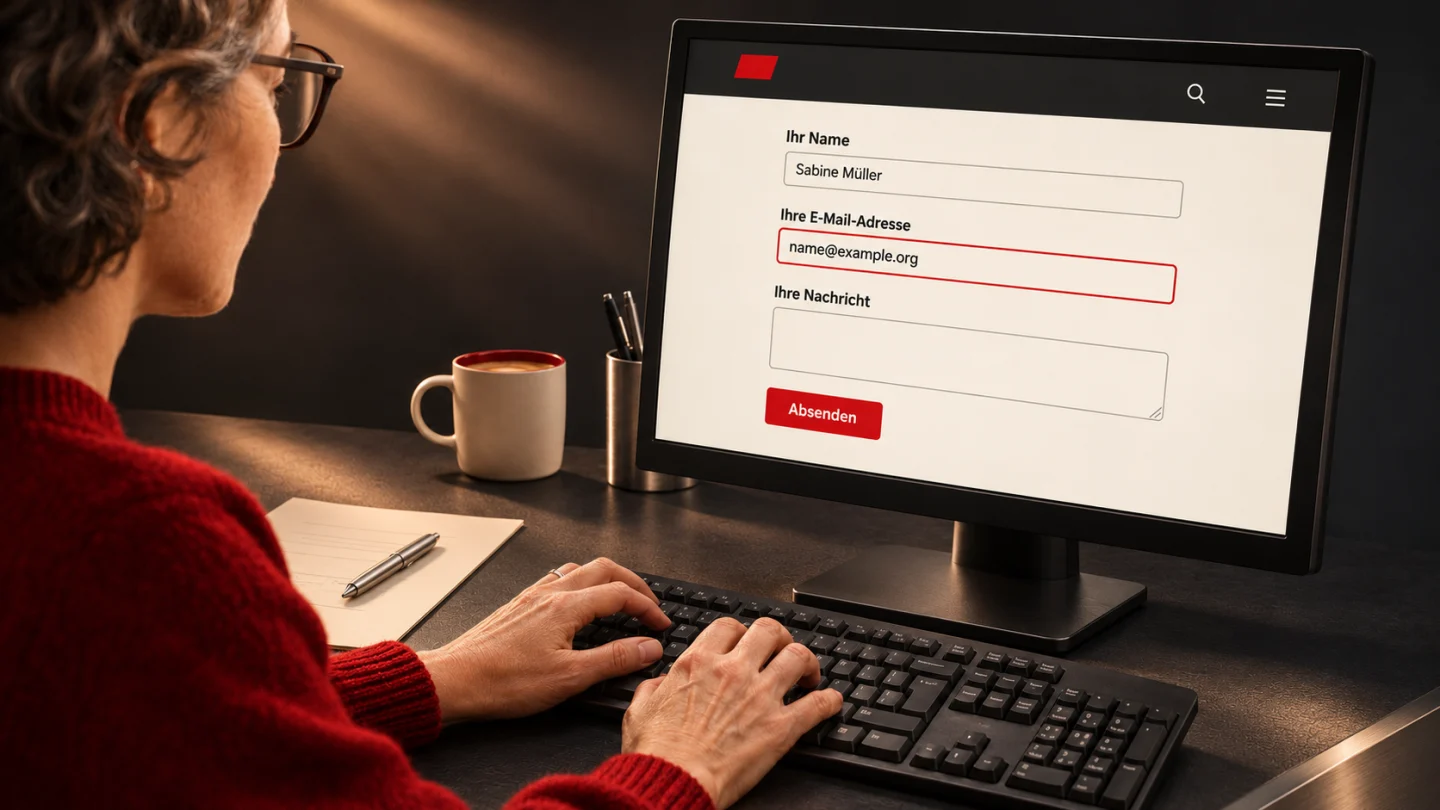
A website can be operated with your eyes closed. Literally. Screen readers read aloud what appears on the screen, while the keyboard replaces the mouse, provided somebody has planned for it. Without alternative text, an image remains silent. Without a visible focus outline, nobody knows where they are. A form field without a label is a puzzle.
In brief: Since 28 June 2025, digital accessibility has been mandatory for many businesses. Germany's Accessibility Strengthening Act, the BFSG, covers online shops, booking services and consumer services, among other categories. Services provided by microenterprises have a statutory exemption. This article explains applicability and technical requirements, then shows common obstacles during implementation. It does not replace legal advice.
What the BFSG requires and since when
The BFSG has applied since 28 June 2025. It requires manufacturers, retailers and service providers to make certain products and digital services accessible. Its basis is EU Directive 2019/882, which establishes uniform requirements across Europe. The aim is to make digital services usable by as many people as possible, regardless of visual impairments, motor impairments or other barriers.
For websites, there is an important distinction: not every site is affected. However, wherever purchases, bookings or contracts are completed online, the requirements apply.
Affected or not? Function matters more than size
A website's function, rather than its size, is decisive. The BFSG covers in particular:
- Online shops and other e-commerce services
- Consumer banking and payment services
- Telecommunications services
- Passenger transport with ticketing and booking systems
- E-books and related reading applications
Pure company or brochure websites without sales or booking functions are generally not included. Pure B2B services aimed exclusively at other businesses usually also fall outside the scope. Once a sales, booking or contracting function for consumers is added, an assessment is advisable.
Understanding the microenterprise exemption
Under section 2, number 17 BFSG, a microenterprise employs fewer than ten people and has either annual turnover or an annual balance-sheet total of no more than €2 million. The employee threshold and at least one of the two financial thresholds must be met.
Section 3(3) BFSG exempts services provided by such microenterprises from the accessibility requirements. Operating an online shop can qualify because e-commerce is itself a service. Selling goods rather than services through the shop does not remove this exemption. Separate obligations apply to products specifically listed in section 1(2) BFSG. These products have no equivalent general microenterprise exemption. Obtain a legal assessment if the classification in a particular case is uncertain.
In practice: a small shop and separate obligations
A typical scenario showing how such a case unfolds in practice.
A specialist retailer with seven employees and annual turnover of €1.8 million operates an online shop. If the business meets the statutory definition of a microenterprise, its e-commerce service qualifies for the exemption. Selling goods through the shop does not exclude that exemption. If the retailer supplies products listed in section 1(2) BFSG, their product-related obligations must be considered separately. Regardless of legal obligations, it is worth examining barriers that prevent customers from shopping.
A one-hour website check reveals five issues typical of almost every shop:
- The “Add to basket” control is a
<div>with a click handler and cannot be reached by keyboard. - Product images use filenames instead of alternative text.
- Order-form errors appear in red at the top of the page without a connection to the relevant field.
- The focus outline has been removed globally with
outline: none. - Prices have a contrast ratio of 3.1:1, below the required value.
In this example, the standard errors can be fixed in two working days. Legal classification remains a separate task: both the actual offering and the conditions of the microenterprise exemption matter. Assess the online-shop service separately from any obligations relating to individual products. This article does not replace legal advice.
EN 301 549, WCAG 2.1 AA and their practical meaning
The technical requirements follow European standard EN 301 549, which refers to the internationally recognised Web Content Accessibility Guidelines, WCAG 2.1, at conformance level AA. In practice, this means achievable foundations:
- Sufficient colour contrast between text and background
- Meaningful alternative text for images
- A logical heading structure
- Complete keyboard operability
- Clearly labelled form fields with understandable error messages
- Clear language and understandable navigation
Much of this is sound web craftsmanship and matches what already characterises modern, well-maintained websites.
Market surveillance, fines and warning letters
A cross-state market surveillance authority is responsible and has been in its active inspection phase since early 2026. Checks follow two routes: proactive systematic inspections, some automated, and reactive investigation of complaints. Violations can lead to orders to remedy defects and fines, depending on the case up to €10,000 and in some circumstances up to €100,000.
A second risk is growing. Since early 2026, more competition-law warning letters have been observed, averaging around €2,700 per case. Their legal basis has not yet been conclusively resolved by German courts. Pressure is also increasing at European level: in 2026, the European Commission formally called on Germany to implement the directive fully.
The side effect few people consider
Accessibility is more than a legal issue. Around 7.8 million people in Germany have severe disabilities. Including temporary and age-related impairments makes the affected group considerably larger. An accessible website therefore reaches an audience that would otherwise remain excluded.
There is also a welcome side effect: many accessibility measures directly support search engine optimisation. Clean semantics, useful alternative text, clear structure and short loading times help people and search engines alike, increasingly including AI-powered search systems that read content automatically. Accessibility, good navigation and visibility are closely linked.
A practical starting point
A practical start is an inventory. First establish whether a website falls under the BFSG and which functions are involved. Then examine the critical pages, such as checkout, contact forms or booking flows, where barriers have the greatest impact.
Many weaknesses can be addressed with manageable effort: adjust contrasts, add alternative text, ensure keyboard access and label forms clearly. A documented review and action plan also helps if evidence is requested. Where uncertainty remains, an experienced agency or specialist organisation can provide a professional assessment.
Identify barriers in everyday use
Check important visitor journeys with a keyboard and a screen reader. Meaningful alternative text, visible focus indicators and clearly labelled forms are essential. Error messages need to be associated with their fields. A logical heading structure helps people navigate.
Automated tools can identify potential issues. Supplement them with manual tests of navigation, forms and other interactive elements. Record the barriers you find and check each correction again.
Conclusion: sound craftsmanship, not a special project
The BFSG makes digital accessibility mandatory for a large share of commercially active websites, and inspections have begun. Those affected should review their services and remove the main barriers promptly. Even where there is no obligation, accessibility remains a sensible investment in reach, usability and visibility. A maintainable technical foundation supports ongoing accessibility work.
Frequently asked questions
Short, factual answers to key questions about Germany's Accessibility Strengthening Act.
When did the BFSG take effect?
The law has applied since 28 June 2025 and transposes the European Accessibility Act into German law.
Must every business website be accessible?
No. Online shops, booking services and consumer services are the main categories affected. Pure company or brochure websites and exclusively B2B services usually fall outside the scope.
When does the microenterprise exemption apply?
To services provided by a business with fewer than ten employees and either annual turnover or an annual balance-sheet total of no more than €2 million. This can include an online-shop service selling goods. Obligations relating to products specifically covered by the BFSG must be assessed separately.
Which technical standards are relevant?
EN 301 549, which refers to WCAG 2.1 at level AA.
What consequences can violations have?
Orders to remedy defects and fines of up to €100,000 are possible. Competition-law warning letters are also being observed.