ChatGPT and Claude at work: contracts, data and responsibility
Germany and EU legal orientation with the current amendment status, explicit responsibilities and a bounded fictional editorial workflow.

ChatGPT and Claude can only be assessed meaningfully for business use once the actual workflow is clear. Drafting from public product information is different from evaluating job applications or accessing a customer mailbox. Paying for an account does not establish the applicable contract, the information being processed or who may use the result. This article translates those distinctions into a reviewable introduction process for businesses operating in Germany.
Describe the work before naming the model
Write the intended activity in one sentence: “The editorial team creates an initial description from approved technical product information.” This is more useful than “We are introducing AI.” It identifies a task, a source and a limited purpose for the result. Then add who checks the description and whether the tool may only prepare a draft or can also publish it. Those are materially different workflows even if the chat interface looks identical.
The boundaries should be equally specific. This activity does not require customer emails, employee files or unpublished supplier contracts. That is an implementation choice for this workflow. It is not a general assertion that those types of information can never lawfully be processed using AI. A different use needs its own assessment involving the appropriate specialists and the relevant facts.
Keep the description visible throughout the introduction. Connecting a mailbox, adding a document collection or enabling automatic sending changes what is being assessed. A previously reviewed writing task does not silently cover those extensions. Recording the original boundary makes it easier to recognize when a small-looking feature change creates a different process.
Record the contracting party, product and account type
Document the actual access arrangement: product, account type, contracting party, workspace and organization using it. A paid personal subscription does not become a managed business workspace merely because an employee uses it for work. API access is likewise not automatically governed by the same agreement as a chat interface. Procurement must establish the specific arrangement rather than relying on a familiar brand name.
Anthropic explains the distinction in its Commercial Terms. The version opened for this review gives an effective date of 17 June 2025 and points consumer offerings to different terms. For your deployment, establish which version was actually accepted and which additional documents are incorporated. A link to today's accessible webpage is not a complete record of an agreement made previously.
Also record who owns administration and how access is removed when someone leaves. A shared password obscures that responsibility. Individual business access with a named owner is easier to govern organizationally. Verify which administrative capabilities are actually included in the selected offering instead of assuming that every business-labelled plan includes the same controls.
Keep four assessment layers separate
| Layer | Main question | Useful evidence |
|---|---|---|
| Task | What will the tool actually do? | Defined workflow and excluded extensions |
| Contract | Which terms govern this access? | Agreed documents, versions and organization |
| Data | Which information goes where? | Sources, recipients and storage in a data-flow record |
| Result | Who reviews and uses the output? | Professional responsibility and an explicit handover |
This table structures the introduction discussion. In particular, it prevents one provider assurance from being treated as the answer to every question. A contract can permit certain activities while a particular input still affects third-party rights. An accurate output may also have been produced from information that should not have been processed for that purpose. Each layer needs its own evidence and a clear relationship to the actual workflow.
Identify and limit personal information
Where personal data is involved, assess purpose and lawful basis under the GDPR. Article 28 addresses processors, Chapter V international transfers and Article 35 potentially required impact assessments for likely high-risk processing. The consolidated GDPR supplied by Hamburg's supervisory authority provides the legal text. A processing agreement does not replace assessment of the organization's own processing purpose.
For our editorial example, data preparation starts before upload. Check whether the selected product list really contains only approved factual information. An additional notes column might hold names, individual customer prices or internal complaints. A file labelled “product data” tells you very little about those details. Prepare an explicit subset for the trial rather than using the entire working spreadsheet simply because it is convenient.
Removing names does not automatically make a record anonymous. A rare combination of role, location and event can still identify someone. Invented records are often the clearer starting point for an initial functional trial. If actual personal information later becomes necessary, carry out the assessment intended for that change before expanding the workflow.
No model training does not mean no processing
The current official OpenAI administration documentation describes no training on business data by default for ChatGPT Enterprise. It also stresses dependencies on plan, configuration, feature and region. Connected services have their own conditions. Do not convert this statement into a blanket property of every ChatGPT account or integration.
Anthropic's commercial-product guidance similarly states that inputs and outputs are not used for training by default. The page dated 18 August 2026 also explains the separate handling of explicitly submitted feedback. Review what feedback employees may send and which administrative settings govern it.
The workflow therefore needs separate questions. Is the input processed to produce the response? Is a conversation saved? Are files retained in a project? Can administrators or connected systems access other information? One training setting does not answer those questions. Record each answer against the relevant feature instead of assigning the entire product a single green privacy label.
Examine storage for each feature
OpenAI's API data-control documentation distinguishes abuse-monitoring logs from application state. Special retention controls have eligibility requirements and feature-specific limitations. Using an API therefore does not imply that nothing is stored. The actual capability and its current documented behaviour determine the question.
Create a short storage inventory for the proposed activity: conversation, upload, project file, connected source, exported draft and internal review record. Add who can initiate deletion and which copies can remain elsewhere. A draft removed from a chat may already exist in the editorial repository or another service's file system. Follow the working result across the actual handover rather than stopping the inventory at the first interface.
Exercise that process using invented sample information. This does not establish the complete internal behaviour of a provider's infrastructure from the outside. It checks the administrative routes actually available to your team and compares them with the applicable documentation. Leave unresolved details as open questions until suitable evidence is available instead of silently assuming the most favourable interpretation.
Do not delegate responsibility to a plan name
Anthropic's controller and processor explanation describes the commercial customer's role for submitted user data. Your assessment still needs the actual data flow. A service's own purposes, additional recipients and connected products may need separate treatment. One general label for “the provider” does not always describe those operations adequately.
Assign a business owner for the use case. IT can maintain access and configuration. Editors can verify factual statements. Privacy and legal specialists can assess the questions within their respective expertise. Bring these contributions together without silently expecting one department to take complete responsibility for all the others. The decision should identify who answers an open question and what evidence is still needed.
A small team does not need a large committee for every drafting exercise. A concise decision record covering scope, unresolved issues and responsibilities can make the introduction manageable. Its value comes from traceability rather than the number of signatures. A later reviewer should understand what was assessed and what was expressly left outside the decision.
Consider trade secrets and customer contracts
Under section 2 of the German Trade Secrets Act, appropriate confidentiality measures are among the elements of a trade secret. The information and suitable measures depend on the circumstances. An AI policy can form part of organizational measures without automatically conferring legal protection on every file marked confidential.
Also examine agreements with customers and business partners. A document can carry contractual disclosure restrictions even when it contains no personal data. A provider's promise not to train does not extend your rights to share it. Preparing a customer proposal therefore requires establishing whether the necessary information may be sent to the particular service being considered, under the actual arrangement.
Our editorial starting point uses only already approved technical characteristics. Unpublished purchasing terms are outside that scope. Team members need to recognize this boundary in real working examples. “Do not use confidential data” is less useful when nobody understands which columns in their everyday spreadsheet contain the relevant information or how the approved subset should be prepared.
Review outputs for facts and rights
Contractual output rights are distinct from statutory protection and third-party rights. The German Copyright Act connects protected works to personal intellectual creation. Whether particular human editing satisfies that requirement cannot be established merely from the use of an AI tool. A provider agreement also does not remove rights in material belonging to someone else.
In the example, editors compare every technical statement with the approved specification. Unsupported certifications, invented delivery times and fabricated customer testimonials are not adopted. If wording closely resembles a known source, clarify its origin and revise where necessary. Fluent language provides no evidence of factual accuracy or permission to reuse a passage. Review must have a reference point beyond whether the text sounds professional.
Keep the specification version and the approved final text in a way that makes later changes understandable. This does not require retaining every intermediate response indefinitely. Decide which evidence the editorial process genuinely needs. A purposeful record is easier to maintain and review than a large unsorted collection whose contents nobody can explain.
Assess the AI Act through the intended use
The official AI Act Explorer explicitly identifies the amendment by Regulation (EU) 2026/1744 and its consolidated reference date of 27 July 2026. The amended article text used here is therefore not merely an unidentified proposal. The platform points to the published legal instruments for the legally authentic wording.
The Commission's AI Act overview confirms the amendment's entry into force on 27 July 2026. Entry into force and application of individual obligations are different matters. Amended Article 113 gives 2 December 2027 for the relevant Annex III high-risk rules and 2 August 2028 for Annex I. This does not generally suspend other applicable rules.
Do not simply assign a brand name to a risk category. A general writing assistant and an application evaluating job candidates have different purposes. Annex III includes specified recruitment and worker-management applications. Such a project requires its own classification, including applicable conditions and exceptions.
Match literacy measures to the work
Current Article 4 requires measures supporting the development of AI literacy without guaranteeing a particular individual's level. The Commission's AI literacy questions and answers explain the change. This does not establish a universal legal requirement to buy a particular commercial certificate.
A practical exercise suits the product-editing team. An invented input table includes a customer comment outside the permitted scope. The sample draft additionally contains an unsupported technical claim. Participants identify both problems and name the appropriate next step. This tests whether data boundaries and factual review are understood within the actual workflow, instead of testing whether people can remember an abstract definition.
Record the subject, audience and handling of uncertainty that the exercise teaches. This organizational suggestion does not assert that this precise training format is legally mandatory. Other capabilities require different knowledge, for example reviewing tool actions or understanding connected data sources. Revisit the learning material when the task changes instead of treating attendance at one session as permanent preparation for every future feature.
Involve employees and their representatives
Section 87(1)(6) of the Works Constitution Act concerns co-determination for relevant technical facilities monitoring behaviour or performance. Assess the actual deployment and its capabilities. Usage records, analytics and administrative visibility therefore belong in early discussion with an existing employee representative body.
Explain which workspaces will exist, who has access and the intended purposes of logs. Avoid unclear secondary uses such as individual rankings assembled later from information originally collected for operational observation. Responsible work depends on understandable expectations and actual visibility. Employees should also know where to ask about a doubtful input without being expected to make a complete legal assessment themselves.
Connected tools change the assessment
Approval of a chat capability does not automatically justify connecting the entire document repository. For each connection, record the source, identity used, readable areas and possible write operations. Pay particular attention to shared connections whose service identity may reach beyond an individual team member's own permissions. Review the actual audience and scope instead of assuming all integrations inherit the same boundary.
The DSK guidance on technical and organizational measures dated June 2025 supplies a broader lifecycle framework. Our narrower editorial implementation starts without a mailbox connection or automatic publication access. Adding either requires a new assessment of the additional information and actions. This is a deliberate staged design for the example rather than a universal rule that every organization must follow exactly.
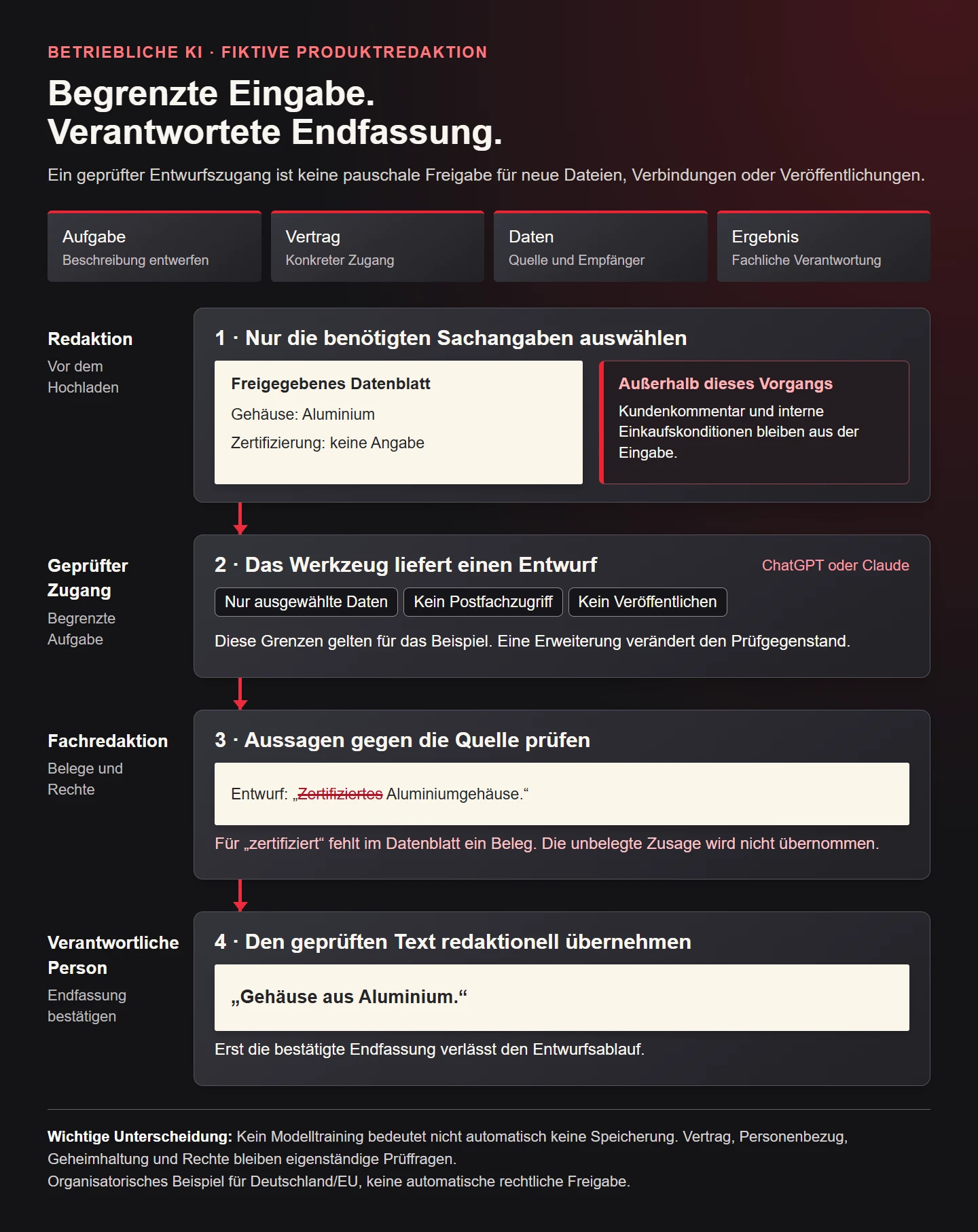
A fictional introduction with explicit handovers
| Step | Product editorial work | Review point |
|---|---|---|
| Prepare | Select the approved specification | No customer or purchasing notes included |
| Draft | Create a description using the reviewed access | Draft only, no publication |
| Review | Compare statements with the specification | Resolve missing evidence and third-party material |
| Adopt | Transfer the approved text into editorial storage | Named person confirms the final version |
| Change | Request a new feature or source | Reassess the scope |
This is an invented workflow, not a completed customer authorization. Its usefulness comes from the limited task. If the draft is unsuitable, the existing editorial team can still do its work. The tool neither makes an employment decision nor sends a promise to a customer. That boundary makes both a trial and a decision to stop easier to manage.
Prepare for incidents, exit and reassessment
Employees need a clear reporting route if the wrong file is uploaded or inaccurate output has already been circulated. Define who assesses the event and which information they need. Do not instruct people to copy the problematic content indiscriminately to more recipients while reporting it. A limited reference may be enough for initial triage, followed by a controlled examination through the responsible team.
Plan the exit too: remove access, disconnect integrations, retain necessary work results and use the applicable deletion routes. Switching products should not become impossible because one personal account holds the working material. When significant product or contract changes occur, identify which previous decisions need reassessment. A review date is useful only when someone owns the follow-up and understands what would trigger earlier attention.
Keep the decision record understandable
The DSK's May 2024 AI and privacy guidance considers selection, introduction and use. Apply that perspective to a concise internal decision record. Include the limited task, reviewed product version and currently excluded extensions. A new colleague should be able to understand why one file is suitable for the workflow while another first needs review.
Distinguish documented facts from organizational choices. “The reviewed documentation describes this storage feature” is a dated factual statement with a source. “We do not use it for this task” is your implementation decision. The separation helps when the product changes. It also prevents a sensible internal limitation from being repeated later as if it were a general statutory prohibition for all businesses.
Checklist for a reviewable introduction
- The task, information sources and excluded extensions are described.
- The account type, organization and agreed contract versions are known.
- Personal information, confidentiality and usage rights have been considered separately.
- Training, storage and connected systems have not been treated as interchangeable.
- Legal questions and unresolved issues have responsible contacts.
- Output review has a concrete professional reference point.
- Literacy measures match the actual work.
- Employees understand access, rules and reporting routes.
- New sources or actions trigger reassessment.
- Exit is possible without losing necessary working documents.
Frequently asked business-use questions
Is a processing agreement enough? It does not automatically answer every question about your own purpose, information sources and other obligations. Treat it as part of the specific contractual arrangement rather than universal permission for any use you can technically perform.
Can publicly accessible information always be reused? Public availability is not a general release of rights. Continue to assess personal information, intended purpose and rights in the materials needed for your activity. Accessibility and permission are different questions.
Must every internal output carry an AI label? A blanket answer ignores the different roles and circumstances. Article 50 distinguishes provider duties, direct interaction and specified publications. For text informing the public on matters of public interest, it includes an exception involving human review or editorial control and editorial responsibility. Other transparency obligations need separate consideration.
What is the best first step? Select a bounded task with suitable information and a named business owner. Resolve the open questions for that activity. A traceable limited introduction provides a better basis for decisions than blanket permission covering every behaviour a tool might support.