AI-generated text: rights and responsibilities
From input material to editorial approval: assess rights, claims and transparency duties as distinct parts of publication.
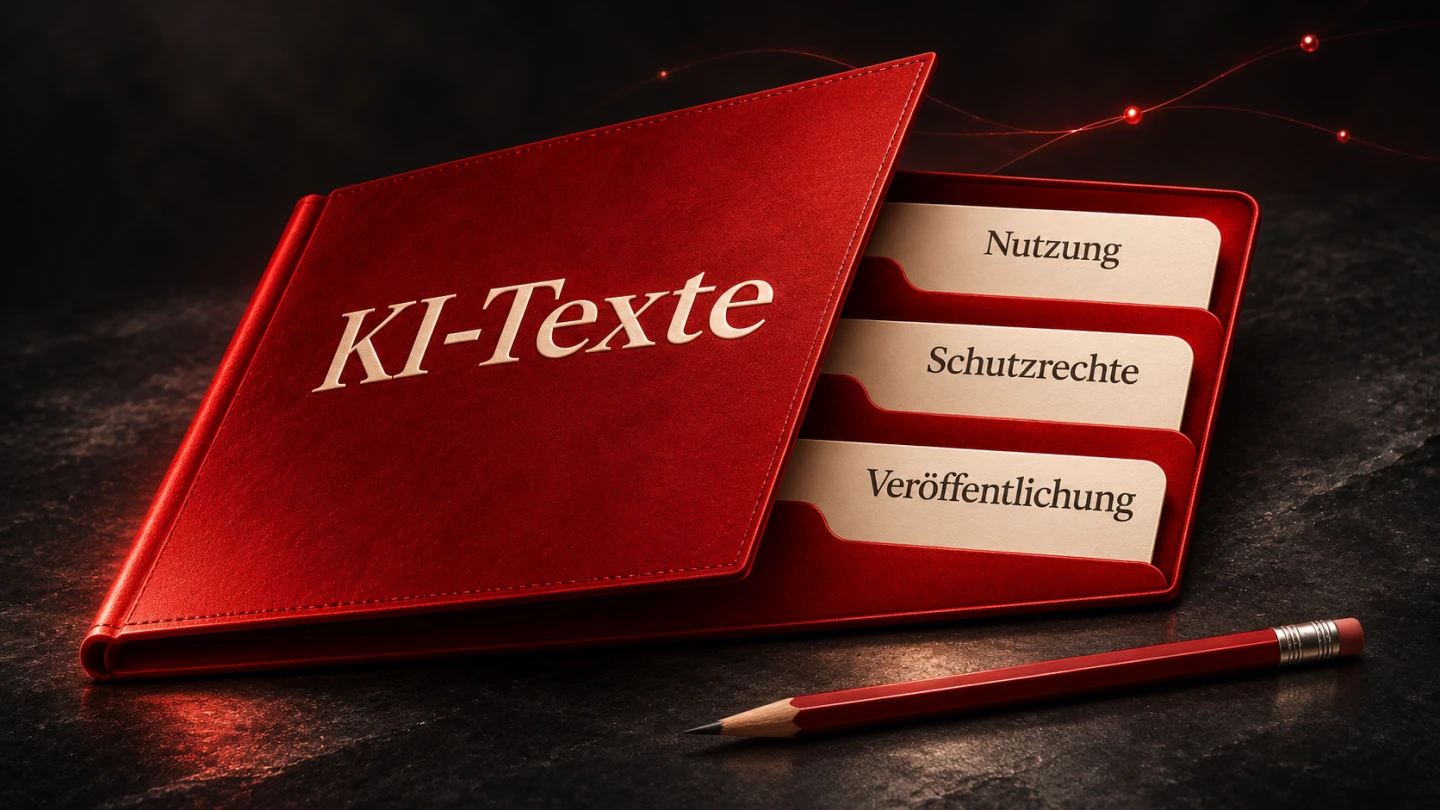
A language model can quickly produce a service description, technical article or advertisement. The result is immediately available to copy. That does not establish exclusivity or guarantee that every statement and borrowed phrase may be used.
This guide provides general orientation for businesses in Germany with relevant EU law considered. Sources were checked on 9 November 2026. Particular contracts, disputed borrowing and actual claims need individual legal assessment. The editorial examples explain a workflow rather than determining a real client's legal position.
1. Separate three different questions
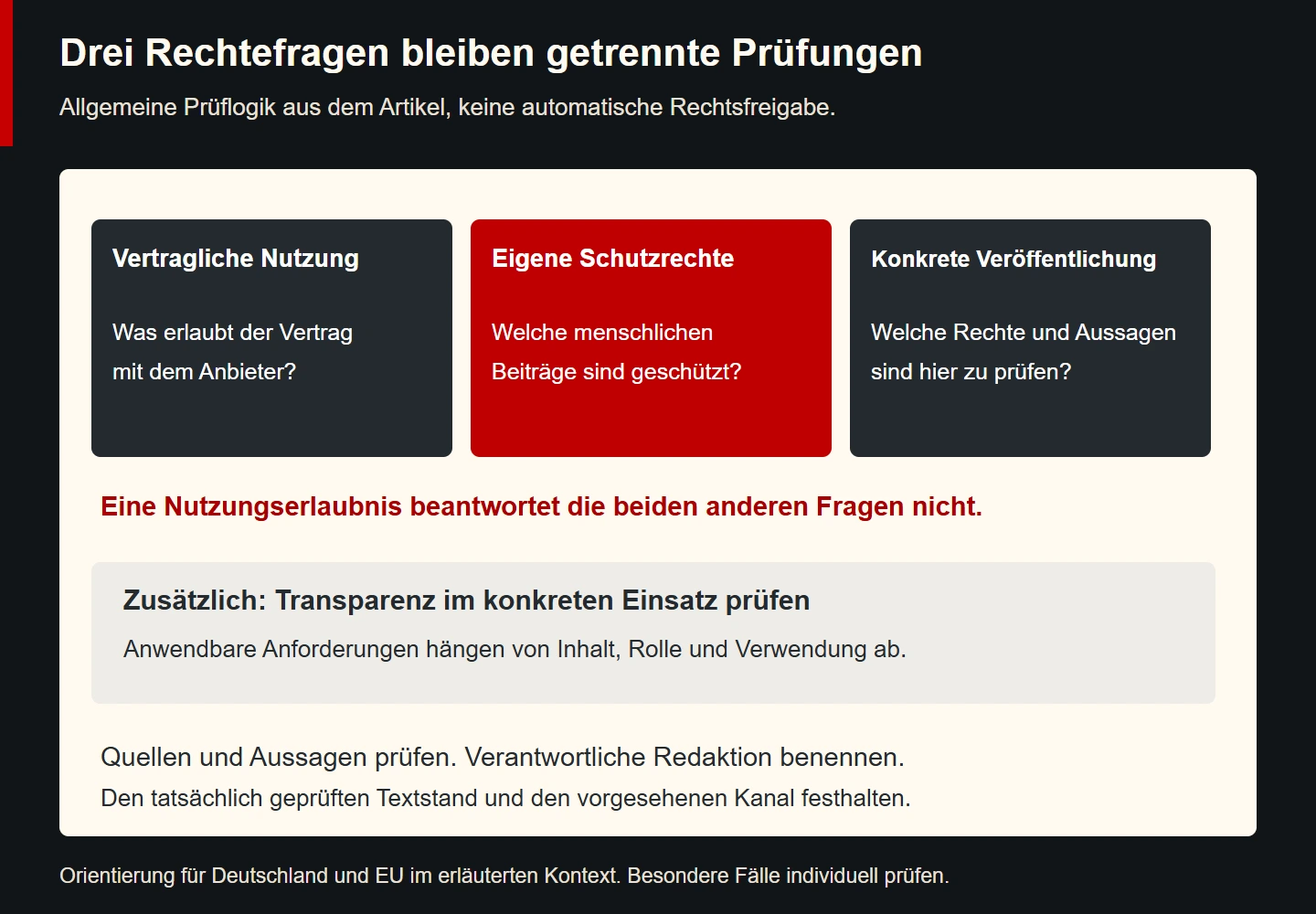
“May I use this AI text?” often combines several concerns. One concerns permission under the provider contract. Another asks whether the result attracts exclusive rights of your own. A third concerns whether publication is lawful in relation to other people and organisations.
These layers should remain distinct. A provider's contractual permission does not automatically establish that nobody else has rights in an included passage. Equally, the absence of your own copyright does not mean every use involving third parties is lawful.
| Question | Subject | Useful foundation |
|---|---|---|
| May the tool output be used? | The provider contract | Applicable terms and contractual scope |
| Are there exclusive rights of your own? | Human creative contributions | The actual creation and expression |
| Is publication lawful? | Third-party rights and content | Source, rights and factual review |
| Is disclosure required? | Transparency in this use | Applicable statutory and contractual requirements |
A clear approval workflow answers these questions individually. This prevents a single “use permitted” checkbox from becoming an assumed approval of every legal aspect of the content.
2. Human creation remains central to copyright
Section 2(2) UrhG refers to personal intellectual creations, while section 7 UrhG identifies the author as the creator of the work. AI-supported text therefore requires examination of the actual human contribution.
A purely machine-generated output does not acquire human authorship simply by appearing. Pressing a generation control does not explain a creative contribution to the whole result. People can, however, contribute their own creative writing, selection and editing. Whether a protected work results requires assessment of the particular expression.
A short general brief, a detailed creative concept and substantial original editing present different situations. Rules such as “change a certain percentage of the words and the whole text becomes yours” are not a sound assessment method.
For important content, document human work: original structure, research, wording and editorial decisions. This does not guarantee protection, but makes the creation process more understandable. For an agency agreement, such records may be more useful than a generic “made with AI” note.
3. Read the applicable provider terms
Tools can use different contractual models and conditions. Identify the version that actually governs the account and service used. A different subscription description or an old blog post is not sufficient to establish your contract.
Review provisions concerning inputs, outputs, required assurances and limitations. Use by staff, external service providers or several companies may also be addressed differently. Identify the contracting party and relevant organisational scope.
Even broad contractual permission to use an output can leave third-party rights unresolved. A provider cannot simply eliminate someone else's rights in an incorporated text through its own conditions. Contract review and assessment of the published result remain separate tasks.
Record more than a product name and date. Note which service was used and where the governing conditions are retained. A later provider or contract change may require review again. Avoid silently carrying assurances from one agreement into another.
4. Review rights in the input material
Rights review begins before generation. Using other people's articles, customer records or confidential documents as input requires an appropriate basis for that purpose. The technical ability to paste text into a service does not grant permission.
A publicly readable source may support research without its complete contents being freely available for every later processing activity. Assess the particular use, relevant conditions and legal grounds. Internal documents can also involve confidentiality and data protection.
For a fictional consultancy, approved internal service facts differ from a confidential customer report. Turning the latter into a public case study needs assessment of the publication purpose. Good anonymisation does not automatically settle every contractual issue.
Keep the origin, approved scope and purpose of significant inputs. This can help establish later which records supported a statement. Store only the information needed for that purpose and protect the records appropriately.
5. Identify borrowed passages in the result
Generated text may resemble someone else's wording or reproduce supplied passages. Replacing isolated words does not settle whether use is lawful. Relevant considerations include the protected content and actual expression.
Section 23 UrhG concerns adaptations and transformations. Use of a tool does not fundamentally remove that assessment. Automated rewriting does not make an otherwise unauthorised exploitation lawful merely because the process was automatic.
Review distinctive technical wording, unusual examples and passages closely resembling a particular source. Similarity searches can provide clues. Finding no match does not guarantee every rights issue has been resolved; technical checking tools have limited coverage.
Where a passage is unclear, an independent professional explanation based on checked facts can be more useful than repeated superficial paraphrasing. The editorial team should be able to explain its claim and foundation. This supports both quality and documentation.
6. Check quotations and sources independently
An AI system can produce a plausible reference that does not exist or does not support the statement. Open the original and compare the passage. Direct quotations need checks of wording, attribution and location.
Section 51 UrhG permits quotation under its conditions, including use whose extent is justified by the particular quotation purpose. Merely adding a source does not turn arbitrary copying into a lawful quotation.
The consultancy's article should distinguish its own analysis, a summary and a direct quote. An invented statement by a known professional should not appear as an authentic quotation. A summary should also preserve rather than reverse its source's meaning.
A useful source log records the actual passage and checking date. For changing online information, retaining the relevant version may help. That record supports evidence without replacing the rights assessment concerning any material reproduced.
7. Verify claims about the business
Marketing drafts often add apparently harmless details: extensive experience, certifications, guaranteed response times or successful customer projects. A model can propose such language without the underlying facts being available.
Check these statements with the business. Which qualification is actually evidenced? What period does an experience claim cover? Was an outcome measured or merely expected? Fluent wording should not conceal the difference between a fact and a marketing aspiration.
| Claim | Pre-publication check | Possible editorial action |
|---|---|---|
| A certification exists | Valid evidence and correct holder | Specify accurately or remove |
| A project achieved a particular result | Actual measurement and scope | Separate observation from cause |
| A service is guaranteed | Binding scope and ability to deliver | State prerequisites understandably |
| A person endorses the offer | Authentic statement and permitted publication | Do not publish without evidence |
“Write legally safe copy” cannot replace this assessment. The necessary company information must be available and a responsible person needs to review the actual text. General confidence in a model is not evidence for a particular business claim.
8. Distinguish transparency duties by use and role
AI Act Article 50 distinguishes provider duties concerning machine-readable marking from specified deployer disclosures. Paragraph 4 addresses AI text informing the public on matters of public interest, with an exception involving human review or editorial control and editorial responsibility. This is not an identical blanket labelling rule for every AI-assisted business sentence. Assess the role, content and exception conditions.
Document who reviewed the content and who is responsible for publication. A byline does not replace actual editorial control. A voluntary AI-support note likewise does not answer every legal question raised by the text.
Evaluate different content types separately. A business service page, an explanatory public-interest article and an automated conversational interface can raise different issues. One technical label may be convenient, but its legal significance must match the use.
Also consider the application provisions in Article 113 and current legislation. This guide uses the consolidated position displayed at the checking date. It does not present current duties as though they necessarily applied throughout an earlier archive period.
9. Make editorial responsibility operational
Separate drafting, review and publication. A person or system creates a draft. Professional review checks statements and sources. Publication follows only when the approval status appropriate to that content has been reached.
One person may hold several roles in a small business. The tasks still need to happen rather than merely exist as controls in a system. “Reviewed” should refer to a real assessment of the particular version.
Changing information needs later attention. Product scope, prices and legal information can become outdated. The team should know which articles contain such statements and which source governs an update. A checked version does not remain current indefinitely.
Make agency responsibilities specific. Who supplies business facts? Who confirms accuracy? What rights are granted in the human-created work? What use of supporting tools is agreed? These questions belong in the actual project scope.
10. Keep a version-specific approval record
Lightweight documentation connects publication with the reviewed version. It does not need to expose complete confidential prompts. An internal content identifier, relevant foundations and recorded review outcomes may be sufficient for the task.
{
  "content_id": "DEMO-TEXT-023",
  "version": 3,
  "source_review": "completed",
  "third_party_rights_review": "completed",
  "company_claims_review": "completed",
  "transparency_review": "completed",
  "editorial_owner": "Fictional example editorial team",
  "publication_status": "approved_for_named_channel"
}
This JSON uses fictional details to illustrate an editorial data structure. The words “completed” and “approved” do not create legal permission. They document a process that must be connected with actual evidence and responsible people.
If the content changes, identify which version was approved. A new paragraph may introduce different sources or rights. An earlier approval should not silently extend to every subsequent revision.
The necessary record depth follows the task. A short internal wording suggestion can differ from a published legal article. What matters is that the organisation can trace and responsibly support its actual statements.
Technical controls can help preserve the relationship. A content identifier, version number and retained review record can stop a changed draft being confused with its approved predecessor. Such controls organise evidence rather than determine the law.
Review records also need sensible access limits. A public article does not require publishing confidential briefs, complete customer documents or private reviewer details. Keep the evidence needed for accountability in an appropriate protected location. The public-facing information should accurately identify responsibility and required disclosures without turning internal process records into unintended public material.
11. Follow a draft through to publication
The fictional consultancy wants to publish an article about a service. It assembles approved service facts and selected public primary sources. AI supports an initial outline and draft, which adds an alleged certification and an unsupported customer result.
Review flags both claims. The certification is removed without evidence. The supposed result is deleted rather than rewritten into another success story, because no real case exists. The sources are opened and compared with the associated statements.
The responsible team then edits structure and language, examines potential borrowing and documents its own analysis. Before publication it considers the applicable transparency question for this content. The published version has a genuine responsible editor and a traceable date.
This is an editorial example. It demonstrates why a persuasive draft and an approved article are different states. AI assistance retains its usefulness while publication rests on checked foundations.
The same example also shows how a review can lead to less text. Removing an unsupported paragraph can improve the article more than replacing it with another confident claim. The objective is a sound publication, not preserving every sentence generated by a tool.
12. Define expectations concerning exclusivity
A client may expect individually developed text rather than an identical standard document supplied to other customers. That contractual expectation differs from statutory copyright protection. The project should not silently treat them as interchangeable.
A clear agreement identifies the deliverable, human editorial work and granted usage scope. A general promise of complete legal exclusivity over every automatically produced phrase may go beyond what has actually been established.
Where significant commercial interests are involved, obtain appropriate drafting for the particular agreement. This is especially relevant if content is licensed, resold or used across companies and platforms. General provider conditions do not automatically resolve every relationship between client and contractor.
Review each language version too. Translation can turn a cautious explanation into a binding-sounding promise or omit a condition. Approval of a German original does not editorially validate every subsequent English revision. Associate translations with the same content and record the version reviewed. When facts change, update affected languages coherently. Assessment follows what is actually published rather than only the initial brief.
A checklist for AI-supported publication
- Contractual use and your own protection are assessed separately.
- Input origin and permitted processing are understood.
- Human editorial contributions are traceable.
- Borrowed or distinctive passages have been reviewed.
- Sources and quotations match the originals.
- Claims about businesses, people and projects are evidenced.
- Transparency is assessed by role and content.
- The actual version has a traceable approval.
- Confidential source material is protected.
- Updates and corrections have a responsible handling route.
Common questions about AI text and law
Does every output belong to me?
Contractual usage permission and copyright protection are separate. Broad ownership language does not establish human authorship or remove third-party rights.
Is personal editing enough?
Editing can matter, but no universal word-change count resolves every issue. The source material and actual expression remain relevant.
Must every AI-assisted sentence be labelled?
Applicable duties depend on role, content and legal conditions. Review the specific rule and relevant exceptions for the publication.
Can AI legally approve its own text?
An output does not replace responsible review of the actual circumstances. A tool can assist but cannot create missing information or permission by asserting approval.
Sources and editorial status
Scope: Germany and the EU. Checked on 9 November 2026. Foundations are the linked German Copyright Act provisions and the official EU AI Act Service Desk on Articles 50 and 113. The latter identifies the consolidated position of 27 July 2026. Workflow examples and the approval record are original editorial implementation aids.
For practical technical context, read ChatGPT and Claude in practical work. For publishing context, see Requirements for a professional business website.