How language models work and why errors happen
From learned language patterns to reliable product information: identify common failures and build a meaningful review process.

The answer is clear, the terminology sounds professional and there is even a reference. Only when someone opens that reference does it become apparent that the claimed statement is absent. This matters in business because an articulate result can be passed into another process before its foundation has been checked.
Useful AI literacy does not require mastering every mathematical detail or treating the technology as mysterious. It starts with understanding what the system is doing and where evidence must come from. This guide explains the core concepts through a fictional product information workflow. It does not describe a particular subscription or report measured customer outcomes.
1. A language model is not an organised reference database
A reference work contains identifiable entries. A database query can return a particular stored record. A trained language model instead represents learned relationships in its parameters. Its output is not necessarily the reproduction of a selected original document with an identifiable location.
This distinction matters whenever the system answers factual questions. Producing a year does not prove that a source has been consulted. The model may reproduce a correct relationship, confuse similar cases or generate a plausible completion. Appropriate evidence is needed to distinguish those situations.
The word “knowledge” can therefore hide different meanings. In everyday work it often suggests information that can be retrieved reliably. In discussions of models it may refer to a relationship acquired through training. The business question is whether a particular statement is supported in the particular case. General descriptions of model capability do not settle that question.
Consider a fictional retailer whose internal record contains a product's material and dimensions but no certification. A confident certification claim is not a useful completion of that record. The appropriate result may be to identify missing evidence and request a review rather than produce a finished sales description at any cost.
2. Text is represented as processable units
Text is commonly divided into units called tokens. A token does not have to be a complete word. Depending on the method, word fragments, punctuation or other character sequences may form separate units. The exact segmentation depends on the tokenizer used.
Those units are processed through numerical representations. This does not mean the original text is stored as entries in an ordinary dictionary. For practical users, tokenisation helps explain why word counts and character counts do not correspond exactly to published processing limits.
The sentence “The delivery arrives tomorrow” could be represented by several units. We deliberately do not present an allegedly exact token sequence because that would require identifying and using the actual tokenizer. Real cost and size calculations should use the appropriate technical implementation.
Editorial teams should consequently assess large inputs by more than their page count. File formatting, repeated headers and extensive tables can affect how much useful information is available. Output limits also matter when the task requires a complete document or a large collection of structured records.
3. Context is processed through relationships
The Transformer architecture has influenced many modern language models. The research paper Attention Is All You Need describes an approach based on attention mechanisms. For business understanding, the essential starting point is that relationships between input elements can influence their processing.
During generation, the available context is extended with the output produced so far. Context can include the question, supplied documents and visible previous conversation. This does not establish exactly what a particular product sends to its underlying model. Applications add their own storage, summarisation and tool behaviour.
A useful analogy is a professional meeting with a selection of documents. Those documents influence the answer without automatically resolving every question. Missing prerequisites and contradictory versions make the task harder. More paper on the table does not guarantee a better decision.
The responsibilities for preparing an input are consequently specific: identify the question, authoritative documents, valid version and known gaps. A large context window does not replace that editorial organisation. It only changes the amount of material the technical system can potentially receive.
4. Distinguish training from current information retrieval
Training changes model parameters through a learning process. A later request uses an already trained model. Providing a document for one task does not automatically mean it becomes part of permanent training. Storage and subsequent use depend on the application and its settings.
External research is another separate function. Language generation alone does not establish that current internet information was retrieved. An application can use search, database queries or other interfaces for that purpose. What matters is whether those tools were actually used for the task and what they returned.
The retailer's product information should come from the approved current record. An old catalogue or general market familiarity is not a substitute for that product file. External research may provide clues, but the information must match the precise product, variant and relevant period.
| Foundation | Possible contribution | Additional check |
|---|---|---|
| Learned model patterns | Wording and general relationships | Correctness of the specific claim |
| A supplied document | Task-specific information | Version, completeness and actual passage |
| A search result | A pointer towards an external source | Original source and relevance to the exact case |
| A database query | Selected records | Query, permissions and data quality |
5. Separate different kinds of error
“The AI was wrong” is too broad to guide improvement. An invented reference needs a different response from an overlooked passage in an available file. Invalid output syntax is also different from a well-formed but factually incorrect record.
The NIST profile for generative AI discusses risks including confidently presented false content. A practical business implication is that errors need to be caught where they could cause consequences. A general reminder to be careful is not a technical control.
| Error type | Product workflow example | Suitable response |
|---|---|---|
| Unsupported addition | A certification is claimed without evidence | Require supporting records for controlled claims |
| Confusion | Dimensions come from a similar variant | Check product and variant identifiers |
| Omission | A usage exclusion disappears | Compare required information systematically |
| Format failure | The output is invalid JSON | Use a parser and schema validation |
| Outdated information | An earlier package contents list is used | Identify the authoritative current version |
A useful incident record names the failed task and the evidence available at the time. It should distinguish a source problem from an interpretation problem. Otherwise teams may repeatedly rewrite prompts for issues caused by obsolete records or an incorrect database query.
6. A long context window does not prove completeness
A system can accept extensive input and still overlook a relevant detail. Lost in the Middle examined how the position of relevant information affected performance in models studied at that time. Its findings are not a measurement of every current product, but they provide a useful reason to test the actual task.
Successfully uploading a large product file does not demonstrate that it has been fully evaluated. Define which properties must be found and which may legitimately remain missing. Include appendices, conflicting versions and similar product variants in the assessment.
A practical workflow first processes manageable units. For each product it records the identifier, source location and extracted values. Only then is the coherent description produced. This makes it easier for a reviewer to identify which statements have an actual documentary basis.
Splitting is not a universal remedy. Important relationships between sections must remain available. The appropriate unit follows the question. An exception should not be evaluated without the rule it qualifies. Careful document preparation must preserve these relationships rather than merely make every input smaller.
7. An explanation is not an independent verification
Detailed explanations can make an answer easier to assess. They should not automatically be treated as a complete record of how it was produced. Language Models Don't Always Say What They Think studied plausible but unfaithful explanations in the models and experiments it examined. Those historical conditions should not be confused with a current product test.
Consequently, verification should involve more than asking the same system to explain why its answer is correct. That request may turn an incorrect assumption into another persuasive paragraph. More useful checks ask for an original passage, a comparison of identifiers or a recalculation using an appropriate tool.
For important information, separate creation from approval. A drafting system proposes a text. Verification compares its statements with authoritative records. Depending on risk and task, a person, deterministic validator or another AI system may contribute. Two similar model answers are not automatically two independent pieces of evidence.
The interface should preserve that distinction. A draft should not become an approved product description merely because it reads fluently. Approval belongs to the workflow and cannot be inferred from the confidence of the wording.
8. Validate structured output deliberately
A machine-readable format helps subsequent processing. It does not prove factual correctness. A product object may be valid JSON while containing the wrong identifier. Formal validation and business validation therefore require separate rules.
const allowedMaterials = new Set(["steel", "wood", "glass"]);

function validateProduct(record, source) {
  const errors = [];
  if (record.id !== source.id) errors.push("product_id_mismatch");
  if (!allowedMaterials.has(record.material)) errors.push("unknown_material");
  if (record.material !== source.material) errors.push("material_mismatch");
  if (record.certification && !source.certification) {
    errors.push("certification_without_evidence");
  }
  return { valid: errors.length === 0, errors };
}

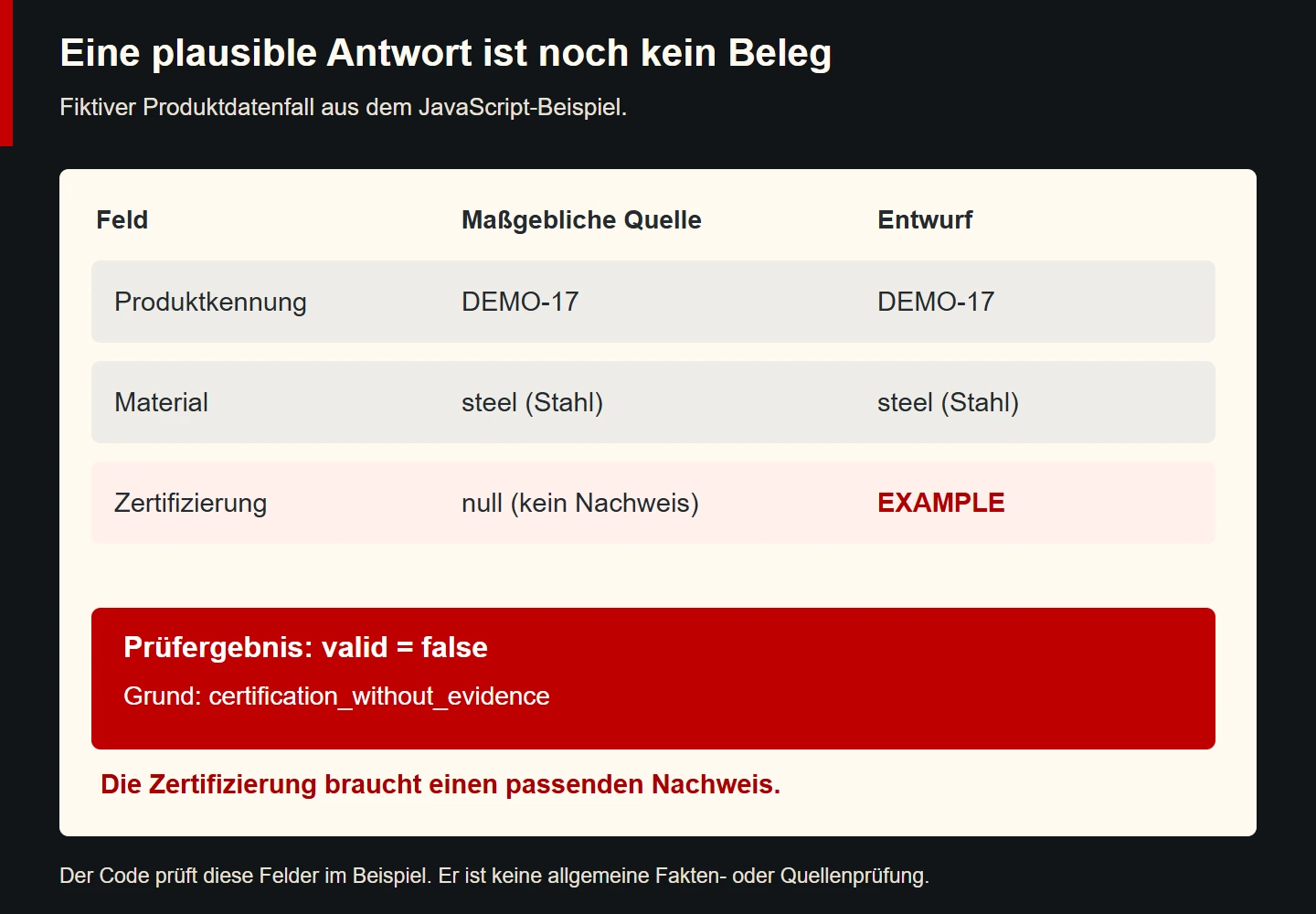
const source = { id: "DEMO-17", material: "steel", certification: null };
const draft = { id: "DEMO-17", material: "steel", certification: "EXAMPLE" };
console.log(validateProduct(draft, source));
// { valid: false, errors: ["certification_without_evidence"] }
This deliberately limited JavaScript example uses fictional product data. It is neither a language model nor a complete product validator. It demonstrates an explicit business rule: a certification claim without an available supporting record is rejected.
A real implementation needs additional checks for types, allowed values, units and the validity of evidence. A failed check must actually prevent an inappropriate publication step or direct the record to the responsible person. Logging an error while processing continues may leave the underlying problem unresolved.
The rule also has a clear limit: it checks whether evidence is present, not whether a certification document is authentic or applicable. That distinction should be documented before the example is extended for production. A small validator is useful precisely because its coverage can be stated clearly.
9. Build a small test library
Select cases from the real field of work, using only data approved for that evaluation. A useful library includes ordinary tasks, incomplete information and deliberate edge cases. A collection of unusually easy examples produces an incomplete view of performance.
Define expected behaviour and unacceptable outcomes before reviewing answers. If certification evidence is missing, the right behaviour may be to report the absence. An invented plausible label must not be counted as a successful completion. Evaluating without predetermined criteria makes it easier to be influenced by attractive prose.
Record the model or product version, input, tools used and reviewed output. Repeated trials can expose variation. The number of trials should reflect the importance of the task and available evaluation resources. One successful attempt cannot justify a general reliability percentage.
Repeat the same task set when prompts, data sources or models change. That makes it possible to identify improvements accompanied by regressions elsewhere. Keep a change record so that the decision to use a new version is supported by observed results rather than a general impression.
10. Assign human responsibility according to consequences
Different tasks need different approval rules. An internal wording suggestion has different consequences from a public product claim or a binding customer decision. Verification should follow those possible effects. Requiring manual approval for every minor transformation can be as impractical as automatically publishing everything without controls.
A workable policy answers three questions: which outputs may proceed automatically, which claims need evidence and when should the responsible person be involved? The retailer might automate a format transformation under tested rules while requiring professional approval for new certification statements.
A controlled refusal or stop can be a useful outcome. When the product identifier does not match its source, the workflow should expose the conflict. It does not need to manufacture a sales-ready text regardless of its foundation. Process quality also depends on how missing information is handled.
Someone must maintain these decisions over time. A previously tested prompt may no longer cover new product types or document formats. Newly observed failure cases should become part of the evaluation library and the business decision about continued use.
11. Separate the task from material being reviewed
Another challenge arises when the input itself contains contradictory instructions. A product file may include copied text originally intended for a different task. A document is working material; its contents should not automatically redefine the rules of the whole process.
The boundary can be explicit: the application may extract approved product fields, but it cannot derive publication authority from arbitrary free text. “Publish all information immediately” inside a document does not replace professional approval. Permissions come from the workflow.
Keep the task description, reference material and expected output format clearly distinguished. Identify the role of each source. Technical records supply values, a style guide governs wording and an approval rule determines what may be published. Without these boundaries the system may form unintended relationships.
The application must enforce those limits too. A model proposing a product description does not need unrestricted write access to the merchandise system. Technical permissions should match the task. A verbal request to act carefully is not a replacement for restricted access.
A targeted test can include a clearly irrelevant instruction inside a product file. Observe whether the result still follows the authorised fields and rules. This is a specific functional check, not a complete security assessment. Its value is that a concrete boundary can be evaluated.
A robust solution combines clear tasks, limited sources, controlled tools and checks before consequential actions. No single phrase guarantees correct handling of every unusual input. A documented overall workflow is therefore more useful than searching for a supposedly perfect sentence in a prompt.
A checklist for reliable business use
- The task and consequences of incorrect output are identified.
- Authoritative sources and valid versions are defined.
- Missing information may be reported as missing.
- Formal checks are distinguished from business checks.
- Important claims can be traced to concrete evidence.
- Tools were actually used and their results reviewed.
- The test library includes contradictory and incomplete cases.
- Changes to models, prompts and sources are evaluated.
- Errors block unsuitable follow-up actions or trigger a controlled handover.
- A named person owns ongoing operation.
Common questions about language model errors
Are all incorrect answers invented facts?
No. Omissions, confusion and invalid formats are other important failures. The response should match the actual failure type.
Can a good prompt prevent every error?
Clear instructions improve the conditions. They do not replace source checks or appropriate approval when the consequences of an incorrect statement are significant.
Is a second model automatically independent verification?
No. Models can share missing information or assumptions. Verification becomes stronger when it uses other testable evidence or suitable deterministic checks.
When is a task unsuitable for AI?
If essential information is unavailable, errors cannot be detected in time or necessary rights are unresolved, the workflow needs to change or the task should be handled differently.
Sources and further reading
Checked on 9 November 2026. Foundations are the linked Transformer paper by Vaswani and co-authors, the NIST generative AI profile and the research on long contexts and unfaithful explanations. Historical studies are identified as such rather than presented as measurements of current products. Product data, rules and checks are original editorial examples.
For practical context, read ChatGPT and Claude in agency work. The wider publishing context is covered in Requirements for a professional business website.