ChatGPT or Claude: compare tasks rather than brands
Build a fair comparison for writing, document analysis and coding with documented conditions and defensible conclusions.

“ChatGPT or Claude?” often leads to a discussion of personal impressions. One answer seems clearer. Another draft sounds more elegant. A programming example appears sooner. A business decision also needs an understandable connection between the task, the result and the work required to use it.
This article develops a practical comparison for writing, document analysis and small coding tasks. It does not report a completed product benchmark or measured ranking. The exercises are original teaching examples. Product information comes from official sources checked on 9 November 2026. Verify availability and settings in your own account before conducting a comparison.
1. Separate the product, model and workflow
ChatGPT and Claude are products offering different access routes and capabilities. A product can provide several models and working modes. Results also depend on which files, search facilities and additional tools are actually available.
Consequently, “ChatGPT won” is usually too broad a conclusion after one attempt. A defensible statement would say that a particular configuration produced the more suitable result for this task under documented conditions. That narrower finding is more useful and can be checked again later.
The official OpenAI documentation on using ChatGPT distinguishes Chat, ChatGPT Work and Codex according to the intended form of work. A short answer and a finished document represent different deliverables. Enabled tools and workspace administration belong in the description of a comparison.
Begin with a brief profile for each candidate. Record the product access route, displayed model name, setting, date and supplied sources. Do not claim an exact model version when the interface does not disclose it. An honest documentation gap is preferable to invented technical precision.
2. Decide what the comparison should answer
Two questions are useful. A controlled task comparison gives both candidates substantially the same inputs and comparable assistance. A workflow comparison instead examines the best approach actually available in each product.
For the first comparison, web search might remain disabled for both candidates. For the second, an available search capability may deliberately form part of the workflow. These results answer different questions. Make that distinction explicit in the test description.
If a product cannot process a required file type through your current access route, record a practical access limitation. That does not establish a general weakness in every model offered by the provider. Separate feature availability from the quality of a task that was actually performed.
Your own workflow ultimately matters for an adoption decision. It includes existing accounts, permitted information and required outputs. A theoretically capable configuration provides limited value if the business cannot approve or operate it sensibly.
State the intended audience for the findings. A procurement team may need an account-level workflow decision. A developer may need to select a model for a particular component. Combining these questions without explanation can produce an impressive-looking report that answers neither one clearly.
3. Assemble a representative task package
| Task | Shared input | Important check |
|---|---|---|
| Service description | Approved facts and intended audience | No invented service commitments |
| Document comparison | Two clearly identified versions | Changes with accurate locations |
| Data extraction | Small sample document with a missing value | Missing value remains unresolved |
| Coding task | Function and observed defect | Behaviour verified through suitable cases |
| Research | Bounded question and source rules | Original source supports the particular claim |
The exercises should reflect real work. A team mainly revising existing copy does not first need a poetry contest. A team drafting support replies should include typical follow-up questions and incomplete information.
The OpenAI guidance on evaluation emphasises task-specific checks and combining metrics with human judgement. That principle can be applied to a manageable internal sample without adopting a particular evaluation platform.
Prefer cleared or deliberately constructed source material. A product comparison does not justify copying confidential customer records into several systems without review. Establish which information may be used for this purpose before starting.
Include ordinary cases as well as difficult ones. A package made entirely of unusual puzzles can exaggerate the importance of rare capabilities. Conversely, only testing clean, complete inputs conceals problems that occur when everyday instructions are incomplete.
4. Define success before the attempt
For each exercise, list the facts that must survive. A service description may need to preserve scope, limitations and a service explicitly excluded from the offer. Check those specific elements afterwards.
Add the intended use. An internal rough draft may need less stylistic refinement than a public service page. Both require accurate facts. The necessary editorial maturity nevertheless differs.
The Anthropic documentation on success criteria and evaluations describes specific, measurable criteria aligned with the intended purpose. A comprehensible checklist is often sufficient for a small comparison. Establish it before reviewing the outputs.
Avoid giving one overall school-style grade. Attractive copy may contain a false guarantee. An accurate extraction may arrive in an unusable format. Separate criteria reveal which kind of repair the result requires.
Write down who is qualified to assess each element. A language reviewer can judge clarity but may need help verifying technical statements. Shared responsibility works best when each person knows which conclusions their review actually supports.
5. Distinguish critical errors from style preferences
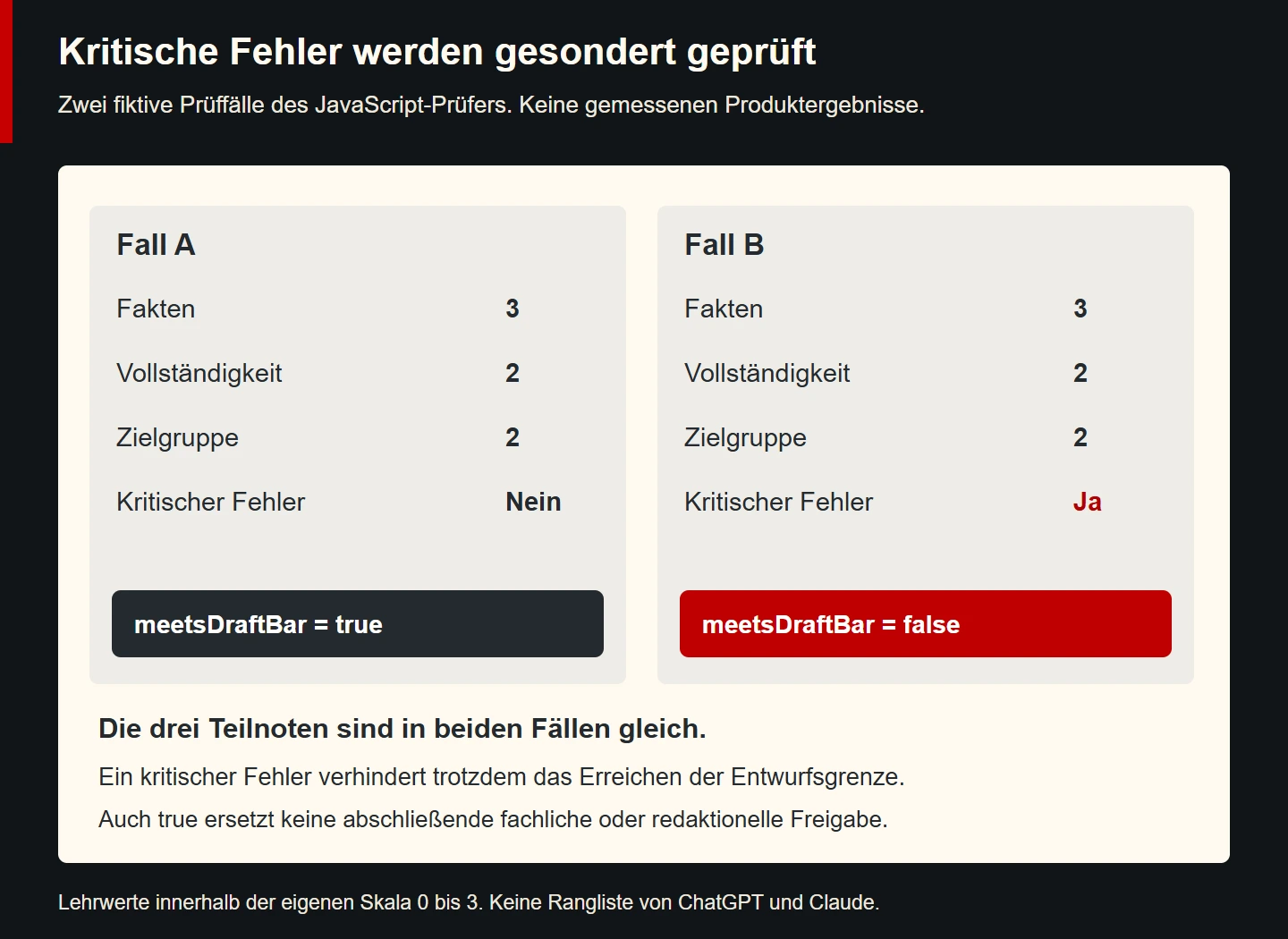
An invented contract deadline or unsupported product guarantee differs from an overly long introduction. Define critical errors as failures for that particular output. Good phrasing must not mathematically compensate for such an error.
A small descriptive scale can support other criteria. The following scale is an editorial planning aid rather than a scientifically validated measurement instrument. Apply it only with its stated meanings.
| Level | Meaning for a draft | Consequence |
|---|---|---|
| 0 | Essential requirement missed | Rework from the foundation |
| 1 | Partly useful with substantial repair | Revise content or structure |
| 2 | Requirement largely met | Targeted corrections needed |
| 3 | Requirement met within the agreed scope | Normal final review |
Support every rating with an observation. “Audience unclear” should point to something such as an unexplained technical term or missing practical instruction. Without evidence, numbers can become apparently precise expressions of taste.
Reviewers can first discuss a small sample together to clarify the rubric. If they disagree about what counts as a critical error, resolve the definition before extending the comparison. Otherwise the apparent differences between products may really be differences between reviewers.
6. A writing exercise with controlled facts
A fictional maintenance business has the following approved facts. It maintains ventilation systems for commercial customers within its own district. Appointments are arranged individually. Refrigeration-system repairs are outside its offer. No round-the-clock service is promised.
A suitable instruction is: “Use the following facts to write a short service description for commercial building managers. Explain the offer and next step clearly. Do not add services, guarantees or availability commitments. Afterwards, identify the information still needed to arrange a specific appointment.”
First check whether the limitations survive. Then assess clarity, audience fit and next steps. A confident statement about an emergency service available at any time would be a critical invented addition in this exercise.
If useful, conduct a second round with focused feedback. Record that feedback just as carefully as the initial instruction. Comparing revised outputs is only understandable when the additional assistance remains visible.
Do not silently repair the source brief for one candidate while leaving the other unchanged. If an ambiguity is discovered, either restart the relevant comparison with the corrected shared input or record the asymmetry explicitly.
7. Evaluate document analysis against a prepared reference
Create two short versions of a fictional proposal. Deliberately alter one service component and one date. Leave a third section unchanged. Record the expected differences independently of the candidates.
Ask for a table showing the change, old version, new version and location. Verify that all expected differences were identified. Also check whether unchanged passages were incorrectly described as changed.
Missing information is particularly important. If the new version contains no price, the system must not automatically present the old price as still valid unless the task actually supports that conclusion. An absent value needs an explicit unresolved status.
Check file access as well. A successful upload does not prove that a particular table was read correctly. For scans and complex layouts, the preceding content-extraction process must also suit the task.
Keep findings traceable to the original documents. A correct answer without a reliable location can still require substantial checking. If references are requested, verify them instead of treating their mere presence as evidence of accuracy.
8. Control project context deliberately
Existing instructions, memories and project files can influence a comparison. One candidate might already know the business's preferred tone. The other might receive only the brief exercise. That is an unequal starting point for a controlled comparison.
Anthropic's guide to creating and managing projects in Claude describes project knowledge and project instructions. Examine which context is actually present in the session. A project name alone does not replace an explicitly supplied working foundation.
Start a controlled attempt in a documented environment. If saved preferences cannot be fully disabled, record the limitation. Do not claim identical starting conditions without evidence.
A workflow comparison may deliberately use existing project context. Its creation then belongs in setup effort. A business maintaining extensive instructions should also account for keeping them current.
Consider whether the context itself contains outdated claims. A beautifully consistent answer can faithfully repeat obsolete company information. The comparison should therefore distinguish following supplied context from independently establishing that the context is current.
9. Assess coding through behaviour
A code sample is not correct merely because it is neatly formatted. Choose a small task with a clear specification. For example, a function might validate an optional percentage and reject invalid inputs.
Provide boundary cases: missing value, zero, the allowed upper limit, a negative number and an unexpected type. Check behaviour independently of the generated explanation. A persuasive completion report does not replace a passing test.
If products may use execution tools, document that permission. Then inspect the saved change and the checks actually performed. A suggestion and a verified modification to a project are different deliverables.
The task should also fit the existing project. New dependencies or altered interfaces are not automatically improvements. Evaluation criteria should cover the agreed scope and preservation of existing behaviour.
When tests fail, retain the failure details. They can distinguish a misunderstanding of requirements from a simple syntax mistake. Both matter, but they may suggest different changes to the task brief or review process.
10. A small review helper
The JavaScript below makes no AI request. It only determines whether a human-reviewed draft meets a previously defined minimum in this fictional exercise. A critical error blocks the output regardless of its other ratings.
function meetsDraftBar(review) {
  const keys = ["facts", "completeness", "audience"];
  if (review === null || typeof review !== "object") return false;
  if (review.criticalError !== false) return false;
  return keys.every(key => {
    const value = review[key];
    return Number.isInteger(value) && value >= 2 && value <= 3;
  });
}
The threshold belongs to this teaching example. It is not a universal publication rule for business content. In particular, the function does not verify facts. It processes existing ratings and must be adapted to the actual task.
Retain the observations supporting every input. An automatic pass says little without defensible human assessment. Public content also requires the agreed editorial final review.
Keep automatic checks narrow enough to explain. It is useful for software to reject a missing rating or critical error flag. It would be misleading to describe the same function as an automated judge of overall truth or commercial suitability.
11. Treat repetitions and revisions fairly
A single strong answer may happen to fit an exercise unusually well. Repeat important cases under documented conditions. Preserve variation instead of selecting only the most attractive output.
Decide beforehand whether both candidates may revise. Use a comparable rule, such as one substantive feedback round for each exercise. Feedback need not be identical word for word, but it should provide the same kind of assistance.
Separate the first response from the finally usable result. Some workflows only need a solid rough draft. Others depend on reliably meeting requirements after a precise correction. Both observations can inform selection.
Do not change the model, instruction and source material simultaneously during a round. Otherwise the cause of an improvement remains unclear. Targeted changes support diagnosis and reduce later arguments based solely on impressions.
12. Relate time and cost to a usable result
Record your own effort alongside waiting time. It includes preparing material, briefing, reviewing results and repairing errors. A fast answer can require more total work than a slower useful draft.
Compare charges against the actual account and applicable terms. A subscription price does not establish the cost of an API integration. Equally, a temporary account limit must not be presented as a permanent characteristic of all access routes.
The OpenAI model-selection documentation identifies GPT-6.1 Sol at medium reasoning effort as a possible starting point for complex technical work and coordinated deliverables that will be revised. That is provider guidance, rather than evidence of a win over Claude.
For a substantial editorial series, use a bounded representative pilot. Examine source work, professional depth, style and necessary repairs. A setting is sufficient when it reliably meets your defined requirements within the actual workflow.
13. Document findings without false precision
For each task, summarise demonstrated strengths, errors and repairs. Prefer observations over broad attributes such as “more creative” or “more intelligent”. A useful finding might say that the draft preserved all five supplied limitations.
Closely matched results are useful too. Existing access, setup effort and the quality of the wider workflow may then decide the choice. Do not force an overall winner when different tasks reveal different strengths.
Store inputs and outputs with the review date. The same task package can be repeated after product changes. Add cases when everyday work exposes a previously unrepresented failure.
A small unsuitable sample does not justify publishing a percentage advantage. An internal task comparison initially supports a statement about those particular tasks. Broader conclusions require an appropriately designed investigation.
14. Checklist for your comparison
- Is the question defined as a task or workflow comparison?
- Are product, model, date, settings and tools documented?
- Do both candidates receive the agreed information?
- Are critical errors and quality criteria established first?
- Does the package include typical work and relevant exceptions?
- Are independent references available for facts and document changes?
- Are repetition and revision rules understandable?
- Does effort include review and repair?
- Are conclusions limited to what was actually examined?
15. Frequently asked questions
Is Claude inherently better at long documents?
A blanket claim is not dependable without the model, access route and task. Test factual fidelity, consistent terminology and retrieval of relevant passages in your own material. Maximum input capacity alone does not answer those questions.
Is GPT-6.1 Sol at medium reasoning effort enough?
It is a reasonable starting point to test for many demanding drafts. Representative outputs, source verification and repair effort determine whether it suits your series. A higher reasoning setting does not replace those checks either.
Must both products remain paid subscriptions?
No. Selection can begin with access that is actually available and permitted for the purpose. Check current conditions before a larger attempt. A permanent second account should provide a defensible benefit in your workflow.
Can another model perform the assessment?
It can help apply clear criteria. Validate its judgements against understandable human assessments. An additional AI comment is not an independent factual source and does not resolve missing original evidence.
Our overview of ChatGPT and Claude for agency work provides broader context. A specific choice becomes defensible when a bounded experiment demonstrates how reliably the configuration handles your own work.