

GPT-6 Astra and Claude Fable 5.1: two flagship models in one week
Two new flagship models within three days: their strengths, prices and differences in everyday use
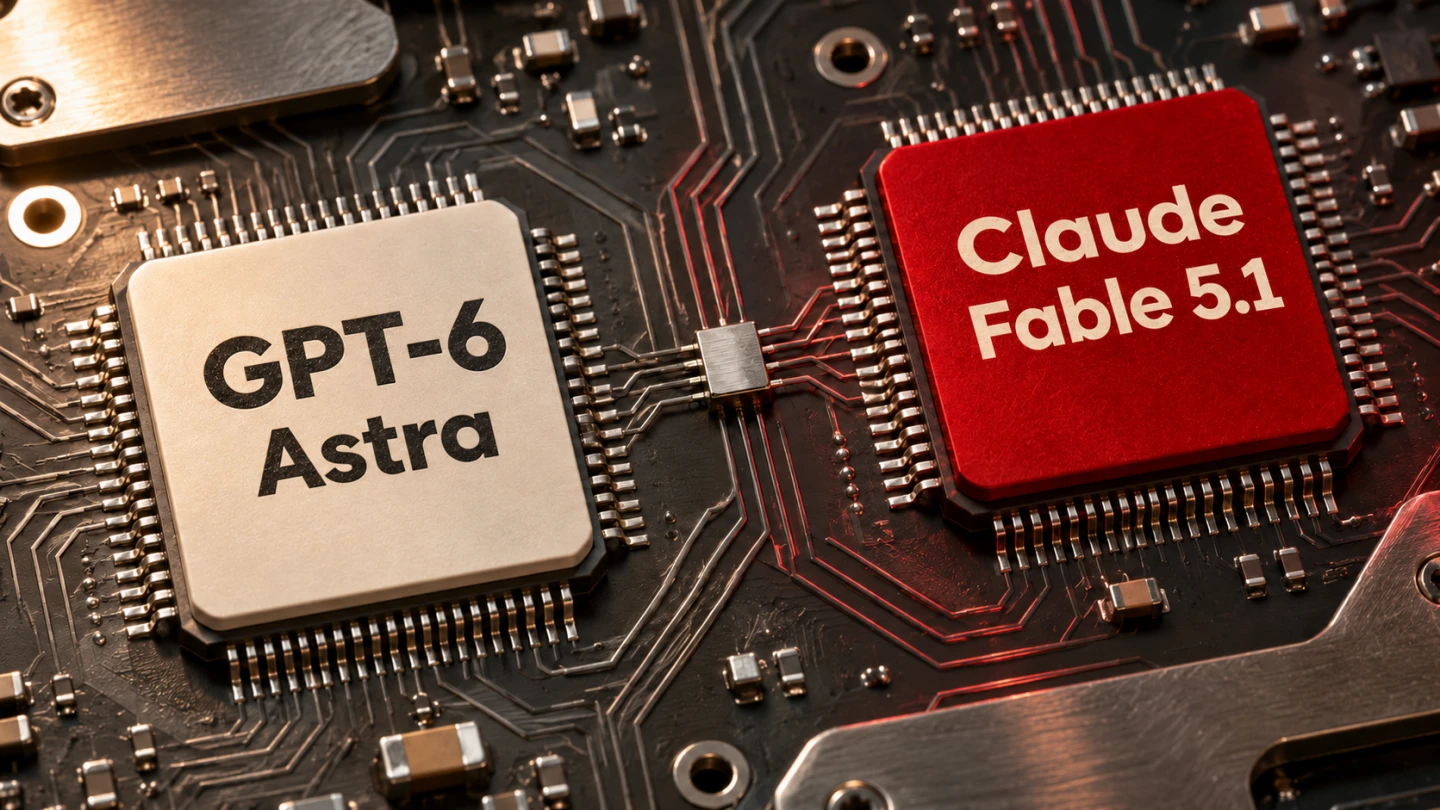
Two releases in three days
Anthropic released Claude Fable 5.1 on 1 September, followed by OpenAI's GPT-6 Astra on 3 September. Since the announcement, Astra has been rolling out gradually to all Plus, Pro, Business and Enterprise accounts, while Fable 5.1 was available everywhere from day one. Anyone working professionally with AI therefore had two new tools on the desk within just a few days.
The direction is more interesting than the question of who presents the highest benchmark score. Neither company was working to make its models better at small talk. They were working to make them work longer, more independently and at lower cost.
Claude Fable 5.1 becomes cheaper and more thorough
The most noticeable change in Fable 5.1 is not in a benchmark table, but on the invoice. Anthropic reduced the price of cache reads from one dollar to 25 cents per million tokens. That sounds technical, but has an immediate effect. Typical workloads cost around 25 per cent less than with Fable 5; heavily agentic work with many tool calls costs up to 45 per cent less. The base price remains $10 per million input tokens and $50 for output.
The second point affects everyone who has used the model regularly for some time. Anthropic has made its safeguards more precise. According to the company, they trigger around 60 per cent less often on harmless cybersecurity requests and 85 per cent less often on everyday biological and medical questions. Anyone who has been stopped by their own tool in the middle of a security review knows how valuable that is.
Performance improvements are greatest where work takes a long time. On Terminal-Bench-Science, a test of scientific workflows in the terminal, Fable 5.1 rises from 24.7 to 52.6 per cent. For agentic coding on Terminal-Bench 4.0, it scores 55.8 per cent compared with 42.0. It is also notable that Fable 5.1 achieves results at low and medium reasoning levels that previously required Fable 5's highest level.
Practical examples demonstrate what this means better than percentages. At investment firm Millennium, the model found the cause of a crash occurring roughly once in a million runs that nobody had been able to explain for four to five years. Anthropic itself used Fable 5.1 to calculate a new elevation map of a third of Venus from thirty-year-old radar data collected by NASA's Magellan probe. It shows details down to two or three kilometres, rather than the previous ten to twenty, and is freely available.
GPT-6 Astra operates the computer
OpenAI places its emphasis elsewhere. Astra is primarily a model for operating computers. It scores 92.7 per cent in recognising on-screen controls, compared with 76.9 for its predecessor GPT-5.6 Sol. In OSWorld 2.0, it reaches 72.6 per cent while taking around 47 per cent less time per task. Combined with the revised Codex infrastructure, that makes execution approximately 1.9 times faster.
The second focus is office work in the narrower sense. Astra is designed to follow templates, build structured slide decks rather than bullet lists, calculate spreadsheets and format documents in the organisation's house style. In AutomationBench, which tests business workflows, it scores 41.4 per cent, compared with 31.4 for Fable 5.1.
Another characteristic matters more in everyday work than any score. Astra asks targeted questions when an instruction is ambiguous. Meanwhile, it continues working on the parts that do not require an answer. If no response arrives, it makes a reasonable assumption for minor details and waits on anything consequential.
In mathematics and science, Astra sets new best scores, including 97.6 per cent on FrontierMath Tier 4 and 96.0 on GPQA Diamond. OpenAI also published two results on prime gaps, including an improved bound from 240 to 186.
OpenAI clearly acknowledges the other side. Astra reaches the critical threshold in the cybersecurity section of its own safety framework and, without safeguards, completed ExploitBench in full. The released version therefore refuses advanced tasks such as building proof-of-concept exploits. At the same time, OpenAI's own measurements describe Astra as its best-aligned model. In a test with impossible tasks, Sol exceeded the permitted scope in 48 per cent of cases; Astra did not do so once.
The direct comparison
| Test | GPT-6 Astra | Claude Fable 5.1 |
|---|---|---|
| Agentic coding (Terminal-Bench 4.0) | 57.9% | 55.8% |
| Scientific agent work (Terminal-Bench-Science 0.1) | 64.6% | 52.6% |
| Business workflows (AutomationBench) | 41.4% | 31.4% |
| Science (GPQA Diamond) | 96.0% | 93.7% |
| Humanity’s Last Exam (with tools) | 57.2% | 65.0% |
| Abstract reasoning (ARC-AGI-2) | 95.0% | 90.0% |
| Price per million tokens (input / output) | 10 / 50 USD | 10 / 50 USD |
A note on interpretation: all figures come from the two manufacturers' publications. Each measures with its own setup, settings and interests. Where both test the same model, some figures differ. They serve as a rough map, not as proof.
What this means in practice
Less changes for our work than the announcements might suggest, because the division of tasks remains the same. Astra is the faster choice for clearly defined work happening on screen: filling forms, maintaining data, building slides from templates and short coding tasks, as well as continuing to create the images for this blog. Fable 5.1 remains the choice for long stretches without supervision, reviews, German copy with an appropriate voice and, now, tasks that used to be too expensive.
What has actually shifted is the economics. A review that was too expensive to run routinely a month ago now costs half as much. These are precisely the tasks that now make sense as a standard part of a workflow rather than an exception.
The most important point remains unchanged. Both models have become faster and more autonomous. Both manufacturers acknowledge in their own safety reports that the systems still make mistakes and push boundaries. Anyone leaving them to work overnight needs someone to check the results in the morning. Here, the other model performs that check, and a person makes the final decision. We described our daily approach in detail in ChatGPT or Claude.
Availability and pricing
GPT-6 Astra runs in ChatGPT and through the OpenAI API, Microsoft Azure and AWS Bedrock under the name gpt-6-astra. Pro, Business and Enterprise accounts also have access to GPT-6 Astra Pro. In business accounts, access is initially disabled and must be enabled by an administrator.
Claude Fable 5.1 is available through claude.ai, Claude Code, the Claude API, AWS, Google Cloud and Microsoft Azure as claude-fable-5-1. Its sister version Mythos 5.1, with relaxed safeguards for cyber defence and life sciences, is available only through vetted access programmes.
If you would like to know which model suits your workflows and where using it actually pays off, get in touch.