Update, merge or retire outdated content deliberately
Implement a deliberate editorial decision coherently across content, response status and references.

An older article is not automatically a poor article. Some explanations remain useful for years while a recently published product guide can already be unsuitable. Reliable maintenance therefore asks about purpose, accuracy and evidence before choosing a technical action. Only then should a page be retained, updated, merged into an appropriate successor or removed without pretending that an unrelated replacement exists.
This guide connects those editorial decisions with an executed technical example. Four artificial knowledge records produce actually checked responses using status codes 200, 308 and 410. Link updates, canonical references and a sitemap are included. A total of 51 conditions and 19 real HTTP requests check this bounded implementation. No existing public address was changed and no search-engine reaction or ranking improvement is presented as measured.
Examine the page's purpose before its age
Start with a concrete question: what problem should this content solve for its readers? A clear explanation of the difference between a backup and a restoration test may still be valuable. Instructions for a demonstration that is no longer offered may instead have lost their purpose. Its publication date alone does not settle either case.
An inventory should connect the title with the actual task. Add known reader questions, responsible people and the claims that need checking. A general label such as “old” is too vague. A concrete observation such as “the described menu sequence no longer exists in the current version” is more useful because somebody can investigate that specific statement rather than debating age in the abstract.
The Google guidance on helpful content emphasises usefulness to people. It does not establish a general freshness benefit from deleting large numbers of older pages. This workflow therefore has no age threshold that automatically makes an article expendable. A decision needs an inspectable reason connected to the content and its role.
Keep four editorial decisions distinct
Retaining means the page still fulfils its role and its relevant claims can remain after the intended review. Updating means the same question continues to be answered at the same address while particular statements are corrected or improved. Merging means another appropriate page takes over the relevant task. Removing without a successor means no such replacement is being claimed.
The distinction prevents two common mistakes. A small factual addition does not necessarily require a new address. Equally, redirecting to a large general overview is not automatically a suitable substitute for specialised information. Someone expecting a particular procedure should not be sent without explanation to a generic home page that never answers the original question.
Record the decision before implementing it. An HTTP status can express the decision but cannot make the underlying editorial judgement. A note does not prove that an authorised person performed a real review either. The code deliberately receives predetermined teaching decisions and checks their technical consistency. It does not assess content quality or confer permission to remove a real publication.
Maintain a small inventory with meaningful review fields
A practical team can begin with a manageable inventory. Each row identifies a unique address and its purpose. Other fields record a proposed action, responsibility, open questions and a potential successor. Evidence is associated with the decision so it remains understandable later. A list containing only page counts and timestamps does not provide that connection.
For an update, identify the specific claims that need changing. For a merger, check whether the destination actually covers the important questions. For removal, explain why no appropriate successor is offered. Article length or an automatically calculated keyword overlap cannot reliably establish those conclusions. Similar words can occur in pages serving very different reader needs.
Traffic figures are useful clues with limited reach. Few recorded visits can have several causes and do not constitute editorial approval to delete a page. First establish what usage was measured and whether the content answers a rare but important question. This artificial inventory therefore contains no invented visitor statistics or purported commercial performance.
Updating should improve a real statement
The fictional restoration article initially says only to check whether a backup file exists. Its new version adds restoration into a separate destination and comparison of the contents actually needed. The same subject is treated more precisely at the same address. That is a concrete content change rather than a timestamp replacement presented as substantive work.
The technical test verifies that the new body is served and the previous sentence is not simply left unchanged. It does not establish that every arbitrary rewording is an improvement. That boundary is explicit in the code. Different text is a necessary mechanical observation for this teaching case, not a general verdict on the accuracy or value of future edits.
The Google guidance on byline dates discusses identifying publication or significant updates. Dates should match their stated meaning and equivalent structured information. A date-only change without corresponding content work would not replace the factual maintenance discussed here. A particular date appearing in search results is still not guaranteed.
Merge only into an appropriate direct destination
The inventory merges its old recovery-path article into the updated restoration article. Coverage is an explicitly supplied teaching assumption. In a real project, actual questions, examples and evidence would need to be compared first. A shared word in the title does not prove that one page takes over the other's function.
The technical model then requires a direct existing content destination. A redirect to another redirect is rejected by this small contract. An unknown destination, a retired destination and a self-reference are rejected as well. These checks prevent ambiguous chains and inconsistent plans without pretending that syntactic validity proves semantic coverage.
The Google redirect documentation describes permanent server-side 301 and 308 redirects as signals concerning a lasting destination. This example uses 308. Such a signal is not a promise to preserve a particular search position. The destination first needs to serve the actual reader task that motivated the merger.
Do not invent a replacement when none exists
The artificial old demonstration is no longer offered and has no appropriate successor in this case. Its address therefore returns 410 rather than a blanket redirect to the home page. An unknown address returns 404. These responses make it explicit that a current knowledge article is not being served at either location.
The current Google explanation of HTTP status codes describes the relevant 4xx responses other than 429 within the same processing model. It does not establish a dependable trick whereby 410 guarantees immediate or faster disappearance from search results. Select an appropriate response for the action instead of treating status codes as a shortcut to a promised indexing outcome.
A helpful error page can provide orientation without secretly changing its status to 200. This fixture deliberately keeps the body simple. A real site might add a search or clearly labelled related topics, but those aids should not pretend to be a content-equivalent successor. The meaning of the original response should remain accurate.
The complete technical teaching case
The first file defines the artificial inventory and builds its bounded response and link model. The second starts a service only on the loopback address. Its content is explicitly marked noindex. This is not a production publishing service and does not authorise removing existing addresses from a real site. The distinction remains part of the example's execution contract.
lifecycle.mjs
const safePath = value => typeof value === 'string' &&
/^\/wissen\/[a-z0-9]+(?:-[a-z0-9]+)*$/.test(value);
const escapeHtml = value => value.replaceAll('&', '&')
.replaceAll('<', '<').replaceAll('>', '>')
.replaceAll('"', '"');
// These are assumed editorial decisions for artificial teaching records.
// A nonempty review note does not prove actual authority or factual quality.
export const examplePlan = [
{
path: '/wissen/sicherungsgrundlagen', decision: 'retain',
title: 'Sicherungsgrundlagen',
body: 'Eine Sicherung und eine tatsächlich geprüfte Wiederherstellung erfüllen unterschiedliche Aufgaben.',
previousBody: null, target: null,
reviewNote: 'Lehrannahme: Die Grundlagen beantworten weiterhin dieselbe Frage.',
links: ['/wissen/alter-rueckweg', '/wissen/alte-demo']
},
{
path: '/wissen/wiederherstellung', decision: 'update',
title: 'Wiederherstellung prüfen',
body: 'Prüfen Sie die Wiederherstellung in einem getrennten Ziel und vergleichen Sie die tatsächlich benötigten Inhalte.',
previousBody: 'Prüfen Sie, ob eine Sicherungsdatei vorhanden ist.', target: null,
reviewNote: 'Lehrannahme: Die fachlich geprüfte Ergänzung wird unter derselben Adresse übernommen.',
links: ['/wissen/sicherungsgrundlagen']
},
{
path: '/wissen/alter-rueckweg', decision: 'merge',
title: 'Alter Rückwegartikel', body: 'Diese Lehrfassung wird fachlich passend zusammengeführt.',
previousBody: null, target: '/wissen/wiederherstellung',
reviewNote: 'Lehrannahme: Ziel und Abdeckung wurden redaktionell geprüft.',
links: []
},
{
path: '/wissen/alte-demo', decision: 'retire',
title: 'Abgeschlossene alte Demonstration',
body: 'Diese künstliche Demonstration wird nicht mehr angeboten.',
previousBody: null, target: null,
reviewNote: 'Lehrannahme: Kein inhaltlich passender Nachfolger vorhanden.',
links: []
}
];
export function buildLifecycle(input, origin) {
const base = new URL(origin);
if (!['http:', 'https:'].includes(base.protocol) || base.username ||
base.password || base.pathname !== '/' || base.search || base.hash) {
throw new TypeError('Fester Ursprung ohne Pfad erforderlich');
}
if (!Array.isArray(input) || input.length < 1 || input.length > 100) {
throw new TypeError('Begrenzter Plan erforderlich');
}
const records = structuredClone(input);
const byPath = new Map();
for (const row of records) {
if (!row || !safePath(row.path) || byPath.has(row.path) ||
!['retain', 'update', 'merge', 'retire'].includes(row.decision) ||
typeof row.title !== 'string' || !row.title.trim() || row.title.length > 160 ||
typeof row.body !== 'string' || !row.body.trim() || row.body.length > 4000 ||
typeof row.reviewNote !== 'string' || !row.reviewNote.trim() ||
!Array.isArray(row.links) || row.links.some(p => !safePath(p)) ||
(row.decision === 'merge' ? !safePath(row.target) : row.target !== null)) {
throw new TypeError('Planeintrag ungültig');
}
if (row.decision === 'update' &&
(typeof row.previousBody !== 'string' || row.previousBody === row.body)) {
throw new TypeError('Geänderter Text erforderlich, keine Qualitätsbewertung');
}
byPath.set(row.path, row);
}
const isCurrent = row => ['retain', 'update'].includes(row.decision);
for (const row of records) {
if (row.decision === 'merge') {
const target = byPath.get(row.target);
if (!target || !isCurrent(target) || row.target === row.path) {
throw new TypeError('Zusammenführung braucht direktes bestehendes Inhaltsziel');
}
}
if (row.links.some(path => !byPath.has(path))) {
throw new TypeError('Unbekanntes internes Linkziel');
}
}
const resolveLink = path => {
const row = byPath.get(path);
if (!row) throw new TypeError('Unbekanntes Linkziel');
if (row.decision === 'retire') return null;
return row.decision === 'merge' ? row.target : row.path;
};
const current = records.filter(isCurrent);
const sitemap = () => '<?xml version="1.0" encoding="UTF-8"?>' +
'<urlset xmlns="http://www.sitemaps.org/schemas/sitemap/0.9">' +
current.map(row => '<url><loc>' + escapeHtml(new URL(row.path, base).href) +
'</loc></url>').join('') + '</urlset>';
const responseFor = (path, method = 'GET') => {
if (!['GET', 'HEAD'].includes(method)) {
return { status: 405, headers: { Allow: 'GET, HEAD' }, body: '' };
}
if (path === '/sitemap.xml') return {
status: 200, headers: { 'Content-Type': 'application/xml; charset=utf-8' },
body: method === 'HEAD' ? '' : sitemap()
};
const row = byPath.get(path);
if (!row) return { status: 404, headers: {}, body: method === 'HEAD' ? '' : 'Nicht gefunden' };
if (row.decision === 'merge') return {
status: 308, headers: { Location: row.target }, body: ''
};
if (row.decision === 'retire') return {
status: 410, headers: {}, body: method === 'HEAD' ? '' : 'Dieser Lehrinhalt hat keinen passenden Nachfolger.'
};
const links = [...new Set(row.links.map(resolveLink).filter(Boolean))];
const body = '<!doctype html><html lang="de"><head><meta charset="utf-8">' +
'<meta name="viewport" content="width=device-width, initial-scale=1">' +
'<meta name="robots" content="noindex"><title>' + escapeHtml(row.title) +
'</title><link rel="canonical" href="' + escapeHtml(new URL(row.path, base).href) +
'"></head><body><main><h1>' + escapeHtml(row.title) + '</h1><p>' +
escapeHtml(row.body) + '</p><ul>' + links.map(path => '<li><a href="' +
escapeHtml(path) + '">' + escapeHtml(byPath.get(path).title) +
'</a></li>').join('') + '</ul></main></body></html>';
return { status: 200, headers: { 'Content-Type': 'text/html; charset=utf-8' },
body: method === 'HEAD' ? '' : body };
};
return { responseFor, resolveLink };
}
serve.mjs
import { createServer } from 'node:http';
import { buildLifecycle, examplePlan } from './lifecycle.mjs';

// Isolated teaching service. No production configuration or data is changed.
const origin = 'http://127.0.0.1:8771';
const model = buildLifecycle(examplePlan, origin);
const server = createServer((req, res) => {
  let target;
  try { target = new URL(req.url, origin); }
  catch { res.writeHead(400); res.end(); return; }
  if (target.origin !== origin || target.search || target.hash) {
    res.writeHead(400); res.end(); return;
  }
  const result = model.responseFor(target.pathname, req.method);
  res.writeHead(result.status, {
    'Content-Type': 'text/plain; charset=utf-8',
    'Cache-Control': 'no-store',
    'X-Robots-Tag': 'noindex',
    ...result.headers
  });
  res.end(result.body);
});
server.listen(8771, '127.0.0.1');
The fixed origin comes from trusted configuration rather than an unchecked request header. Unknown paths remain unknown. Unexpected query parameters are rejected by the complete teaching service. That is a deliberately narrow fixture rule, not a recommendation to treat every parameter on every real content page identically. An actual integration needs to preserve the site's intended routing behaviour.
Update links and the sitemap with the decision
The retained foundation article initially links to the old recovery article and the retired demonstration. Output rewrites the first link directly to the appropriate current article. The second is omitted because its referenced content has been retired. The rendered link therefore avoids an unnecessary redirect and does not point readers to a deliberately removed page.
The sitemap contains only the two current 200 destinations. Neither the redirecting old address nor the retired address is listed as a current content target. Tests inspect actual XML output and served link attributes. They also inspect the retained page's canonical reference. Related technical signals are therefore checked together instead of being configured independently in contradictory directions.
The resulting model applies only to the listed teaching addresses. It does not search other people's content or modify real incoming links. A real change also requires consideration of navigation, indexes, translations and important cross-references. A correct redirect target does not eliminate the need to inventory those relationships.
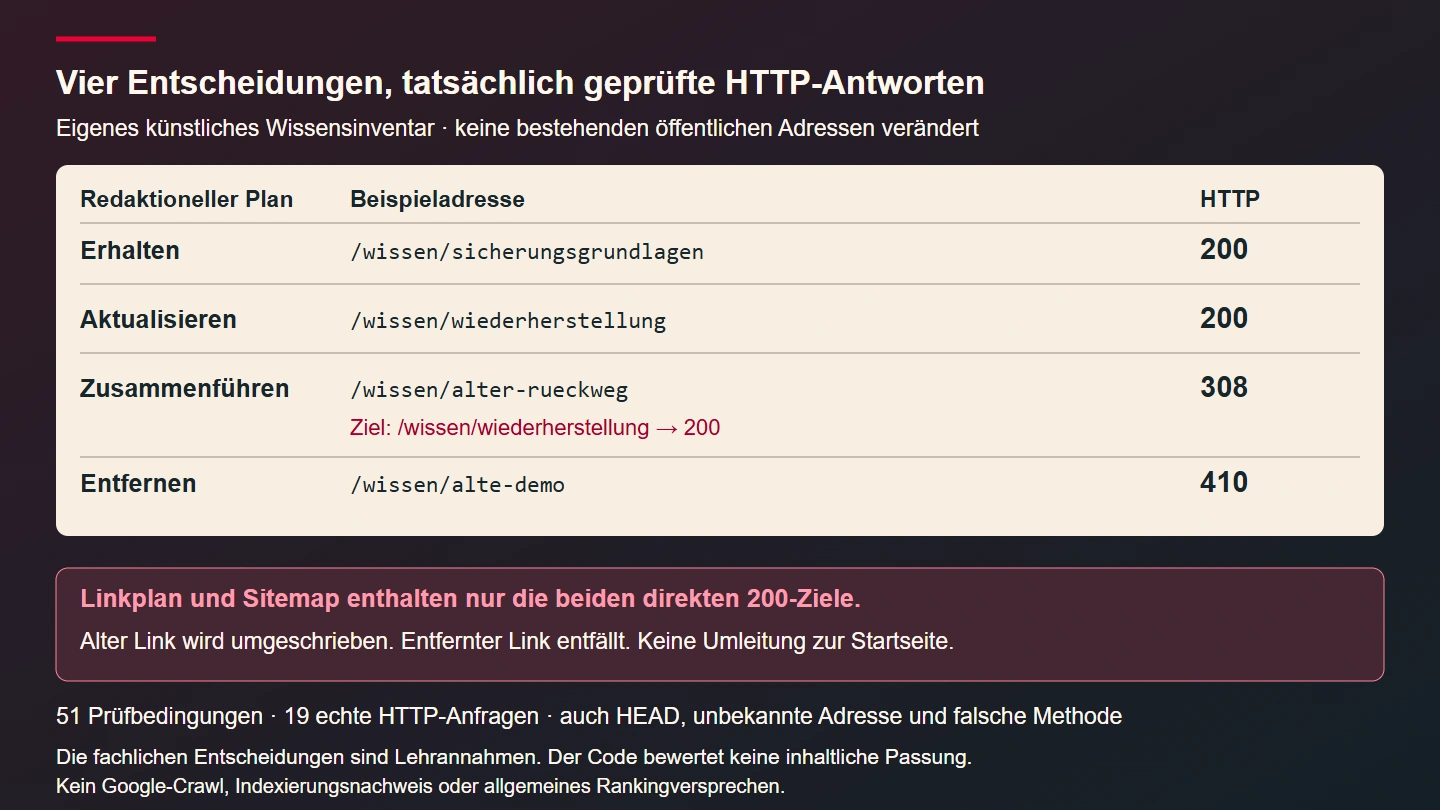
Read the responses that were actually executed
| Teaching decision | Observed response | Additional check |
|---|---|---|
| Retain foundations | 200 with the same content purpose | Canonical points to the same address |
| Update restoration | 200 with the new body | The previous statement is replaced |
| Merge the old recovery path | 308 to the restoration article | Actually following it reaches 200 directly |
| Retire the old demonstration | 410 without an invented successor | Links and sitemap omit it as current content |
GET and HEAD are really requested for each address. HEAD returns its corresponding status without a response body. An unknown address is checked too. An unsupported method produces 405 with an appropriate Allow value. These observations come from the own Node service and are not inferred from a hypothetical configuration of another server.
The complete second source file is also started in a child process. Tests verify its reachable content, redirect and rejection of unexpected parameters. They check that the spawned process remains alive without a startup error, rather than accidentally accepting some unrelated listener. All owned services are stopped afterwards. No permanent public replacement server is installed.
Separate technical validity from editorial approval
A nonempty review note is required by the model, but it does not prove that a real factual review took place. An existing destination likewise does not prove appropriate coverage. Decisions come from a prepared trusted teaching plan. The example provides neither editorial user administration nor an authorisation mechanism for an actual organisation.
This separation prevents a dangerous shortcut: a technically valid plan should not become editorially approved merely because it passes structural checks. A real system would need to bind confirmation to responsible people, inspected content and a particular destination collection. Later body or destination changes would need renewed assessment instead of reusing an old note as unrestricted permission.
Prepare a change that can be investigated and reversed
Before a real switch, preserve the original content, metadata and routing state in an inspectable backup. It needs to identify the exact starting version. Copying only visible paragraphs is insufficient if addresses, cross-references or delivery rules also change. A planned recovery path should consider those related parts together.
Reversal also differs from restoring an older database over subsequent work. If other people have made newer changes, an old backup should not be copied blindly over them. The isolated fixture has no such outside modifications. It demonstrates consistency of responses and links, not a complete rollback implementation for a production editorial database.
A small initial group of related pages can help test assumptions. Review their new responses and links before processing another group. That does not make the remaining pages complete. Progress reporting should distinguish proposed decisions, applied changes and changes that have actually passed the intended checks.
Ask the original reader question again afterwards
After merging, check more than the redirect response. A responsible reader should still be able to answer the original question at the destination. If a crucial example is missing, a working redirect does not make the task complete. An update should similarly fix the identified statement rather than append unrelated text somewhere else.
Decide in advance what later observation should answer. Do important old references reach a suitable destination? Are unexpected errors appearing? Have new factual questions emerged? Search or usage data can supplement that review but should be described with its period, scope and known gaps. This fixture invents no movement in those metrics.
Review language editions as related content
One correct redirect is not enough for a multilingual site. Each edition has its own address, text and potentially important incoming references. Merging a German article should prompt consideration of its English counterpart. A suitable German destination is not automatically the right replacement for an English procedure. The decision must consider the languages actually available.
This technical inventory deliberately contains one small German knowledge collection. It does not implement a general multilingual address manager. An extension would need to review relationships between editions and their annotations together. A remaining language reference to a retired page is a different issue from a correct redirect within German. Neither should be hidden behind one vague success message.
Trace source changes back to particular claims
An unreachable source is a useful review trigger, not automatic proof that every claim in the article is false. Identify which statement depends on it and whether the source moved or became outdated. A replacement address is useful only if it supplies the needed evidence. A publisher's broad home page is often too imprecise to stand in for a particular document.
A reachable source can also describe an obsolete version. Review its content and date together. When correcting a claim, inspect related examples, tables and captions so a new paragraph does not contradict an old illustration. This is particularly important for technical instructions whose code and explanation need to be treated as one reviewable object.
A documented review should also permit a justified decision to make no public change. If the inspected statement remains accurate, there is no need to invent another paragraph merely to create a visible editing effect. Private review evidence can record the inspection while suitable public content remains intact. Responsibility then follows the actual claim rather than the amount of visible churn.
Use a maintenance checklist with inspectable decisions
- Name the purpose and the outdated claim rather than only recording age.
- Record responsibility, evidence and unresolved questions.
- Distinguish retaining, updating, merging and retiring explicitly.
- Assess a proposed destination against the original questions.
- Check responses, links, canonical references and the sitemap together.
- Preserve original versions and a suitable recovery path.
- Recheck the applied change against the same reader task.
The fixture's 51 conditions do not automate this editorial work. They establish whether a predetermined bounded plan creates consistent responses and connections. Its 19 HTTP requests are actual execution evidence for that service. Search indexing, index removal and commercial value were not measured by these checks.
Organise maintenance as an ongoing responsibility
Useful content needs clear reasons to be reviewed again. Changed product functionality, a withdrawn source or new factual evidence can all trigger inspection. Regular review of particularly important material may be appropriate as well. A scheduled date alone does not mean the review happened. Its record should identify which statement was inspected and what decision followed.
This approach connects that responsibility with a technically inspectable implementation. It does not dismiss old content indiscriminately or sell a redirect as a substitute for substance. It makes a deliberate decision consistent across responses, references and annotations. Maintenance then stays understandable and readers have a clear route to the material that actually answers their question today.