Write precise page titles and meta descriptions
Name each page clearly, verify technical output and interpret the generated search presentation accurately.

Precision starts with the individual page
A useful page title identifies the actual content and distinguishes the page from others. A useful meta description explains why a relevant visitor might open it. Both need to match the page itself. They are editorial inputs to search systems, not a binding order for a particular title link, snippet or ranking. Keeping that distinction clear prevents unrealistic expectations about what a metadata change can control.
Our original example is a fictional provider called Beispielwerk. It has a maintenance page, a relaunch page and a contact page. Each receives its own title and description. No real references, commercial advantages or search results are claimed. The pages have different jobs, and those differences should be apparent before someone opens them. That gives us a concrete basis for choosing words rather than optimising an abstract score.
Do not begin with a desired character count. First write one sentence describing what the page actually provides. Our maintenance page explains inspection, agreed updates and documented findings. That is more concrete than a promise of comprehensive digital success. This content decision supplies the vocabulary for the title, main heading and description. Length review comes after the important information has been identified.
Connect intent with the page’s actual task
Someone may be learning about maintenance, comparing a scope of work or trying to contact a familiar provider. One page does not have to satisfy every intention completely. In this example, the maintenance page explains activities and outstanding agreements, while the contact page supports a specific project enquiry. Giving both the same title would unnecessarily conceal their different responsibilities.
Record a main question, the supported answer and the appropriate next step for each page. This creates an editorial decision rather than a list of every potentially attractive search term. A possible main question is which maintenance activities a business should clarify before entering an agreement. The title can identify the subject concisely while the description explains the practical scope and decision support.
Vocabulary from real conversations, internal searches or existing search reports can help, but it should not be concatenated mechanically. If customers use a different term from the technical explanation, make the relationship understandable in the content. Adding another synonym to a title is useful only when it improves orientation. Repetition does not automatically make the page more relevant, more precise or easier for a reader to distinguish.
Write a distinctive title
Our first example title identifies business website maintenance before the fictional provider name. The separator is a design choice rather than a ranking technique. A familiar product name or a particular brand-oriented journey could justify another order. The important point is that the distinguishing page information remains useful even when the visible presentation is shortened. Prioritise meaning rather than a decorative formula.
The relaunch page identifies a structured relaunch and the contact page identifies contact and project enquiries. Both retain the shared provider name while describing separate jobs. Review titles as a set: could someone unfamiliar with the site distinguish the destinations from these lines alone? Repeating a generic word such as Services on every detail page would provide little help in choosing the relevant destination.
Avoid unsupported superlatives and commitments the page does not explain. A claim of the best maintenance with guaranteed success would not suit this example. A concrete supported scope is more useful. Locations also belong only where they are relevant to the page. An endless list of towns would displace the service information and would need meaningful corresponding content rather than being added as an arbitrary visibility tactic.
Make the description explain the visit
The maintenance description names recurring inspection, coordinated updates and documented findings, then explains that the page helps clarify activities before an agreement. It adds useful detail rather than merely repeating the title. A person can judge more easily whether the destination addresses their question. That is the editorial objective of this example, without a promise about the external search presentation.
The description is not necessarily a space for general promotional language. Words such as innovative, tailored and dependable could apply to almost any page and give little orientation by themselves. Our draft replaces them with concrete activities. If the page contains a checklist, the description can mention it. If it does not, the checklist should not be invented merely to make a preview sound more attractive.
A next-step invitation can be useful when it follows the page’s task. A comparison can invite readers to inspect criteria, while a contact page can invite a description of their project. Every description does not need the same urgent call to action. Its wording should create an accurate expectation rather than demanding an unrelated immediate response regardless of what the destination actually offers.
Separate metadata from the generated search presentation
Google documents title-link creation as an automated process that can draw on several sources. A snippet may likewise come from page content instead of the meta description. Our practical response is to write the supplied values carefully and keep them consistent with visible content. We do not then claim that the search interface must reproduce them unchanged in every context.
When a different text appears, investigate the particular page, query and observed processing state. An unclear main heading, contradictory content or an older version may warrant review. One manual search is not complete evidence for every possible presentation. Record the observation with a date and a concrete question. This makes it useful for investigation without turning it into a universal statement about how the page always appears.
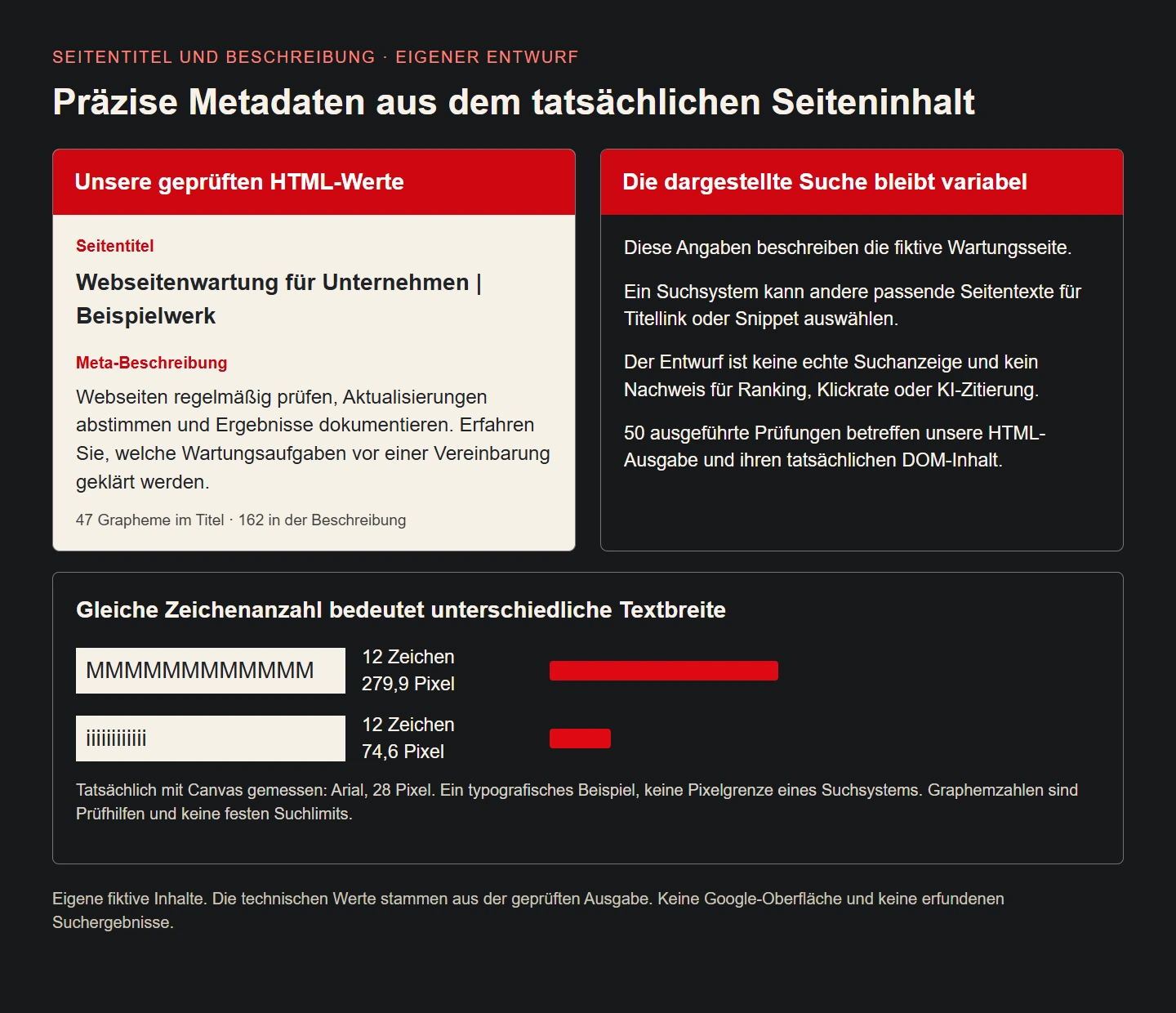
A preview in an editorial tool is a drafting aid. It can show how wording reads in a bounded area, but it is not an actual search result generated by the search provider. This article’s explanatory graphic therefore contains no imitation Google interface or fabricated position. It shows the values our HTML actually supplies and the boundary between those values and another system’s presentation decisions.
Google Search Central: Title links · Snippets and descriptions
Use counts as review signals
Our draft has no rigid character count that guarantees a particular visible presentation. Different characters occupy different widths: a sequence of broad capitals can be much wider than the same number of narrow letters. Typeface, available width and search-system decisions add further variation. One count cannot represent all those factors. It can still be a useful prompt to review an unusually long or vague draft.
A very long title deserves attention to priorities and repetition. A short one may be too general, but a concise contact-page label can also be entirely appropriate. The content remains the deciding factor. Automatically cutting after a generic boundary might remove the word that distinguishes this page from another. A drafting tool should help the editor make that decision rather than silently replacing it with truncation.
The example helper counts graphemes with Intl.Segmenter so that combined visible character sequences are considered more appropriately than a raw JavaScript string length. That number is still not a search limit. The illustration also measures two equal-length strings using a specified Canvas font. It is a reproducible typographic demonstration, not an asserted pixel threshold used by a search engine.
Align title, main heading and actual value
The document title and visible main heading have related but different contexts. They need not be character-for-character identical, but both should identify the same page. A precise maintenance title paired with a main heading saying only that the company does everything would abandon the useful distinction. Our example keeps topic, scope and audience coherent across the short metadata and the visible introduction.
Review the first substantive paragraph too. Does it deliver the expectation created by the description or begin with an interchangeable company story? The maintenance example should quickly establish which activities it explains and what still needs agreement. Readers should not have to cross several decorative sections merely to determine whether they reached the right page. Editorial precision extends beyond the two metadata fields.
A compact review asks whether the title identifies, the description explains and the content delivers. If those pieces disagree, revise them together. This prevents an isolated metadata exercise from merely announcing a weak page more convincingly. Useful metadata is part of maintaining useful content. It does not replace evidence, a coherent explanation or the work required to answer the reader’s actual question.
Keep the technical output narrowly defined
The HTML title belongs in a title element in the head, while the description is emitted as a meta element with name="description" and the intended content attribute. The original helper normalises whitespace and Unicode, rejects empty strings and unexpected control characters, then escapes relevant output characters. These responsibilities concern dependable output rather than where the page will rank or whether it will be indexed.
Quotation marks and text resembling a closing title tag must not change the document structure. We therefore exercise deliberate special-character cases in an actual browser DOM. Values must round-trip as title text and attribute content without creating additional script elements. This is bounded evidence for the particular renderer, not a comprehensive security review of every later template or unrelated output context.
export function cleanText(value) {
if (typeof value !== 'string') throw new TypeError('Text expected');
if (/[\u0000-\u0008\u000B\u000C\u000E-\u001F\u007F]/u.test(value)) {
throw new TypeError('Unexpected control character');
}
const result = value.normalize('NFC').replace(/\s+/gu, ' ').trim();
if (!result) throw new TypeError('Non-empty text expected');
return result;
}
export function escapeHtml(value) {
return value.replace(/[&<>"']/g, char => ({
'&': '&', '<': '<', '>': '>',
'"': '"', "'": '''
})[char]);
}
export function renderMeta({title, description}) {
const t = cleanText(title), d = cleanText(description);
return '<title>' + escapeHtml(t) + '</title>\n'
+ '<meta name="description" content="' + escapeHtml(d) + '">';
}
export function reviewText(value) {
const text = cleanText(value);
const segments = new Intl.Segmenter('de', {granularity: 'grapheme'});
return {text, graphemes: [...segments.segment(text)].length};
}
Understand the renderer and its executed results
The code produces the two agreed elements from a title and description. It does not implement a complete SEO platform, a crawler or a search-service integration. It imposes no automatic ranking boundaries based on length. Keeping its responsibility small makes output easier to inspect. In an existing application, identify which final template actually emits these elements so that another layer does not overwrite the reviewed values.
The 50 executed checks cover invalid input, whitespace normalisation, combined Unicode characters, grapheme counting and special-character DOM round-trips. Each fictional example page is checked for exactly one title and one description with the expected values. Their distinct texts are also confirmed. These results concern our output only; they are not evidence of crawling, indexing, click-through rate or a Google-generated snippet.
Review repeated patterns and duplicate wording
A title inventory helps with larger collections. In our example, maintenance, relaunch and contact appear side by side. Identical wording is a reason to investigate the pages, not automatically a reason to add an arbitrary extra word. Perhaps the pages overlap too heavily, perhaps a description is vague or perhaps a template is overriding the individual values. Resolve the underlying cause rather than merely making strings different.
An editorial inventory can contain URL, page type, main question, title, description and responsible editor. Its value is a shared overview. It does not replace checking the publicly delivered HTML. Stored values may look correct while the active template still outputs the same default on every page. In a large series, the saved editorial state and the actual delivered state need separate traceable evidence.
If descriptions are generated, base them on reliable page-specific facts. A product name, a meaningful type and a supported scope may provide useful ingredients. A generator should not invent reviews, delivery promises or outcomes. Define what happens when a value is missing. A long list of search terms would not adequately describe our three pages and would make their differences harder to understand.
Treat languages and variants deliberately
A translated page needs metadata that reads naturally in its actual language. Word-for-word conversion can create an awkward or inaccurate expectation. An English maintenance page requires review of the service explained there and the vocabulary its readers use. A German description does not become suitable merely because software has translated every individual word. The page task and supported scope must survive the transformation.
Different language versions may need different lengths and sentence structures while retaining a consistent company name. Translation should not introduce a new promise or a different service boundary. Review headings, metadata and substantive content together instead of approving every field in isolation. A neat title is of little value if its translated description announces an offer the actual page does not contain.
Filtered variants, print views and other routes introduce further technical questions. This small renderer does not decide their indexability or canonical relationships. A real site needs an explicit URL model for those decisions. Metadata names a page more precisely but does not settle which variants should independently appear in search. Assign those responsibilities separately during planning instead of expecting two text fields to resolve the whole information architecture.
Bring GEO claims back to verifiable foundations
Google’s reviewed documentation describes its search AI features as using the underlying search requirements without a special additional metadata formula. That does not guarantee an AI mention for this example. We keep important content understandable in text and describe it accurately. This statement concerns the documented Google features and should not be generalised without evidence to every other AI system or retrieval product.
Clear naming may help people and systems recognise the subject, while the content itself must explain its terms, limits and evidence. Adding large claims to a supposed GEO description would not supply that substance. For our maintenance page, concrete activities and outstanding agreement points are more useful than a collection of new optimisation abbreviations. The label attached to the marketing technique does not change the underlying editorial responsibility.
The meta keywords tag is not a substitute either: Google’s official documentation states that its search does not use it. The example renderer therefore concentrates on the two text values actually discussed. Other technical signals may matter in a particular project, but they need their own appropriate source and clear purpose. Adding more fields is not automatically equivalent to improving visibility or making a page eligible for every external system.
Google Search Central: AI features · Meta-Tags
Evaluate changes with a concrete hypothesis
Document why a title is changed. If the maintenance page previously used only Services, the revision first aims to distinguish its actual task. That is a specific editorial improvement we can review directly. A later visibility comparison additionally needs an appropriate observation period and consideration of other changes during that period. Do not turn an intention into a measured result before any real observation exists.
A higher click-through rate may have several causes, including different queries or a changed position. One description edit therefore does not automatically prove its isolated effect. Useful evaluation records the observed data, search context and actual published version together. This fictional example contains no real search-report dataset, so it makes no claim of a measured visibility or conversion improvement.
After publication, check the output under our control first: the intended page and language, one unambiguous title, one appropriate description and consistent visible content. External processing is then observed separately. This sequence distinguishes an actionable quality review from a presentation generated elsewhere. A preview alone completes neither part. Each requires evidence appropriate to the question being asked.
Prepare a practical editorial handover
Each fictional example page has a clear job. Maintenance explains tasks and agreements, relaunch explains a structured process and contact supports a project enquiry. Titles and descriptions follow those purposes. A change in substantive content triggers another review of the short metadata. They remain part of the maintained page rather than becoming forgotten fields written once during an initial launch.
Acceptance asks about clarity, distinction and supported scope. Another reader should be able to say what they expect from the metadata, then find that content on the page. Review technical output separately. A small reusable set of questions helps with series production without forcing every description into the same promotional sentence pattern. Consistency means a common quality standard, not identical wording for different pages.
Precise metadata comes from selection. It names what matters, avoids unsupported promises and distinguishes the destination. Its output remains inspectable. This provides a sound basis for search and reuse while actual presentation and outcomes are assessed through real observations. Those activities support one another and retain their separate evidence, preventing a well-written draft from being misrepresented as a guaranteed external result.
The three original example pages
| URL | Page title |
|---|---|
| /leistungen/wartung | Webseitenwartung für Unternehmen | Beispielwerk |
| /leistungen/relaunch | Relaunch mit klarer Struktur | Beispielwerk |
| /kontakt | Kontakt und Projektanfrage | Beispielwerk |
Checklist for precise metadata
- The page task and main question are clear.
- Title and description distinguish the particular page.
- Every concrete claim is supported by visible content.
- Length is reviewed without inventing a fixed search threshold.
- Title, main heading and introduction agree.
- Actual HTML output contains the intended values.
- Languages and page variants have explicit treatment.
- Changes and external observations remain traceably distinct.
Sources and technical review
Primary sources reviewed on 9 November 2026. Beispielwerk and its three pages are original fictional designs. The 50 checks concern metadata output and DOM behaviour, not an actual search presentation or visibility measurement.