Local service pages with independent usefulness
Move from a local reader question to an accurate description through real relationships and useful page decisions.

A local service page should help someone make a concrete decision. Is the service actually available where they are? How does the work proceed? Is there a location they can visit, or does collaboration happen another way? A place name in a heading does not answer these questions. Accurate information and independent usefulness matter more.
Local content therefore needs more than a template with interchangeable city names. It needs a traceable foundation. This guide offers an editorial method for distinguishing real geographic relationships from unsupported claims. Its examples describe review questions rather than invented branches, customers or service areas, and promise no search position.
Identify the reader's local question first
Someone searching for a nearby service can have several needs. An on-site appointment may be necessary, they may want an accessible business location or a suitable remote service may be sufficient. Do not answer these situations with one generic statement about proximity. The actual question determines which information belongs on the page.
Start with real enquiries and available information. Which places are genuinely served? Which work requires attendance? Which discussion can happen remotely? The text should explain those relationships rather than derive its assertions from a wish to own page titles for as many cities as possible.
Google's helpful-content guidance emphasizes usefulness for people. A practical editorial question follows: after reading, does someone have enough appropriate information to choose their next step? A list of place names alone does not supply that explanation.
Distinguish premises, service area and remote delivery
Actual business premises differ from an area where a service is offered. Work performed without a local appointment is another arrangement again. Describe these distinctions. Offering a service to people from a city does not automatically establish a branch within that city.
Google's business-representation guidelines require accurate information and address premises and service areas, including specific rules for virtual offices and coworking addresses. A rented mailing address or desired city association is therefore not a freely interchangeable foundation for a Business Profile.
A service page and a Business Profile are different publications. Creating a website does not create a real location. Conversely, an individual profile rule does not alone determine the structure of every useful service description. Separate those responsibilities and review each assertion within its relevant context.
The page may need only a short clear explanation. Real visitable premises need appropriate information, a genuine service area needs an accurate availability description and remote work needs an understandable process. Do not replace an unconfirmed fact with reassuring wording such as right there with you on site.
Build the local connection from verifiable information
A useful geographic relationship connects a place with the actual service. This may involve genuine travel arrangements, confirmed responsibility, organizational conditions or a verifiable project. General city trivia does not replace that connection. A paragraph about famous landmarks usually explains little about how a particular service is delivered.
Ask what supports each local claim, who can confirm it and which scope it covers. These questions keep wording proportionate. Confirmed on-site work can be described. Missing experience should not be replaced with a fictional account of personal local knowledge that merely sounds convincing.
Consider relevance as well as truth. Real directions can help when a visit is intended. For entirely remote editorial work, exchanging the necessary materials may matter more. Explain the genuine process rather than accumulating local details as decoration without identifying what decision they support.
Create a claim register before writing
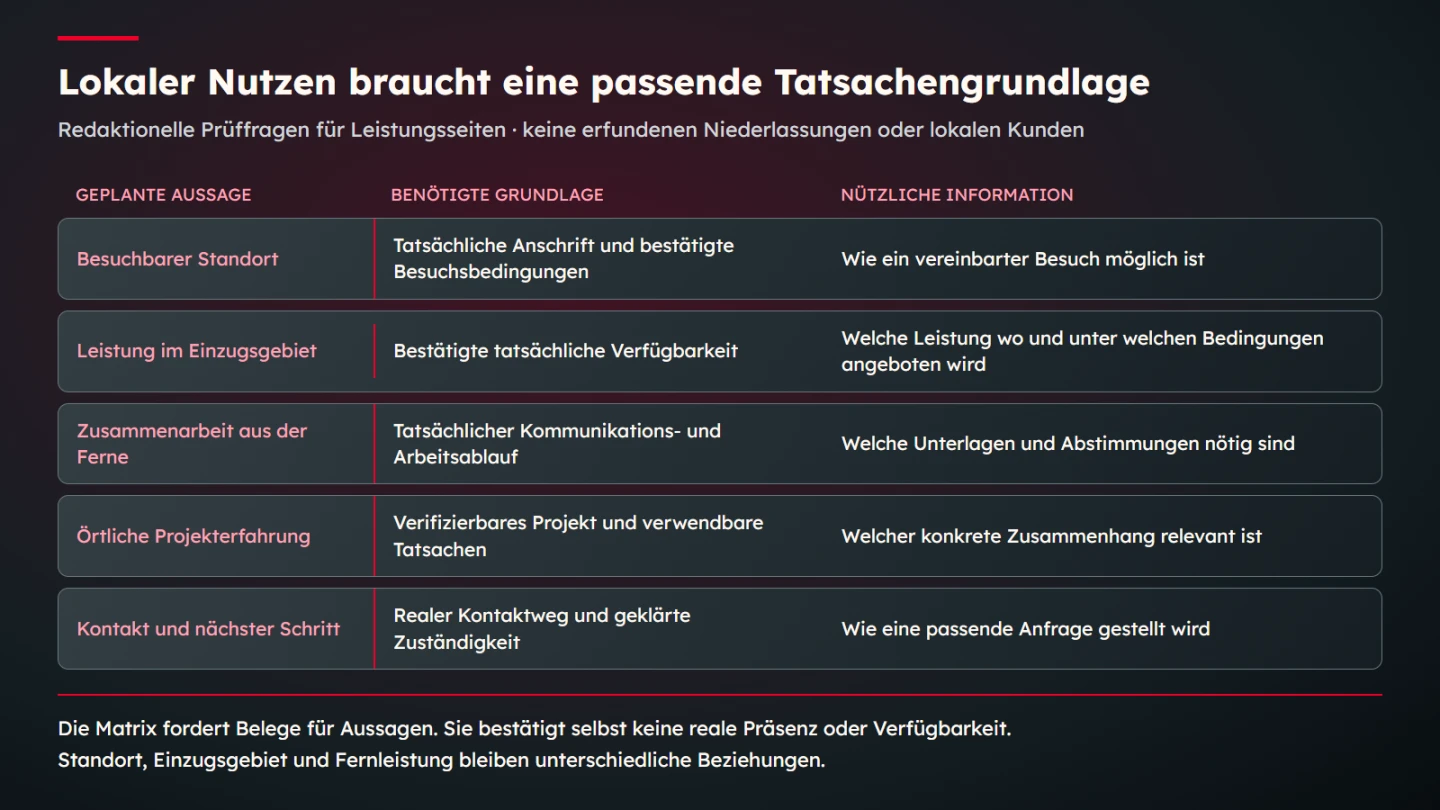
A table connecting a planned statement, required evidence and useful reader information supports planning. It is not an automated truth checker. It makes the necessary foundation explicit so claims are questioned before a finished advertising passage makes them appear established.
| Planned statement | Required foundation | Useful reader information |
|---|---|---|
| Visitable premises | Actual address and confirmed visiting conditions | How an agreed visit can happen |
| Service-area availability | Confirmed real availability | Which service is offered where and under which conditions |
| Remote collaboration | The actual communication and work process | Materials and discussions needed |
| Local project experience | A verifiable project and usable facts | The specific relevant relationship |
| Contact and next step | A real contact route and clarified responsibility | How to make an appropriate enquiry |
The register states evidence requirements rather than actual properties of an invented firm. This article's explanatory figure serves exactly that purpose. It shows the relationship a claim needs without inventing an address or a regional success figure. Preserve that boundary when adapting the table to real work.
Resolve missing information in the working process rather than publishing construction-status notices on a finished service page. An unconfirmed local claim should not be published. Describe the genuinely known process instead of concealing missing facts behind generic promises. That is an editorial decision about evidence and scope.
Distinguish independent usefulness from interchangeable pages
Repeated layout is not automatically a problem. Navigation, contact information and basic service details can sensibly be shared. The important question concerns the individual page's task: does it provide an accurate useful answer for the situation addressed, or merely add another intermediary without its own value?
Google's doorway-abuse policy describes manipulative patterns involving similar queries and insufficiently useful intermediary destinations, including regional or city-targeted pages funneling to one destination. Do not turn this into a blanket claim that every local page or repeated sentence is prohibited. Assess the actual pattern described.
A practical comparison temporarily removes place names. If no relevant difference remains, justify the individual page's purpose. A shared service page with an accurate service-area description may be clearer. Alternatively, genuine geographic differences may exist but have not yet been explained in a useful way.
Do not manufacture a difference. Random synonyms add no new usefulness and fabricated local customer stories do not justify another page. Let structure follow existing information. Where no independent content exists, fewer clear pages can be a substantively reasoned choice rather than an admission of missing marketing effort.
Build an understandable service description
Explain the service and its intended audience early, followed by locally relevant conditions. An opening about a city's digital future often delays that answer. A concrete statement about the actual work and organization can provide a better beginning when its underlying information is confirmed.
A useful structure can connect service, process, required inputs and contact. Introduce geography where it changes the question. Necessary travel belongs in the process; remote coordination needs an explanation of that route. Do not force an assertion of local closeness into every heading simply to repeat a place name.
Describe outputs and limits. Consultation does not automatically include implementing every discussed action, and editorial work on supplied images is not photography. The description should match the actual offer. A geographically targeted heading should not silently expand the scope through a broader impression than the body supports.
The next action should fit the task. Requirements may need describing or an appointment may be needed. A generic contact invitation is insufficient if readers need to know which inputs make an enquiry useful. Identify those actual inputs without adding an unsupported reply deadline.
Treat references and images as genuine evidence
A project example can explain the relationship between a service and its application when verifiable facts exist. What was actually done and which information can be used? An invented business name or a model success story told as real is not an appropriate replacement for a missing reference.
Images have different roles too. An editorial illustration can explain an idea without proving a real location or completed project. A genuine photograph still needs accurate context. An attractive city image does not establish a branch. Captions should clarify the role rather than allow decorative material to imply evidence it cannot provide.
Do not invent performance figures for local content. Increased enquiries or improved rankings need an appropriate actual evaluation. Publication and technically correct rendering are different results. A professional article can explain reasons for a design without claiming an unmeasured commercial improvement.
Connect structured descriptions with visible reality
Machine-readable information can describe a real organization or actual location. It should not manufacture missing premises. Google's LocalBusiness documentation defines properties and requirements for that use case. Selection needs a suitable foundation and is not an automatic obligation for every locally worded service page.
If an address is used, its meaning must be correct. A delivery region is not an interchangeable street address and a city in the page title does not prove business premises. Avoid mechanically generating location objects from a list of place names. Data should describe what exists rather than the desired search effect.
Review visible details and structured output together. Readable JSON does not establish actual availability, while correctly populated properties do not guarantee special display. A review report should identify exactly which information and technical rules were examined rather than present a parser result as overall validation.
Give the page an understandable place in the website
Local content needs a coherent position within navigation and the wider information structure. Visitors should understand how it relates to the main service and real contact route. A collection of barely distinguishable intermediate pages can obstruct that orientation. Build hierarchy from information rather than only from a list of potential queries.
Internal links help when they answer a real next question. A process paragraph can lead to a fuller explanation, while a confirmed reference can develop its actual project context. Links should not imply experience that does not exist. Their wording needs to announce the destination accurately.
Check contradictions across pages. If the contact page identifies one real location while another page invents several offices, the result is not credible proximity. The descriptions need to agree. Geographic wording is not permission to present a different business reality for each city.
Review revisions through concrete questions
Begin a substantive review without the decoration. Which geographic claim is made, what service is intended and what conditions actually apply? Then check that title, image and contact invitation create the same impression. A precise paragraph cannot quietly correct a contradictory prominent visual claim.
Compare proposed pages with existing ones. Where is the additional usefulness? If only the city changes, justify the structure again. If real organizational differences exist, explain them correctly. The review should neither generate unnecessary pages automatically nor remove meaningful local information through a blanket rule.
Record changes and supporting foundations. Availability, contact routes and project context can change later. Page maintenance is therefore part of the work. A source date documents a review at that time rather than guaranteeing perpetual accuracy of every assertion.
- The local decision question is clear.
- Premises, service area and remote work are distinguished.
- Geographic claims have verifiable foundations.
- The page has an understandable individual purpose.
- The service description preserves actual scope.
- References and images imply no invented presence.
- Structured data matches visible reality.
- Internal links support a coherent hierarchy.
- Effects are described only with actual evidence.
- Later changes have an identifiable owner.
A useful local service page explains a real relationship and shows whether and how the service fits the situation. A place name supports orientation but does not replace that explanation. Independent value comes from accurate information, a clear task and a traceable next step.
Choose a page structure from the actual information
Suppose a service follows one confirmed remote workflow. For two places, there are no different activities or conditions. Inventing a geographic distinction would be inaccurate. One service page can explain the actual process and contact route, with geographic statements limited to relationships that genuinely exist.
The situation differs when an actual on-site appointment is necessary and its organization matters to readers. Include confirmed conditions. A separate page may be appropriate if it independently explains that situation, but the decision does not follow from the place name alone. It follows from information needs and maintained evidence.
A third case involves real visitable premises. Confirmed visiting conditions and an appropriate appointment route can provide concrete value. Invent neither opening hours nor spontaneous consultation availability. If visits require agreement, describe that relationship accurately. An appealing entrance photograph cannot substitute for the necessary information.
These are editorial decision patterns rather than properties of a particular firm. They explain why structure should not precede facts. Review existing information first, then choose the page that carries it usefully. A large proposed page count does not establish that enough relevant content exists.
Match wording to the reach of the local claim
Working in a city, being based there and being available there at any time mean different things. They should not be treated as interchangeable synonyms. A service may be offered in a place without premises there, while an actual address alone does not establish walk-in availability. Express the confirmed relationship precisely.
Review short titles and summaries carefully. A word such as branch can introduce a broader assertion while the body describes only a service area. Include headings, captions and metadata in editorial checks because they often create the first impression. Their brevity does not justify crossing the substantive boundary.
Precision need not sound unwelcoming. Explain how collaboration genuinely starts and which information it requires. A real responsibility or process provides more orientation than asserted proximity. A friendly voice should follow existing facts rather than depend on invented local presence.
Preserve the reason for a structural revision. If pages are combined or a geographic emphasis changes, record which information was organized more clearly. That note supports future maintenance without claiming the change will automatically improve rankings or generate more enquiries.
Resolve a misleading heading through its actual meaning
Consider a proposed heading that calls a page a city office while the available information confirms only remote work for customers. The problem is not solved by adding a general sentence about flexible collaboration below it. The heading itself needs revision because it introduces a premises claim that the evidence does not support.
A second review checks the contact section. A real appointment route can be useful without implying that anyone may arrive at an address unannounced. State confirmed visiting conditions where relevant and keep remote contact separate. The right wording depends on actual arrangements rather than the most reassuring phrase an editor can invent.
Record why the wording changed. The correction removes an unsupported office claim or clarifies how an actual visit is arranged. Those outcomes are concrete enough to verify. They do not establish a numerical increase in trust or local search performance, and no such metric is needed to explain the editorial improvement.
Sources and scope
Sources checked on 9 November 2026. The linked Google primary sources were opened. The claim matrix is an original editorial teaching tool. It contains no invented premises, local customers or confirmed service areas. No specific search ranking, profile approval or measured business effect is promised.