Build useful topic clusters and internal links
From a visitor task to maintained relationships: a fictional maintenance cluster with clear linking reasons and controlled publication.

A topic cluster connects information that collectively explains a larger task. It is neither the longest possible keyword list nor a process in which every article links to every other article. Its value comes from distinct useful answers and understandable transitions between them. This guide develops that structure for a fictional website-maintenance publication and explains how internal linking, release timing and ongoing editorial care work together.
What a topic cluster should accomplish
Someone wants to organize maintenance for their business website. They initially need an overview: which activities recur and who is responsible? A particular decision creates more detailed questions, such as restoring a backup or checking an update. One enormous article can struggle to serve all of these situations equally well. The reader needs an appropriate answer at the point where the question becomes relevant.
A cluster distributes those answers across suitable resources. An overview explains the larger picture and helps with selection. Detailed articles solve bounded tasks. Contextual links lead onward when another question naturally arises in a particular passage. A strong structure can therefore be described as a sequence of user decisions rather than merely a collection of related words.
The number of pages follows actual information needs. This article establishes no universal minimum for a successful cluster. Nor does every small subquestion automatically deserve its own address. If two drafts answer the same task using nearly identical information, clarify their distinction before adding both. More addresses do not inherently create more useful coverage.
Begin with an information inventory
List existing resources with title, address, primary question and publication state. Add the intended audience and the action or decision each resource supports. This exposes whether a useful answer already exists or whether a headline merely sounds similar. Review the actual body rather than treating a familiar term in the title as evidence of coverage.
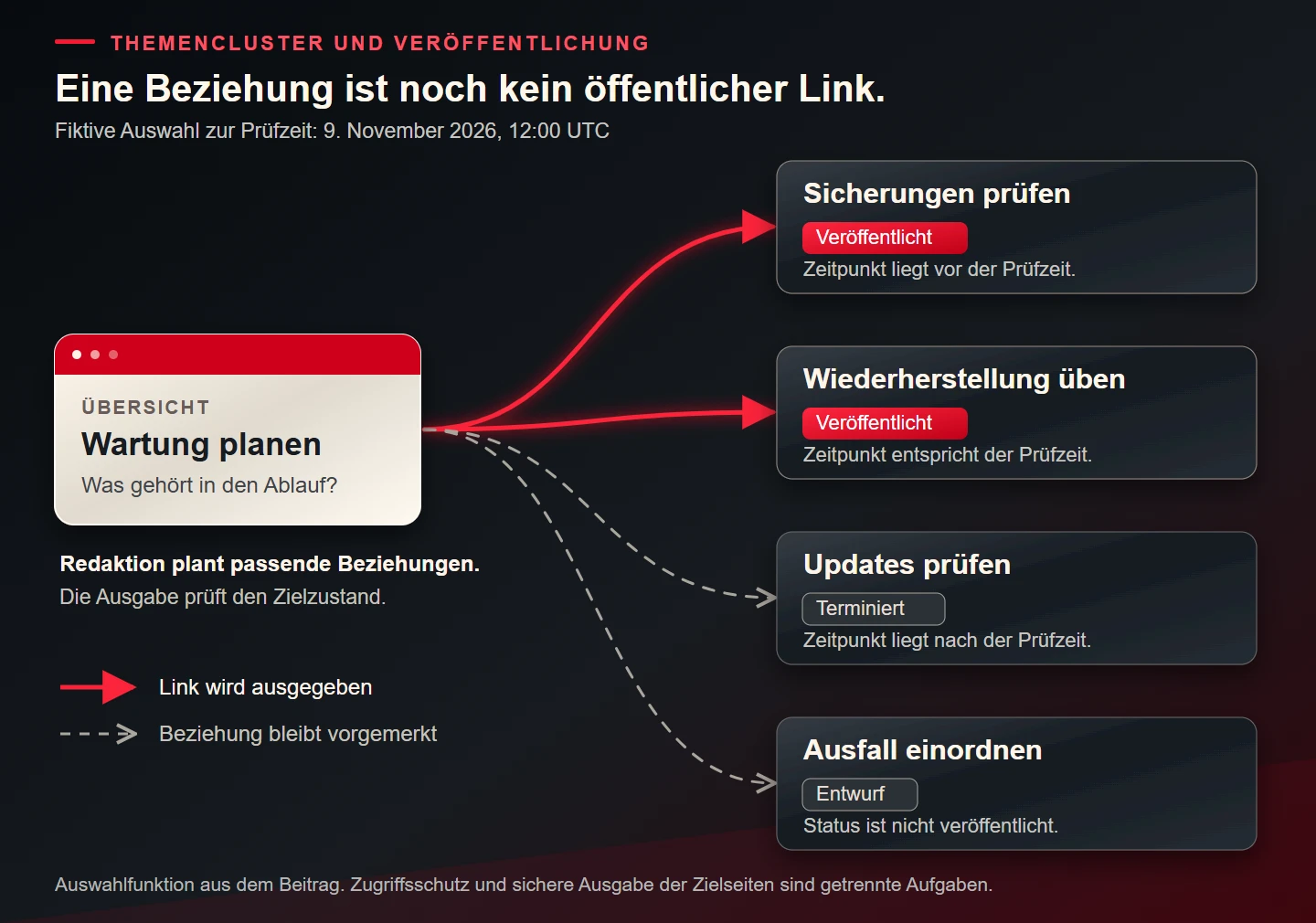
Separate public resources from drafts and scheduled topics. An editorial relationship can be planned before both texts are published. That does not require immediately displaying a public link. This distinction matters particularly when a large series appears over time. Publishing the relationship should not accidentally precede publication of the destination it promises.
Also record who maintains the underlying expertise. An article about restoration needs someone capable of assessing the described steps. Without that responsibility, a formally tidy cluster can become technically outdated. The inventory is therefore a working basis for future maintenance as well as a planning aid for new content.
A fictional website-maintenance cluster
| Resource | Main question | Distinct task |
|---|---|---|
| Plan maintenance | What belongs in a dependable process? | Overview and responsibilities |
| Review backups | What makes an existing backup useful? | Assess inventory and recoverability |
| Practise restoration | How do we check the way back? | Prepare a controlled exercise |
| Review updates | What is checked before and after a change? | Accept a change against business requirements |
| Assess an outage | What follows the first observed problem? | Clarify responsibility and reporting |
These five resources are an editorial construction for the example. The table claims neither that every business needs exactly five pages nor that this arrangement generates a specific search result. It makes the tasks distinct enough for individual links to have an understandable purpose later. A different publication might combine two tasks or need a separate specialist guide.
The overview must provide a useful answer in its own right. It is not an empty list pointing to detailed articles. It explains relationships, offers selection criteria and helps readers identify which next step suits their circumstances. Someone should gain orientation even if they do not immediately follow another link.
Express search intent as a substantive question
A phrase such as “website backup” can cover several intentions. One person seeks a service provider, another wants instructions and another is assessing an existing backup. A complete question is more useful for planning than an isolated keyword. Add the situation and desired outcome so the intended answer becomes specific enough to review.
“Which activities belong in a maintenance agreement?” differs materially from “How do we restore a saved dataset in a controlled trial?” That distinction justifies separate resources more convincingly than slightly rearranged versions of the same phrase. The difference should remain visible in the actual drafts rather than being asserted only in their metadata.
Google's people-first content guidance emphasizes usefulness for the intended audience. Our planning question is whether the reader can make a previously unresolved decision better after reading. A high concentration of matching terms does not substitute for that answer. Each proposed article should have a reason to exist beyond occupying another search phrase.
Let the overview and detailed articles complement each other
The overview explains relationships at a suitable depth. It need not include every restoration step. It should nevertheless explain why having an archive and having verified restoration are different things. Only then does the detailed article become a meaningful next destination. The link follows from the explanation instead of interrupting it with a disconnected recommendation.
The detailed article starts with its actual task and necessary prerequisites. It can link back to the overview without reproducing the entire introduction. This creates independently understandable resources with deliberate transitions. A visitor entering directly from search should not need to read three other pages before understanding what the detailed guide is trying to help them do.
Use shared terminology consistently. If the overview calls an operation a “test restoration”, the detailed guide should not unexpectedly rename it “emergency migration”. Different terms can describe genuine technical differences. They should not be introduced merely to create superficial linguistic variety. Consistency makes it easier to recognize the same concept across the cluster.
Give each internal link a reason
A contextual link answers a likely next question at the point where it appears. In an update guide, the rollback section can point to practising restoration. The link explains how readers can establish the prerequisite just mentioned. A random reference to a general design trend would have no comparable purpose in that passage.
Google's official link guidance describes crawlable links and descriptive anchor text. It also recommends making important pages reachable from other pages on the same site. This does not specify an ideal fixed number of links for every paragraph. An individual reference still needs to be useful and understandable.
Add a short reason to the internal inventory for each important relationship. “Explains how to check the rollback prerequisite” is more concrete than “SEO link”. The reason helps when content is shortened or reorganized later. If the target changes its purpose, the team can reassess whether the relationship still works instead of preserving it automatically because the URL continues to respond.
Make anchor text clear and technically usable
Anchor text should indicate the information waiting at the destination. “Check restoration of a backup” is usually more informative than “click here”. It must still fit the sentence. Forcing a long collection of search terms into the anchor worsens the passage and does not automatically make the relationship more helpful.
For ordinary navigation, an actual link with a destination address provides the right foundation. A clickable area styled to look like a text link but lacking href has a different technical implementation. Inspect the rendered content instead of relying exclusively on an editorial interface. Automatically generated cards and related-article sections can produce different HTML from what their visual editor suggests.
<p>Before an update, establish how to
<a href="/knowledge/check-backup-restoration">
check restoration of a backup</a>.</p>
The address in this code is an invented planning destination. Before using such a link in a real publication, suitable public content must exist there. Review the sentence and anchor together. The promised task should be answered at the destination rather than merely appearing in its title or category.
Check reachability without inventing rigid click rules
An important resource should not be reachable only through internal search or a long accidental archive sequence. Examine which meaningful starting points lead to it. An overview, relevant service page and related expert article can each play a different role. The useful route depends on how a visitor encounters the subject.
Google's SEO starter guide discusses logical organization. It does not establish a universal obligation to place every article exactly three clicks away. A short path can be practically useful, but distance alone explains neither a page's significance nor the quality of the journey to it.
Exercise concrete tasks. Where does someone start if they know only the maintenance overview? How does a reader of the update guide find the prerequisites for rollback? These journeys expose missing connections more effectively than a metric that treats every link as equally useful regardless of whether its wording and placement make sense.
Separate planned relationships from displayed links
In an ongoing series, a published article may already have a planned relationship with a future topic. Keep that relationship in editorial data. The public output must additionally respect actual publication state and time. This avoids reconstructing every intended connection from memory later without showing readers premature links to unavailable material.
The small function below illustrates selection from trusted example records only. It excludes unknown destinations, self-links, duplicates and items that are unpublished or scheduled for later. It does not replace access control at the destination or safe HTML rendering. Titles and addresses must originate from the checked content system rather than arbitrary user input.
function relatedLinks(sourceId, pages, relations, now) {
  if (!Number.isFinite(now)) throw new TypeError('Ungültige Prüfzeit');
  const byId = new Map(pages.map(page => [page.id, page]));
  const selected = new Set();
  return relations
    .filter(link => link.from === sourceId)
    .map(link => byId.get(link.to))
    .filter(page => {
      if (!page || page.id === sourceId || selected.has(page.id)) return false;
      const release = Date.parse(page.publishAt);
      if (page.status !== 'published' || !Number.isFinite(release) || release > now) return false;
      selected.add(page.id);
      return true;
    })
    .map(page => ({ id: page.id, title: page.title, url: page.url }));
}
The check time is passed as a number so the same inventory can be tested against a fixed instant. The example publication values explicitly include a time zone. A real application should use server time and its central publication rule. Two independently maintained definitions can otherwise produce contradictory public states even when each function appears reasonable on its own.
What the example checks actually establish
The accompanying experiment executes the function extracted from both language editions against an invented inventory. It includes a currently available target, a future target, a draft, an invalid date and an unknown reference. A repeated relationship must appear only once. This verifies selection behaviour rather than any effect on search performance.
A technically valid relationship is not necessarily a good editorial recommendation. The function cannot establish whether the destination convincingly answers the promised question. That remains an editorial judgment. Automation is useful here for reliably applying clearly defined states and exposing suspicious records, not for proving relevance from a shared tag.
For larger inventories, an additional report can identify isolated pages or references to deleted identifiers. It should not automatically create links in bulk. A list of questions needing review is more useful than an artificially complete network with no understandable transitions. The content owner can then decide where a missing connection actually belongs.
Improve existing articles deliberately
A new specialist article often creates an opportunity to improve suitable older resources. Read the entire old passage first. Add the reference where the new detail answers an existing question. An extra generic paragraph at the bottom is not always the best location, especially when readers need the explanation much earlier in the task.
At the same time, check whether the original statement remains accurate. A new link should not merely decorate an outdated or overly broad instruction. Sometimes the sentence needs substantive revision before the connection becomes useful. Record the content change and explain why the new destination fits. That record helps distinguish editorial improvement from indiscriminate link insertion.
Automated related-article selection can supplement this work but does not replace it. Shared categories provide a coarse signal. They do not guarantee that the next text advances the particular task. Important resources deserve explicitly maintained relationships with identifiable reasons, especially when a series spans several technical and legal subject areas.
Distinguish related pages, duplicates and overlap
Two pages can address the same broad topic while answering different questions. That does not automatically make them duplicates. Compare their primary task, audience and required information. When those characteristics barely differ, combining the resources may be more useful than adding another link between almost identical texts.
Google's canonicalization documentation concerns identical or very similar variants. Canonical is not a mechanism for pointing every distinct detailed article at a cluster overview. Doing that would incorrectly treat different answers as alternative versions of one page. Editorial hierarchy and duplicate handling address different problems.
For a genuine consolidation, plan suitable redirects and existing references together. Do not remove an old resource merely because a newer headline sounds more modern. Assess whether its independent task is still needed and whether the new destination actually takes over that task. Preserve useful distinctions rather than reducing page count as an end in itself.
Control categories and filters deliberately
A category can provide a helpful entry point when it groups an understandable subject. It is not automatically a strong cluster overview. An unexplained unordered list gives limited support for a substantive decision. Where appropriate, add orientation and a sensible sequence of central resources so readers can recognize which answer they need.
Combined filters can generate many technical address variants. Google's faceted-navigation guidance explains potential crawling and resource implications. Our small example does not need an independent editorial landing page for every combination of year, keyword and category. The decision should follow the usefulness of the particular selection.
Separate the value of a visitor-facing filter from the question of which variants should be independent search destinations. This prevents automatically generated archive pages from quietly taking over the content strategy. The substantive resource remains the centre of the cluster, while filters serve the navigation task they were designed to support.
Consider SEO and AI search without extra promises
Google's documentation for AI search features does not specify additional special optimization requirements for AI Overviews or AI Mode. Foundational requirements for discoverable useful content remain relevant. This does not guarantee that a particular article will be selected as a source.
For editors, the practical task is to make claims understandable, explain terms and link suitable primary evidence. A direct opening helps readers. A table can make decisions comparable. Those choices should answer the actual question rather than mechanically satisfy a supposed formula for being cited. A well-structured passage must still be accurate and relevant.
Google also determines sitelinks automatically. A clear structure is useful without making a specific search presentation something the publisher can order. Report the orientation improvements implemented and any observed outcomes separately. Do not claim control over how another system will ultimately select or display the material.
Choose an appropriate maintenance action
| Observation | Editorial question | Possible action |
|---|---|---|
| Important page lacks suitable references | Where does its main question arise? | Add a contextual entry point |
| Two nearly identical answers | Are there genuinely two tasks? | Differentiate or consolidate deliberately |
| Destination changed | Does the existing promise still hold? | Review anchor and context |
| New article scheduled | Which relationship is already planned? | Record it, display after publication |
| Many filter variants | Which selection is independently useful? | Review archive and crawl strategy |
Prioritize actions by concrete usefulness. A missing transition in an important guide can matter more than distributing internal links evenly across the inventory. Also preserve readability. A paragraph with nearly every second word linked does not automatically guide people more effectively through a subject. A clear next step is often more useful than several competing destinations.
Assess success with suitable observations
Before editing, define what should improve for readers. Perhaps someone should be able to choose the right procedure after reading the overview. Perhaps an existing specialist page should gain a meaningful entry point. These are reviewable expectations for content. Later changes in search traffic may also be interesting, but they do not by themselves establish the cause of a trend.
Record when the change occurred and which pages were affected. Afterwards, check whether links work, deliver their promised task and remain understandable on smaller screens. If content, navigation and release cadence changed together, report that context. This produces a defensible account of the work without prematurely attributing every new observation to the cluster structure.
Checklist for the next cluster
- The overarching visitor task is described in one sentence.
- Every proposed resource answers a distinct recognizable question.
- Existing answers were reviewed before new drafts were commissioned.
- The overview provides useful content itself.
- Each central link has a concrete editorial reason.
- Anchors announce the information actually found at the destination.
- Important public resources are meaningfully reachable.
- Planned relationships do not display premature public links.
- Relevant older articles are checked and improved substantively.
- Maintenance responsibility and reassessment are defined.
Frequently asked topic-cluster questions
Must every detailed article link to every other one? No. Choose connections based on the next useful question. A fully connected network is not an editorial quality target. Each relationship should help the reader do something understandable.
Does a cluster need a special technical extension? Useful information and ordinary working links are the foundation. A content model can simplify maintenance. It does not replace substantive planning or prove that all suggested relationships are relevant.
When is the structure good enough? When the important tasks are answered independently and readers can reach the appropriate detail from understandable context. Exercise those journeys with concrete examples and improve the gaps you actually observe.