Recognising search intent and planning useful content
A practical route from search questions and supporting evidence to an appropriate page format, with decision tables and a briefing counter-check.

A query is not yet a complete editorial assignment. “Ventilation maintenance” may come from someone trying to understand the process, find a provider or prepare documents for an existing appointment. The same few words can hide different tasks.
This guide develops a practical planning method. Search phrases and business scenarios are teaching examples. No real search volumes or customer account analysis are claimed. The method makes assumptions explicit and helps plan useful pages rather than collections of keywords.
1. Move from wording to a possible task
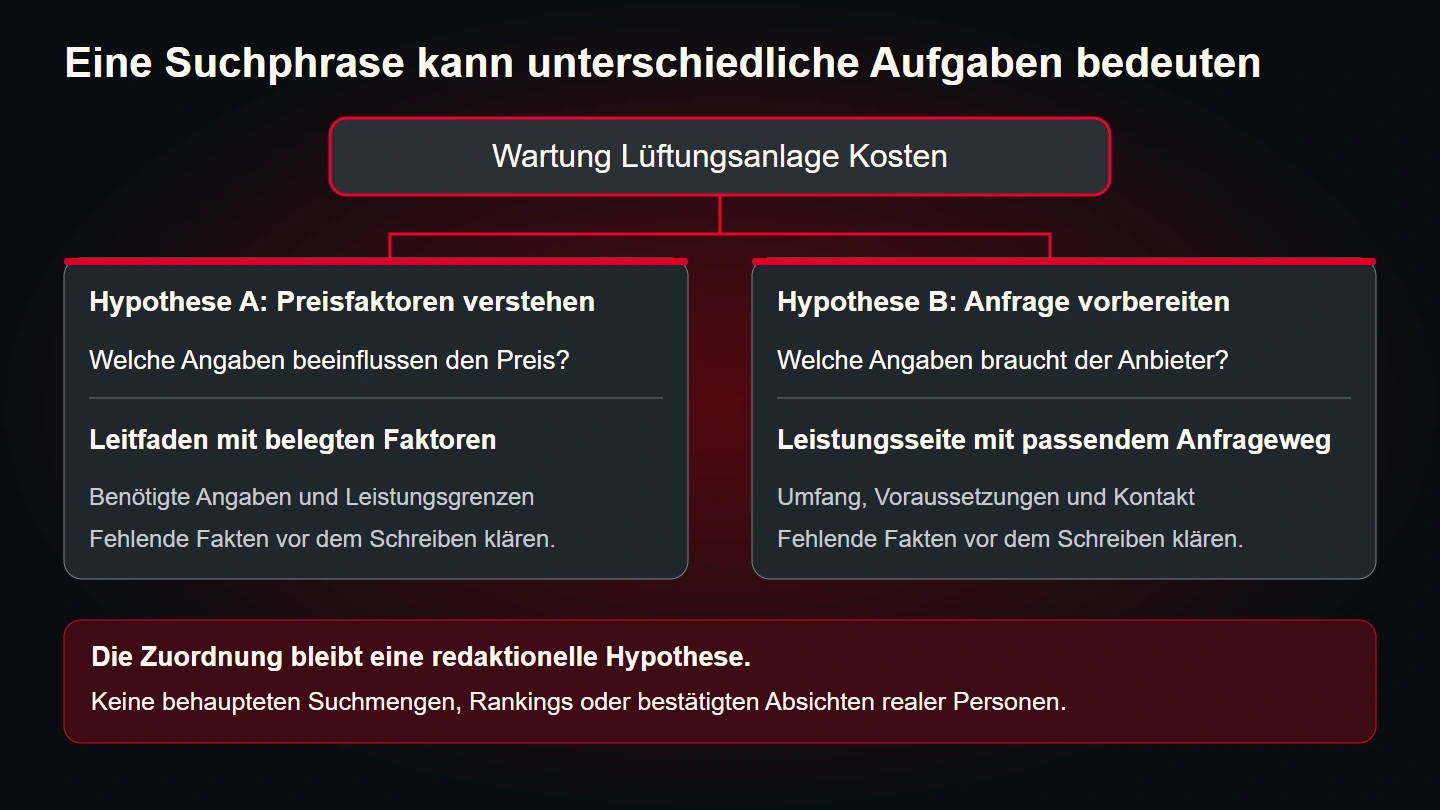
Write down the phrase and a possible first-person task. For “ventilation maintenance cost”, that might be: “I want to understand pricing factors before making an enquiry.” This is more precise than requesting a page containing many cost-related words.
The interpretation initially remains uncertain. A few words cannot establish someone's full motivation. If several tasks are plausible, record them side by side. Only then decide whether they share a useful answer or require distinct content.
Consider prior knowledge. A specialist purchasing manager may need specific service boundaries. Someone without technical experience may need an introductory explanation first. One page can support both when its structure provides different levels of detail sensibly.
Google's SEO Starter Guide connects discoverability with understandable, useful information. In planning terms, define the answer people need before refining wording and technical discoverability.
2. Use a simple organising model
The following categories are an editorial aid, not a claimed view inside a search algorithm or a complete classification of every search. They help prevent different tasks from being forced into the same content format unnoticed.
| Possible task | Illustrative query | Useful response format |
|---|---|---|
| Understand something | How does system maintenance work? | A guide explaining process and limits |
| Find a known destination | Example company contact | A clear contact or company page |
| Compare options | Maintenance contract or single visit | A reasoned comparison with prerequisites |
| Start an action | Request maintenance in Braunschweig | A relevant service page and enquiry route |
A query can combine tasks. Cost questions often involve both explanation and comparison. A location may suggest a provider search or accompany a general information need. The table exposes these distinctions rather than creating artificial certainty.
For each category, ask what would be missing if a different page type were offered instead. An immediate contact request does not explain pricing factors. A long introductory guide may obstruct someone who only wants the phone number of a known business.
3. Gather available clues
Customer questions, conversations, existing search data and feedback can provide evidence. Which terms do people actually use? Which prerequisites do staff repeatedly explain? Which questions remain after someone visits a service page?
Separate observations from assumptions. A question recorded in a real conversation differs from a possible query invented by the editorial team. Both can help planning, but should not receive the same evidential weight.
Existing search results provide another perspective. At the time of a particular check, which page types appear: guides, providers or product pages? That observation concerns a specific context. It does not automatically establish every searcher's motivation.
Record the date and conditions of such a review. Results can vary by location, device and other circumstances. One search offers a clue for further questions rather than conclusive proof of which content format will succeed.
4. Read search data within its limits
Where suitable Search Console data exists, examine queries and destination pages together. The official performance report documentation explains clicks, impressions and grouping by queries or pages.
An impression does not establish that the underlying task is fully understood. A click does not prove that a question was answered. These measures describe part of observed search activity and should be connected to actual page content and other feedback.
Compare appropriate periods and segments. Seasonality, new content and a different query mix can influence changes. A whole-site figure can conceal a development on one service page. Start an analysis with a specific question rather than an undirected inspection of numbers.
Do not fill missing evidence with invented volumes. State a testable hypothesis and plan later review instead. A clearly identified customer problem can matter even before reliable search statistics are available.
5. Choose the right page, not merely some text
The reader task suggests a suitable page. Service descriptions explain scope and prerequisites, guides explore questions, comparisons need meaningful criteria and contact destinations should make the intended action easy to reach.
For the fictional cost question, an explanation of confirmed pricing factors may be more useful than an unsupported fixed price. It can identify information needed for an estimate. It must not invent numbers simply because the query asks about cost.
One page can address related subquestions when that improves understanding. Independent offers or substantially different decisions should not be forced together merely because their wording overlaps.
Review existing content before creating another page. The question may already have an answer that needs clearer organisation. Another near-duplicate can increase maintenance without offering identifiable additional value.
6. Derive a concrete editorial brief
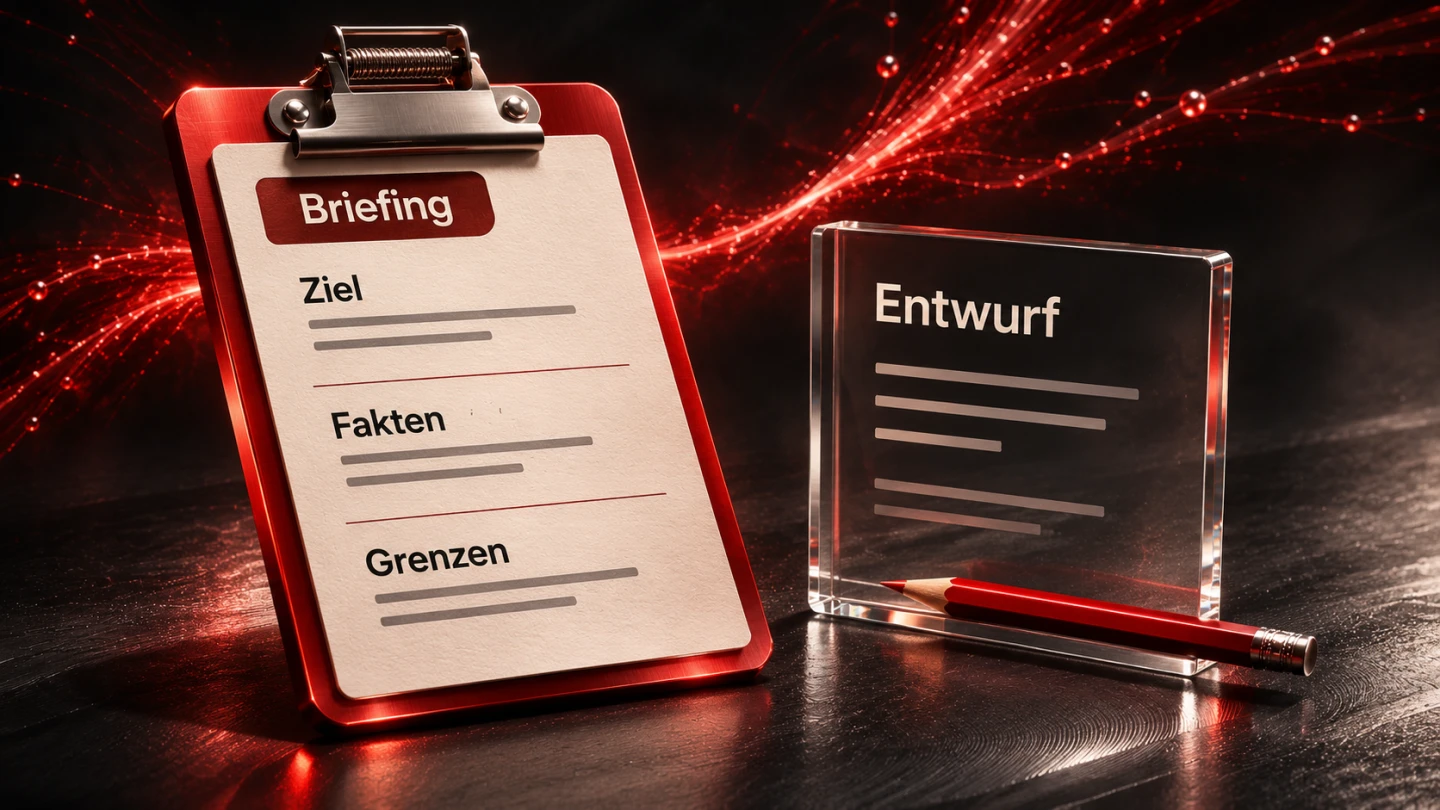
A brief connects the phrase, proposed task, factual foundation and intended answer. The following is an original planning format, not a technical schema search engines require. It makes the editorial decision explicit before drafting.
{
  "working_query": "ventilation maintenance cost",
  "reader_task": "Understand pricing factors before an initial enquiry",
  "page_type": "Guide connected to the service",
  "required_answers": [
    "Which information is needed for an estimate?",
    "Which services are actually described?",
    "How can a suitable enquiry be prepared?"
  ],
  "must_not_claim": [
    "Unsupported fixed prices",
    "Guaranteed immediate availability"
  ],
  "review": "Confirm service facts before publication"
}
It deliberately contains neither an invented volume nor an assumed position. It describes the task. Responsible specialists add confirmed information and sources, after which an editor or AI-assisted workflow can produce a draft.
A useful outline answers the main question early and organises detail afterwards. A long introduction about general corporate values may do little for a specific cost question. That information can matter elsewhere without displacing the answer sought here.
7. Connect the main answer to its conditions
A concise opening answer supports orientation, but must not omit prerequisites. In the cost example it might explain that an estimate needs equipment type and scope. The relevant business must confirm which factors actually apply.
Subsequent sections explain confirmed factors and useful enquiry information. Distinguish general explanation from an actual offer. An editorial example is not a binding quotation.
Tables also need clear premises. Comparing a maintenance agreement with a one-off visit can help if scope and criteria are established. Declaring a universal winner without that foundation would distort the decision.
Quality includes making a claim's boundaries understandable. A precise limited answer can be more useful than a very simple general assertion. Clarity does not require removing important distinctions.
8. Align title and introduction with the task
A page title should accurately introduce its content. A promise to explain pricing factors should be fulfilled. A dramatic title containing an unsupported number may create an expectation the page cannot meet.
Google's official title link guidance discusses concise, distinguishable titles and notes that Google determines its own display. Maintaining a title is an important editorial action, not a guarantee of identical search presentation.
The opening should recognise that expectation. If the first screen contains only generic promotion, the link with the query can be lost. A brief orientation, clear main heading and early substance help visitors understand whether they found the right page.
The meta description should also explain actual value. A list of similar phrases does not replace a comprehensible summary. Agreement between title, description and content supports an informed visitor choice.
9. Plan connections between different tasks
People may move from one task to another while researching. After an explanation they may want to compare options or enquire. Useful internal links connect those stages without turning every educational section immediately into a sales request.
| Starting content | Useful next detail | Reason |
|---|---|---|
| General maintenance process | Preparing an enquiry | Make the explanation practically usable |
| Comparison of service forms | Actual service scope | Check the decision against the real offer |
| Service description | Required details and contact | Make a relevant enquiry easier |
| Known company search | Unambiguous contact information | Reach the intended destination directly |
These connections need understandable labels. “Prepare an enquiry” describes a destination better than repeated “More” links. The destination must then fulfil that expectation. A remotely related article is not automatically a useful continuation.
Consider direct entry too. A guide may be opened straight from search. It should clearly belong to the organisation and journal without requiring prior knowledge of the home page. Navigation and appropriate return paths support that orientation.
10. Prioritise value and evidence
The largest assumed search volume is not automatically the best first subject. A broad phrase may combine many tasks. A specific question can matter more to the business when it resolves a common uncertainty before relevant enquiries.
A practical prioritisation considers reader need, relevance, available evidence and the effort required for a good answer. It avoids choosing only because a keyword looks attractive. Specialist subjects require an editorial capability to deliver the necessary quality.
Record missing prerequisites. A reliable comparison may need updated service details, while another article can already use confirmed information. The order then follows evidence rather than a superficially precise but unsupported score.
Include maintenance. A lasting explanation needs different updates from a price or version comparison. Choosing a topic therefore also means deciding who notices changes and revises the content later.
11. Review the hypothesis after publication
Observe whether the page appears for expected questions and what actual usage feedback suggests. Do people continue asking something important? Do relevant enquiries arrive? Such clues can support or change the initial task hypothesis.
A change in clicks or impressions does not automatically have one cause. New material, changing demand and different search presentations may contribute. Avoid turning one before-and-after figure into a universal success claim.
If the page attracts different questions, review its title, content and context first. The task may be broader than expected or the wording may promise the wrong thing. Adding another keyword does not necessarily resolve that uncertainty.
Record the conclusion and a targeted revision. Across several pieces, this creates a learning editorial process rather than a plan whose assumptions are never reconsidered after publication.
12. Counter-check the proposed answer
A simple review can help before writing a long page. Show the proposed query, title and short content description separately to someone unfamiliar with the draft. Ask what answer they expect from each. Differences may reveal an unclear plan.
In the cost scenario, a title might suggest a fixed price while the outline covers only general pricing factors. Either content type can be useful, but the promise should match the answer. Clarify the title or obtain the reliable information that is missing.
Also check whether another page already solves the task. Different wording alone does not create a distinct topic. If two pages explain the same prerequisites, process and next action, one careful revision may be more useful than another copy.
Record specific uncertainties. “The person does not find the page convincing” is vague. “They expect a regional provider overview but receive a general process guide” identifies a mismatch that supports an editorial decision.
One qualitative check does not represent every searcher. It provides clues about possible misunderstandings. Add other suitable perspectives for important decisions and keep conclusions proportional to the evidence actually available.
Put the result back into the brief. A changed task hypothesis requires title, opening and link destinations to agree again. Otherwise the new text carries an old expectation elsewhere. Implement a clear decision consistently across affected parts.
This is especially helpful with AI-assisted drafts. A model can produce convincing prose for an unclear task. More wording variants do not resolve that problem. The editorial team must first decide which specific answer it will provide.
Distinguish known-brand queries from general technical questions in later analysis too. Someone looking for a particular organisation starts elsewhere in the journey. A changing mix should not automatically be interpreted as success or failure of a new guide.
Keep confidence in the topic separate from confidence in the facts used to answer it. A repeated customer question may provide strong evidence that the topic matters, while the organisation still lacks verified pricing information. The first observation does not establish the second. The editorial response is to obtain the missing facts or explain confirmed factors within their actual limits.
This distinction also helps when several teams contribute. Search analysis can identify likely needs, service specialists confirm what the business offers and editors organise the answer. None of those roles should silently substitute for another. A popular phrase does not authorise a new service promise, and a technically accurate fact does not by itself establish that it answers the intended reader question. Record both decisions in the brief so later revisions preserve the relationship between need and evidence.
13. Topic-decision checklist
- Query and proposed reader task are recorded separately.
- Ambiguous tasks have been considered explicitly.
- Observed clues are distinguishable from assumptions.
- Search data is read with appropriate timeframe and scope.
- The page format suits the required answer.
- Existing content was reviewed before creating another page.
- Confirmed facts and boundaries are available for drafting.
- Title, description and opening promise the same topic.
- Internal links support useful next tasks.
- Maintenance and later hypothesis review are planned.
Common questions
Does every query have exactly one intent?
No. Several tasks can be plausible. Classification is a working hypothesis to examine using appropriate evidence.
Does every similar word need another page?
No. When the task and answer are the same, a well-structured shared page may be more useful. Distinct tasks need appropriate boundaries instead.
Does matching intent guarantee ranking?
No. It supports useful planning, while technical discovery, quality and other considerations remain relevant. It does not promise a position.
Sources and related reading
Checked on 9 November 2026: the linked official Google documentation on SEO foundations, Search Console performance and title links. Queries, the task model and planning schema are original teaching examples without claimed real volumes.
The wider page context is explored in What a professional business website needs to achieve. For the changing search environment, read SEO in 2026: Google and AI search visibility.