Creating a useful brief for AI-generated text
From reader needs to factual review: specify AI writing assignments clearly and assess drafts against reliable criteria.
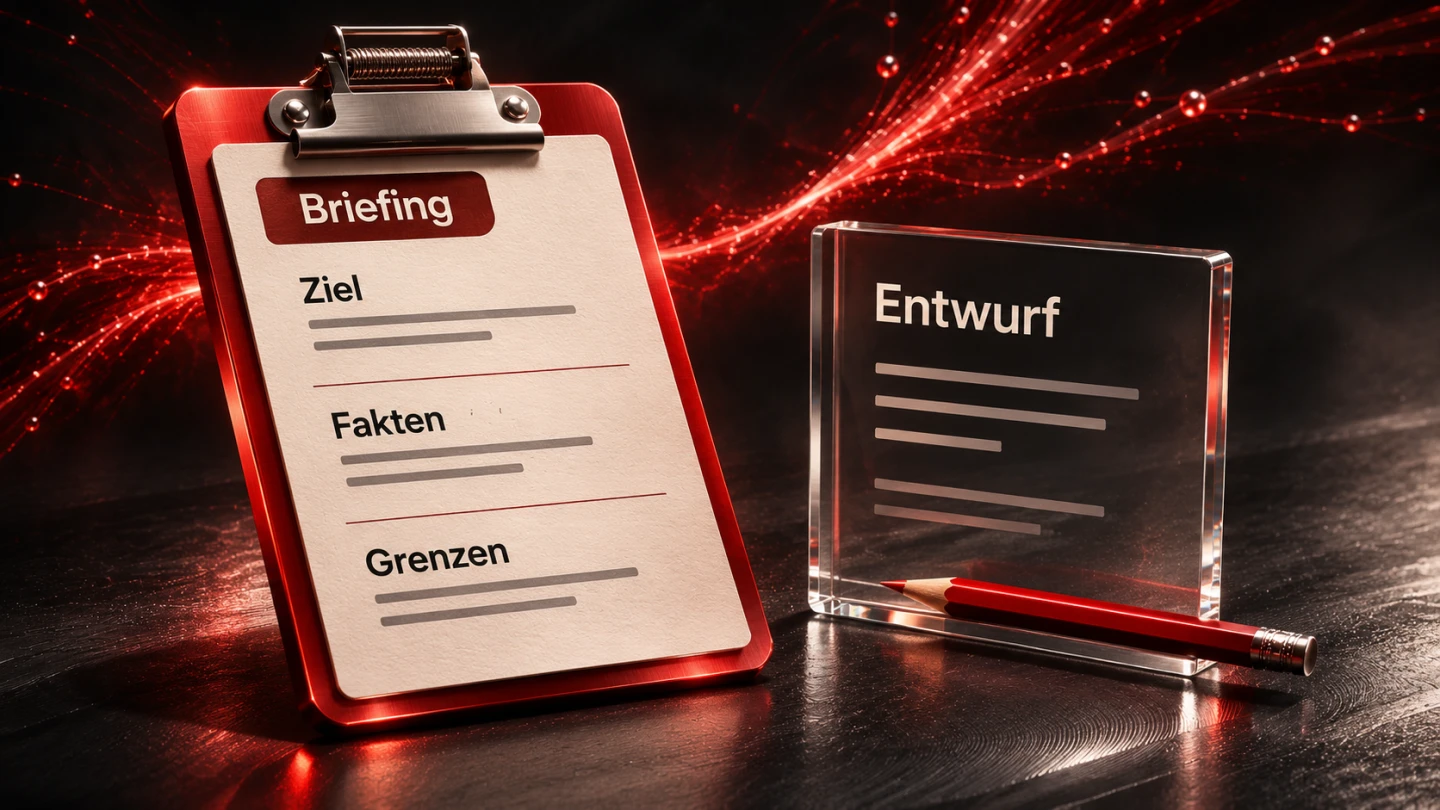
“Write a professional text about our company” leaves much unspecified. A model has to infer the audience, relevant service and claims that actually hold true. Fluent wording can conceal those gaps. A useful brief is therefore more than a collection of impressive style adjectives.
This guide develops a reusable approach for business content. A fictional maintenance company provides the running example. Every example fact is explicitly supplied. The sample wording is editorial teaching material, not a claimed test of a particular model or an actual customer's statement.
1. Begin with the reader's task
Useful content supports a specific question or decision. For the maintenance company, a commercial property manager might need to determine whether their ventilation system is supported and what information an initial enquiry should contain. That task informs content and sequence.
“More visibility” is an understandable business objective, but does not say what one page must answer. Demographics alone are insufficient too. Situation, prior knowledge and the unresolved decision matter. People of the same age can need entirely different information.
The GOV.UK guidance on user needs starts with what people are trying to accomplish. A practical question for a business brief follows: what should someone understand or be able to do after reading?
Write the answer in one sentence. Resolve disagreement about that sentence before drafting. Otherwise three convincing versions may solve three different tasks, leaving selection to personal taste rather than an informed content decision.
2. Separate facts, assumptions and open questions
A model needs an identifiable factual foundation. A list of desired benefits does not provide one. Which services are actually offered, where do they apply and what prerequisites exist? Which statements are supported and who confirmed them? Answer these questions during preparation.
| Information type | Fictional example | Treatment in the brief |
|---|---|---|
| Confirmed information | Commercial ventilation maintenance | May be stated as a service |
| Boundary | No continuously staffed emergency service | Do not imply that availability |
| Open question | The exact geographic service radius | Resolve before publication |
| Aspiration | More relevant initial enquiries | Treat as an objective, not an established outcome |
This distinction also prevents accidental promises. “Fast help” can sound harmless while creating a response-time expectation. If no commitment exists, ask the brief to describe the actual process instead.
Collect unresolved information in an internal questions list. It does not have to become public placeholder text. The published page should contain adequately established statements. Drawing that boundary before release is part of editorial work.
3. Specify channel, scope and function
A service page, newsletter and short social post have different constraints. Name the actual format. For a web page, its relationship with navigation, neighbouring pages and contact matters too. An isolated text can repeat information or omit prerequisites needed in context.
Length limits provide orientation rather than completeness. An exact word count does not guarantee an adequate answer. Five clearly defined information blocks may matter more for the maintenance page than reaching a precise character count. Specify required information before a sensible length range.
Include the expected next action. Should readers use a checklist, compare services or prepare an enquiry? A generic contact request is not automatically appropriate after every explanation. The brief should describe why the proposed next step helps at that point.
For a series, define the difference from existing articles. Each new piece should have its own task and connect relevant detail. Repeating a general introduction with different keywords adds little practical value and makes later maintenance harder.
4. Make language rules concrete and testable
“Modern, premium and emotional” can mean many things. Translate those wishes into observable characteristics such as clear paragraphs, specific verbs, explained terminology and no unsupported superlatives. These instructions support a more focused revision.
A short positive example often communicates more than a long prohibition list. An explicitly unsuitable version can illustrate what to avoid alongside it. Both should fit the actual brand. Do not simply adopt another organisation's text as a style to imitate.
Specify forms of address, terms and spellings. Is a product name always written the same way? Is a technical label required? Which words would readers themselves use? A maintained glossary helps multilingual content describe the same service consistently.
The official Anthropic guidance on clear instructions and examples discusses related prompting principles. The editorial framework here is our own working aid, not a promise that every model will deliver the same publication-ready result without review.
5. Use a compact briefing template
This template separates the assignment, supporting information and quality review. It is deliberately provider-neutral. Include information needed for the specific task. Use confidential material only after the organisation has established the intended handling arrangements.
ASSIGNMENT
Draft [specific format and publishing location].

READER TASK
[Who needs which answer, in what situation?]

OBJECTIVE
After reading, [verifiable understanding or next step] should be possible.

CONFIRMED FOUNDATION
- [Fact with source or internal confirmation]
- [Fact with its scope]

BOUNDARIES AND OPEN ITEMS
- Do not invent services, prices, results or quotations.
- Place missing information only in a separate questions list.
- Do not add unsupported claims to visitor-facing text.

STRUCTURE AND LANGUAGE
[Required sections, address, terminology and positive examples]

OUTPUT
1. Outline
2. Draft
3. Claims to verify with their origins
4. Open questions

REVIEW CRITERIA
[Facts, completeness, clarity, format and boundaries]
The questions list is not an invitation to create arbitrary uncertainty. It distinguishes necessary missing information from established facts. A complete brief may produce a very short list. Unnecessary questions should not replace useful work.
Shorten the template for routine tasks. Revising one paragraph does not require every field to be restated at length. Refer to valid shared language rules and describe the particular change. The relevant context must actually be available to the tool receiving the assignment.
6. Bound the maintenance example completely
Our teaching example has these fictional facts: the company maintains commercial ventilation systems, checks enquiries before making a binding commitment and needs a location, equipment type and short problem description. No price or guaranteed response time has been supplied.
An appropriate objective is to help the responsible person understand the offer and prepare an enquiry containing those details. The draft must not promise immediate repair or guaranteed availability. It should not pretend to complete a technical diagnosis either.
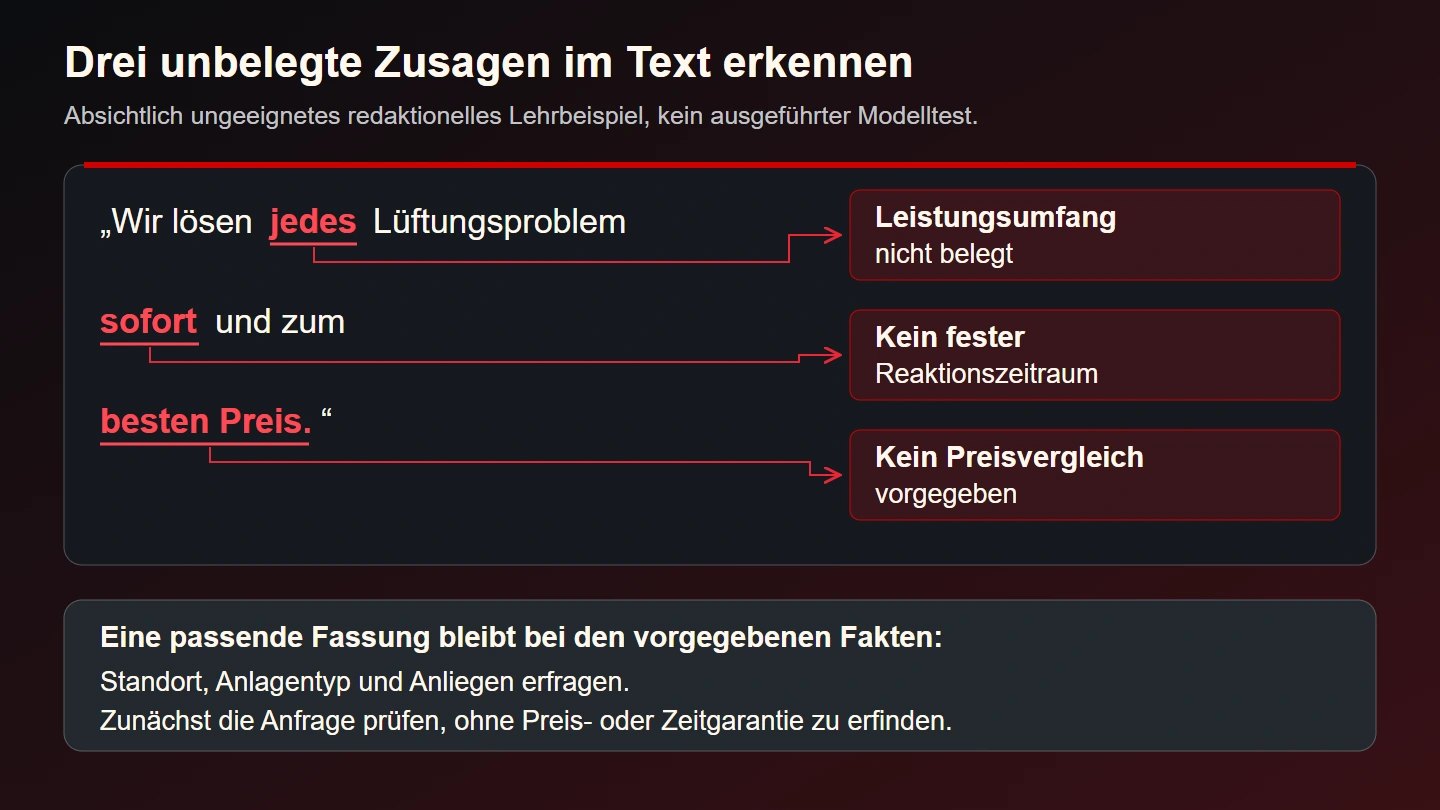
Deliberately unsuitable editorial example: “We solve every ventilation problem immediately and at the best price.”
This version includes several unsupported claims. “Every” expands the scope, “immediately” creates a timing promise and “best price” implies an unsubstantiated comparison. The problem is more than tone: the wording changes the offered commitment.
Possible editorial version: “Need support with a commercial ventilation system? Tell us the location, equipment type and issue. We first check whether the task fits our service scope and what further information is needed for the next discussion.”
The second version stays within supplied information. It is one possible solution to the task, not an automatically approved model result. A real business would still need to confirm the facts and process before publication.
7. Organise sources as working evidence
A source list without claim-level relationships is often insufficient for specialist content. Which source supports which statement, is it current and is it original evidence or a summary? A brief can establish those connections through a small evidence table.
Internal business information also needs responsible confirmation. An old quotation or earlier draft is not automatically the current service definition. Resolve conflicting documents before publishing. A model should not simply choose whichever version sounds most attractive.
Prefer original sources for external technical information. Keep facts, conclusions and examples distinguishable. An original illustrative scenario can be useful, but must not look like a documented real case. Quotations need verified wording and traceable origins.
Editorial checking must inspect the sources themselves. A plausible address or confidently formatted reference is not evidence. This is especially important for automatically generated citations. The brief should therefore define a checking process rather than merely requesting many references.
8. Review with a small quality matrix
Assess drafts against criteria agreed in advance. The following is an editorial aid rather than a scientific quality instrument. Critical defects must not disappear inside an attractive average score. An invented price remains a publication defect even when the prose reads smoothly.
| Criterion | Specific question | Acceptance condition |
|---|---|---|
| Facts | Are service statements supported? | No unresolved central claim |
| Reader task | Does it support the intended decision? | The answer and next step are recognisable |
| Scope | Is a prerequisite missing? | Required information is complete |
| Language | Are terminology and address appropriate? | Agreed rules are followed |
| Promises | Were boundaries expanded? | No unsupported commitment |
| Format | Does it fit the intended location? | Structure and presentation are usable |
A useful assessment identifies the affected wording. “It does not feel premium enough” leaves much unclear. “The second paragraph promises an emergency service absent from the factual foundation” supports a specific correction. Distinguish a factual defect from a presentation preference.
9. Request focused revisions
After a first draft, do not necessarily restate the whole assignment. Identify what is already correct and what must change. This preserves valid foundations. A full rewrite may be appropriate when the draft fundamentally misses the reader task.
A focused follow-up might say: “Preserve confirmed service information. Reduce the introduction to the two points most relevant to an enquiry. Remove the unsupported response-time statement. Return the revised wording and a short list of factual changes.”
Recheck critical facts after each revision. A language change can accidentally alter scope, turning a conditional offer into a guaranteed service. Review against the valid brief rather than comparing only with the immediately preceding version.
Record final decisions outside transient drafts. Which facts are approved, which wording is used and who confirmed a specialist point? A clearly documented final state makes later updates easier and prevents rejected text from accidentally being published again.
10. Connect SEO with useful answers
Search terms can help identify audience language, but do not instruct the writer to repeat a phrase in every paragraph. Describe the actual search question and useful answer. A service page needs to do more than mention a keyword.
Google's guidance on helpful content prioritises usefulness and reliability for people. A practical editorial question follows: does this text provide a substantive original answer or merely an interchangeable summary?
A concise opening answer, clear terminology and traceable evidence also make information easier to reuse and cite. They do not guarantee preferential treatment by a search engine or AI system. A brief must not treat that hoped-for outcome as an established fact.
Titles and meta descriptions become meaningful when the actual page is defined. Both should introduce its topic accurately. An attention-grabbing title promising more than the page delivers creates false expectations. Metadata and editorial quality should agree.
11. Reuse the framework without making content interchangeable
A shared briefing framework avoids repeated organisational decisions. It should not give every piece the same opening and argument sequence. Reader tasks determine necessary sections. A guide and an organisational introduction require different emphasis.
Maintain common brand rules separately from the facts of one assignment. This allows a spelling rule to be corrected centrally without transferring another project's service information. Sources, customer material and technical claims stay associated with their own task.
A small approved example can communicate structure and tone for recurring content, but should not supply new business facts. Internally distinguish a style illustration from information approved as factual input. That distinction prevents many unintended transfers.
12. Check the brief before generating variants
A short counter-check can reveal gaps before many drafts are produced. Give someone unfamiliar with the subject only the brief. Ask them to explain the permitted offer, missing statements and intended next step. No model call is required for that exercise.
In the maintenance scenario, it should be clear that enquiries are checked first. If the reader expects an immediate binding repair commitment instead, the foundation is not explicit enough. The service-area question must also remain visibly unresolved rather than being quietly answered through attractive wording.
Then compare requirements with the review matrix. A brief requesting a price comparison without reliable comparison data contains a conflict. Correct the assignment or perform appropriate research. Do not let plausible figures stand in for missing evidence.
This check also exposes format conflicts. A short teaser cannot explain every technical prerequisite in detail. Divide the responsibilities sensibly: the teaser leads to a relevant detail page. State that relationship rather than forcing both tasks into an unsuitable space.
Record clarified changes in one place. A newly confirmed fact replaces its earlier open question so future drafts do not use contradictory versions. The brief becomes maintained working information while remaining as small as the task allows.
A useful final check is to list the draft's factual claims separately from its persuasive wording. For the teaching example, the permitted claims concern the service type, initial assessment and requested enquiry details. Attractive additions about guaranteed speed, prices or universal capability remain unsupported even if they sound plausible. This inventory makes the review more concrete than asking whether the whole paragraph feels trustworthy. It also gives a subject specialist a shorter set of statements to verify without requiring them to evaluate every stylistic decision.
13. Before-drafting checklist
- Reader, situation and task are identified.
- The desired result can be assessed in the text.
- Format, location and appropriate scope are specified.
- Confirmed facts are separate from assumptions and aspirations.
- Sources and internal confirmations are traceable.
- Service boundaries and prohibited promises are explicit.
- Address, terminology and positive examples are supplied.
- Missing information goes in an internal questions list.
- Review criteria also apply to later revisions.
- The final approved state has a clear home.
Common questions
How long should a brief be?
As detailed as the task requires. Existing verified context allows short additions, while a new specialist topic usually requires more foundation. Length alone is not quality.
Should the model receive a role?
A role can frame the assignment, but does not replace facts, audience or criteria. Calling it an expert does not make unsupported claims reliable.
Can AI write the brief itself?
It can help organise questions and structure. Business facts and real service boundaries must still come from suitable sources or responsible people.
Is the first convincing draft ready to publish?
Only after the intended factual and editorial review. Fluent language is part of quality, not evidence that the information is correct.
Sources and related reading
Sources checked on 9 November 2026: GOV.UK on user needs, Anthropic on clear instructions and examples, and Google Search Central on helpful content. The template, maintenance scenario and review matrix are original editorial aids.
The connection between content and visitor tasks is explored in What a professional business website needs to achieve. For practical context, read AI in practice: content and website maintenance for SMEs.