Defining brand voice and usable language rules
From underlying attitude to practical editorial decisions, with examples and a bounded automatic word check.

A business may sound factual on its service page, excessively excited in a confirmation and technically dismissive in an error. Each text might be intelligible while the collection creates inconsistent expectations. A shared brand voice connects these touchpoints without requiring every message to sound identical or perform the same task.
This article uses a fictional provider of appointment-management software. It wants to communicate clearly, considerately and accurately. Examples describe capabilities, responses and errors. They are editorial proposals without claimed customer outcomes. A small JavaScript example also demonstrates a bounded responsibility that an automatic word check can perform and test.
1. Distinguish voice from situational tone
Voice describes a recognizable underlying attitude. Tone responds to the particular situation and the reader's circumstances. A provider can remain clear and respectful while describing success differently from data loss. Uniform enthusiasm would not necessarily create appropriate consistency across those situations.
Mailchimp's published guidance explicitly distinguishes voice and tone for its own communication. Microsoft's style guidance also describes a stable voice with tone adapted to context. These are examples of a working approach. Their individual personalities are not imported as requirements for this fictional business.
The example retains one attitude across states: explain specifically what is possible and what happens next. During a problem, the wording becomes calmer and more useful. A success message may be friendly but should not claim a later state the application has not reached. Recognizability comes from that consistent relationship with the reader.
2. Collect the actual reading situations
Before selecting characteristics, collect important text situations: an offer, input guidance, confirmation, error, schedule change and personal response. Each has a different job. A promotional heading helps people understand relevance, while an error needs to make correction possible during an interrupted task.
Use categories grounded in real business work. Do not copy confidential messages indiscriminately into public style examples. Summarizing the occasion and necessary information is often sufficient. The team can work with plausible situations without unnecessarily distributing personal contents from individual enquiries.
Consider attention as well. A visitor chooses to read a service description and can return to an earlier paragraph. An error appears during an activity and needs a direct relationship to the input. Those differences affect length, order and tone. One favourite example cannot adequately describe the language of the whole service.
3. Connect a few characteristics with behaviour
The fictional provider chooses three characteristics. Clear means using familiar terms and explaining the next step. Considerate means taking the person's task seriously. Accurate means describing states and promises correctly. Those meanings provide more useful direction than a list of attractive adjectives without practical application.
| Characteristic | Language behaviour | Review question |
|---|---|---|
| Clear | Lead with a concrete action or information | Can the reader identify the next step? |
| Considerate | Explain helpfully without assigning blame | Does the message support the actual task? |
| Accurate | Name only reached states and supportable promises | Does the statement match the workflow? |
Address possible misinterpretations too. Being considerate does not require making jokes about every problem. Accuracy does not mean concealing uncertainty through confident phrasing. Clear writing can include necessary specialist terms when explained. Rules should support decisions rather than impose artificially simplified language that loses important meaning.
4. Define address and perspective
Decide the relationship expressed by the form of address and identify exceptions. The fictional German-language provider uses Sie. This follows the intended relationship with its audience rather than a universal rule for digital services. An English version needs its own decisions about distance, directness and familiarity.
We also needs a clear referent. Readers should understand which organization acts. A named contact may be suitable in personal correspondence. An automated message should not suggest personal handling that has not happened. The perspective follows the actual process rather than merely the desired impression of warmth.
Review language versions independently. A literal transfer of address conventions is not always possible. Preserve the relationship, clarity and appropriate distance instead. Identical sentence structure does not establish an equivalent brand effect. A translated text still needs to perform its task naturally for the intended reader.
5. Maintain a shared terminology list
Record the names of offers and states. In this example, an enquiry, a confirmed appointment and an appointment change are different things. Exchanging those terms freely can imply an incorrect state. Consistent naming therefore supports both recognizable communication and understandable operation.
Give important terms a meaning and use, not just a preferred spelling. Confirmation might describe receipt of a message or an agreed appointment. The glossary needs to preserve that distinction explicitly. Implementation and editorial work should review the same workflow so the language does not become detached from system behaviour.
Document discouraged terms with reasons as well. An expression useful internally may explain too little to visitors. Choose an alternative that describes the actual task. GOV.UK's writing guidance offers a professional reference for clear language. Its particular rules for government content should not be applied indiscriminately to every brand or commercial context.
6. Write examples for different situations
An offer might explain that people can manage appointment requests and see which details are missing. That statement is appropriate only if the application actually supports those tasks. Promising complete relief from administration would claim substantially more. Check the substance before polishing its style.
A response should name a reached state: the enquiry has arrived and the appointment will be agreed afterwards. This preserves the distinction between receipt and appointment confirmation. Its suitability depends on actual handling. Friendly wording should not blur that boundary or make an operational promise nobody has agreed to fulfil.
An input error might ask for a complete email address. Other acceptable entries should remain available. The wording avoids blame and identifies a correction. Humour or a broad promotional statement would distract from the immediate task. WAI's guidance on labels and instructions provides context for making the expected entry understandable.
7. Separate hard rules from judgement
Some rules are objectively checkable. A product name has an agreed spelling. A state label should not be confused with another state. Other decisions depend on context: is the message helpful enough, or is its excitement inappropriate here? A word list alone cannot answer those questions dependably.
Make those differences visible in the guidance. Give fixed spellings an owner and explain style principles through examples. During a conflict, secure the accurate information first, then find wording that fits the attitude. A distinctive brand expression does not justify misleading the person using the service.
Handle exceptions transparently. An accurately reproduced quotation may contain a term discouraged in original marketing copy. An automatic check can flag the occurrence while an editor assesses the context. The editor needs to know which rule produced the hint and why an exception might be justified.
8. Use a bounded automatic word check
The following code identifies three review words selected for the German example. It normalizes Unicode and compares complete sequences of letters. Its output is an editorial hint, not a truth assessment or comprehensive language review. The English explanation retains the German configuration so the executable example stays the same.
const reviewWords = new Set([
  'revolutionär', 'unschlagbar', 'garantiert'
]);

function findReviewWords(text) {
  const words = text.normalize('NFC')
    .toLocaleLowerCase('de-DE')
    .match(/\p{L}+/gu) ?? [];
  return [...new Set(
    words.filter(word => reviewWords.has(word))
  )];
}
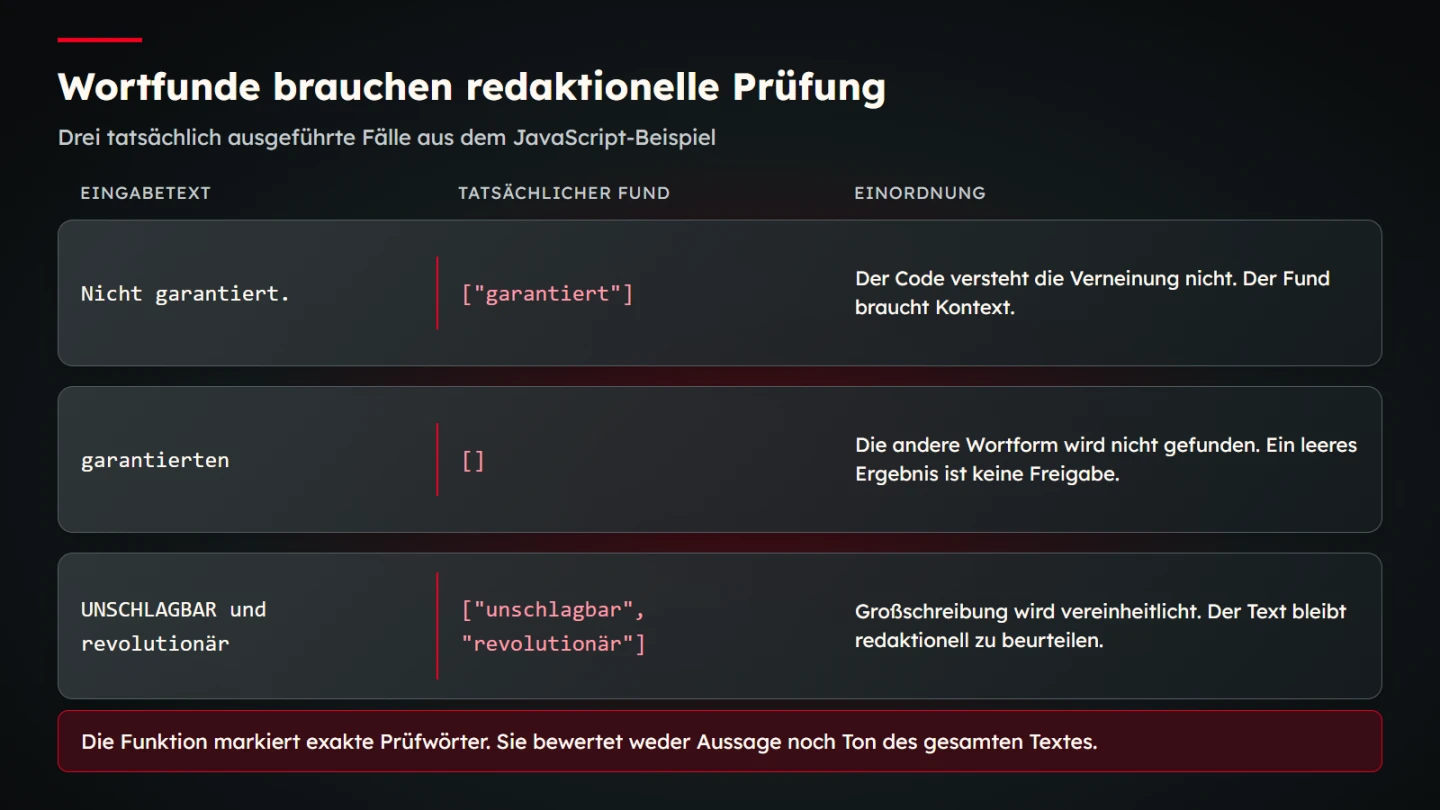
Uppercase and lowercase versions can therefore produce the same hint. A corresponding decomposed Unicode form is normalized. However, the function searches only the listed forms. An inflected version can remain unmarked. It also does not interpret negation or distinguish quotations from the author's own assertion.
Actual test cases expose those boundaries. The German phrase Nicht garantiert produces a hint despite denying a guarantee. Garantierten is a different form and is not found. An empty result must therefore not become general approval. Automation supports one defined step while keeping the limits of that step visible to the editor.
9. Give AI a specific working foundation
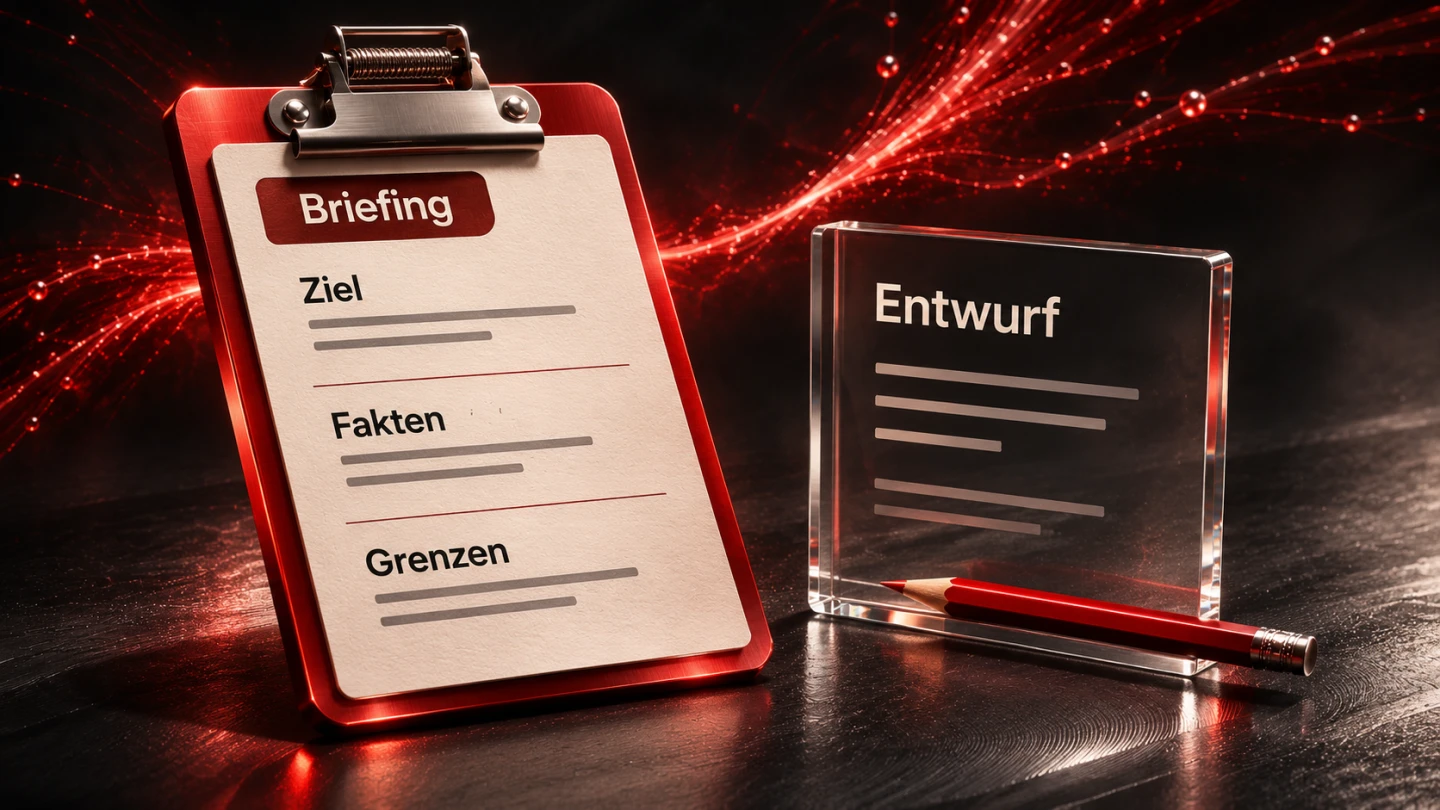
A text model needs more than an instruction to sound on-brand. Supply audience, situation, approved facts, address, terminology and relevant examples. State which information is missing as well. The model should not turn a gap into an attractive invented capability or service promise.
A useful task describes the purpose before the style rules. For the response example, it can request confirmation only of enquiry receipt and explain later appointment coordination. Short examples illustrate the desired attitude. This creates a more reviewable draft than an unspecified request for friendly writing.
Treat the result as a draft. Responsible people check facts, promises, tone and actual context. A model can produce consistent language while naming the wrong state. Confidential information belongs only in an approved processing arrangement. Technical access to a tool does not provide universal permission to place every business document into it.
10. Turn rules into an editorial review route
Start with the purpose of the text: what information is needed and what follows? Check facts and states next. Then assess address, terminology and tone. This order prevents polished wording from concealing a substantive error that could mislead someone even when the sentence feels entirely appropriate to the brand.
A short checklist can ask whether the statement is true, supports the person's task, uses consistent terms and fits the occasion. Necessary limitations should remain understandable. Not every item requires a large meeting. Reusable patterns can make review easier when the underlying state genuinely matches the approved example.
Involve the responsible specialist for important claims. An appointment confirmation needs an accurate account of the process reached. An offer needs confirmed capabilities. Language editors cannot independently approve operational promises they cannot verify. Ownership and style rules complement one another rather than competing for the same decision.
11. Ask understanding questions rather than taste questions
Give readers a concrete task during review. After a response, ask what happens next and whether an appointment is already agreed. A wrong answer can expose a misunderstanding. Asking only whether the text sounds likeable provides little evidence about that practical distinction.
Separate observation from interpretation. Perhaps confirmation was understood as a binding agreement. Investigate the state label rather than merely shortening the message. Revise the cause of the misunderstanding and review the same task again. This keeps changes grounded in what the wording needs to communicate.
A small qualitative review does not produce a representative success percentage. It can reveal specific ambiguity. Metrics require clear definitions and actual measurement if used. This article supplies no claimed improvement rate from adopting a brand voice. The examples demonstrate a reviewable editorial workflow rather than a marketing outcome.
12. Keep the guidance findable and maintainable
Place rules where writing and review happen. A long presentation without an identifiable current version is difficult to use. A short overview, glossary and approved examples for important situations are practical starting points. Keep fuller reasoning accessible when someone needs to make a new decision.
A responsible role collects questions and confirms updates. Renaming a product can affect several touchpoints, so identify relevant text types and their current state. Replace or classify old examples clearly. A folder containing contradictory versions makes consistent application harder, even when every document once had an approval.
Maintain AI instructions and automatic checks alongside the human guidance. A new rule in one document does not automatically reach an existing creation workflow. Review the templates and examples actually used. This keeps human editorial work and technical support aligned with the same decisions.
13. Fill a concise language-rule template
- Identify audiences and principal reading situations.
- Explain a few characteristics through specific behaviour.
- Define address and perspective.
- Record terms together with their meanings.
- Separate fixed spellings from editorial judgement.
- Provide offer, response and error examples.
- Approve facts and permissible promises separately.
- Document automatic hints and their limited purpose.
- Assign ownership and a change route.
Try the completed guidance against realistic writing tasks. If two people infer sharply conflicting results, clarify the rule. That reveals a problem in the working foundation rather than automatically demonstrating careless writing. A useful rule helps people make an actual decision when a new situation arises.
14. Develop the language with the offer
New functions and audiences introduce further situations. The attitude need not be reinvented each time. Test it against the new task and extend the guidance where needed. Helpful text for an experienced administrator may need different explanations from the first introduction for a new prospect.
Connect language maintenance with substantive change. When states, handling or responsibilities change, revisit the affected text. A previously accurate confirmation can become false after a process revision. The language guide remains useful when it accounts for these relationships rather than preserving attractive sentences in isolation.
Dependability comes from understandable rules, actual use and clear ownership. It does not mean mechanical repetition. The organization remains recognizable while individual texts perform their own tasks. That relationship makes brand voice useful for human writers and for assisted text generation.
15. Retain a small set of difficult cases
Keep realistic cases that challenge the rules. An unavailable appointment, an uncertain delivery state and a quoted discouraged word each require different judgement. These cases reveal more than a collection of uncomplicated promotional headings. They help future editors understand where factual responsibility and situational tone matter most.
Record the reasoning behind an approved revision. Explain which misunderstanding was addressed and what information remained necessary. Later teams can then adapt the principle rather than copying a sentence into an incompatible situation. This makes the guidance an evolving working tool while preserving a stable and recognizable relationship with the reader.
16. Document one rule completely
A useful rule record identifies scope, required meaning and permitted variation. For this example it might cover enquiry receipt. The statement must reflect actual receipt; its tone may remain friendly. Appointment confirmation or personal handling can be claimed only when the process supports those states. Record an appropriate example and explain the misunderstanding an unsuitable version creates.
Identify the change that would require review as well. If the contact route later becomes immediate appointment booking, the previous rule needs reconsideration. States and permissible statements have changed. This keeps the language system grounded in real tasks rather than maintaining only an expanding list of preferred and discouraged words. Implementation supplies the state and editorial work makes it understandable.
Sources and scope
Sources checked on 9 November 2026. These primary references were reviewed for voice, tone, clear writing and input guidance. The provider, text specimens and review words are original conceptual working examples.