Writing and designing useful service pages
Specific information instead of interchangeable promises: connecting service descriptions, design and the enquiry journey.

A service page has a different purpose from a general company introduction. Visitors want to judge whether a particular offer can address their situation. They need more than a welcoming heading and a list of positive characteristics. They need to understand the work included and the information still required before a collaboration can begin.
This guide uses a fictional photography studio producing images of technical products for catalogues and digital media. It is not a real customer reference. The example supports concrete discussion of briefing, shot planning, editing and delivery without invented revenue or testimonials. The planning method can be adapted to other services that require explanation before purchase.
1. Define a service as a decision unit
First establish what holds the page together. Product photography may include isolated images, technical details, application scenes and complete campaigns. One page need not treat all those possibilities equally. Begin with the decision visitors need to make. Here that decision concerns photographing technical components for a planned product catalogue.
Record the scope in a short working statement: the studio plans and produces coordinated product images against an agreed shot list. This describes a checkable activity more precisely than a collection of words such as creative, premium and individual. The editing and delivery included in that work can then be explained separately.
Link to neighbouring offers where their differences matter. An extensive campaign production may require its own explanation. A route to that alternative helps when visitors can recognize why it differs. Create pages around meaningful service distinctions rather than multiplying almost identical content simply to accommodate more search phrases.
2. Describe the audience's actual decision
In the example, a marketing manager needs photographs of several components. She knows the catalogue deadline and internal contacts but not every photographic requirement. The page should provide practical orientation: which product information is needed, whether samples must be shipped, how views are agreed and who approves the shot list.
These questions are assumptions within the fictional proposal. A real studio would compare them with previous briefs, enquiries and production workflows. Extract only the necessary professional patterns from internal documents. Confidential product details and personal information should not be copied indiscriminately into a public service description.
Distinguish specialist knowledge from organizational responsibility. An engineer may assess surface details, while procurement coordinates delivery conditions. One page can help both roles through understandable sections and precise language. A single promotional appeal rarely answers their different practical questions adequately, even if its tone is appealing.
3. Separate the outcome from the work
The intended outcome might be a consistent set of product images for a specified catalogue. The scope describes how that outcome is agreed and produced. It may include shot planning, photography, defined retouching and delivery of specified files. Both levels should be recognizable. Promising an outcome alone leaves the actual work unclear.
Technical delivery values help only when their context is clear. A high pixel count does not establish suitability for every crop or printing process. The page can explain that formats and requirements are agreed in the brief. It should not present an arbitrary standard file as a universally appropriate solution for all intended uses.
Also distinguish what a service can generally include from what a particular quotation will commit to. The public page need not anticipate every contractual detail. It should nevertheless prevent someone confusing a photography assignment with complete catalogue design. That distinction creates a better foundation for the enquiry that follows.
4. Develop a reviewable service map
| Decision question | Example content | Boundary to clarify |
|---|---|---|
| Who is the offer for? | Businesses with technical products | Supported sizes and conditions |
| What is produced? | Agreed product views | Scope and quantity in the shot list |
| What needs preparation? | Samples, product details and intended use | Transport and special handling |
| What is delivered? | Agreed image files | Formats, editing and usage context |
| How does collaboration start? | A brief to establish the assignment | No automatic order confirmation |
This map is an editorial working model. It might become a visible summary later, but it need not retain the same table format. The essential point is that each question receives an answer. If the business has not resolved an item, clarify it internally rather than covering the uncertainty with positive but imprecise language.
The map also supports acceptance. Service specialists verify accuracy, editors check comprehensibility and designers check relationships between the parts. Responsibilities become specific. A general approval saying the page looks good does not establish whether those practical questions have been answered or whether its promises match delivery.
5. Open with the specific offer
A possible opening is product photography for technical components, planned around your catalogue. The following paragraph explains the shot list, views and delivery. This connects the service with its use. It claims neither unverified experience nor a commercial outcome beyond the studio's control.
Supplement or replace adjectives with concrete information. Precise might mean agreeing relevant details and views before the session. Consistent might refer to a jointly defined image composition. Without an explanation, those words remain open to interpretation. A useful service page reduces that uncertainty without adding technical detail that contributes nothing to the decision.
The first action should fit what visitors already know. Someone still clarifying product quantity, timing and intended use may need a briefing conversation. Its label should not imply an immediate booking if feasibility must be assessed first. Explain which information helps and what actually happens after the visitor makes contact.
6. Replace assertions with checkable details
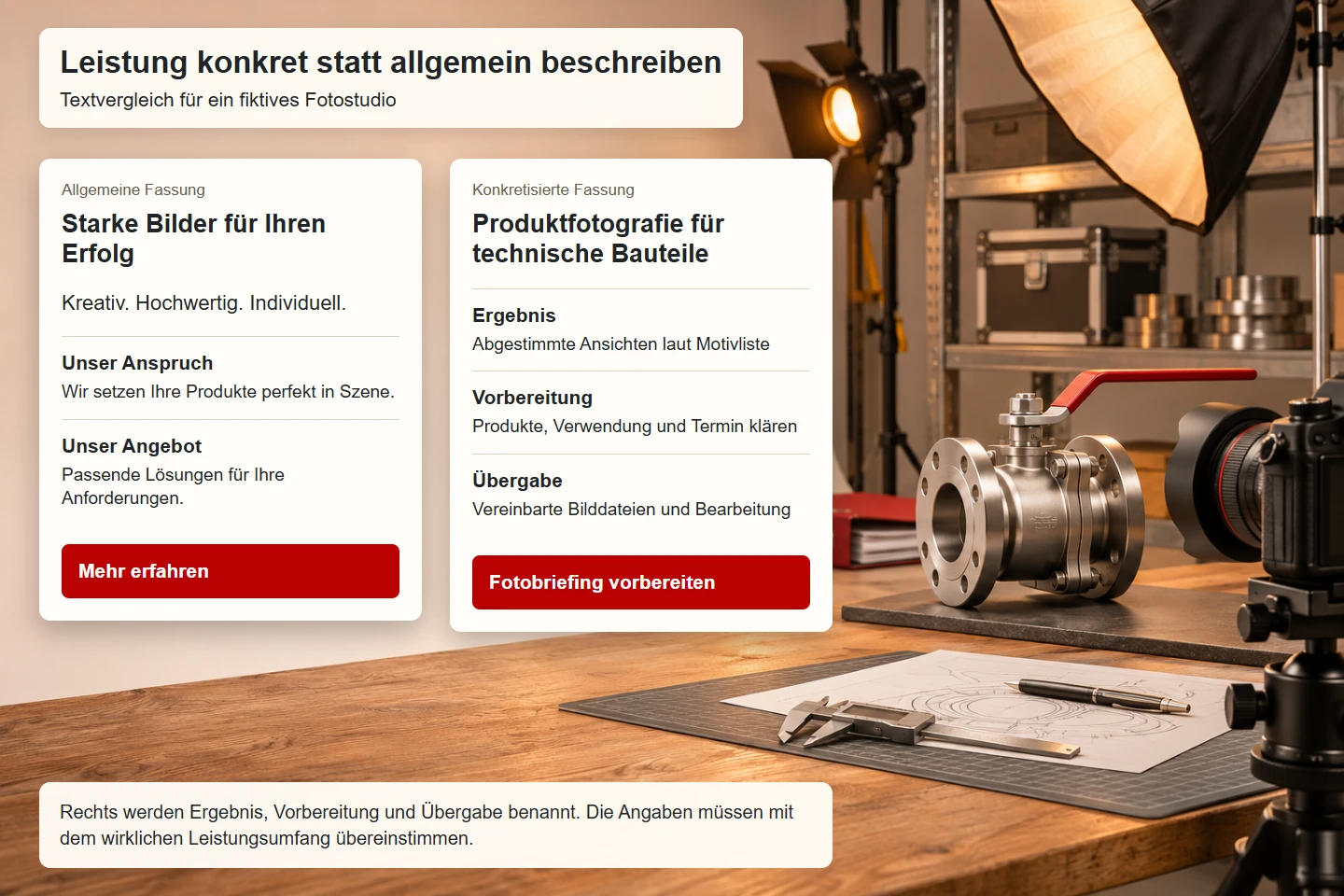
The explanatory view compares two versions of the same service. The left relies on broad quality terms. The right specifies the audience, agreed views, preparation and file delivery. The comparison illustrates an editorial decision. It does not measure enquiry behaviour or claim that adding more words always improves a service page.
The specific version must reflect the real offer. If the studio does not agree shot lists, that statement would be false. Either describe the actual workflow or deliberately change and confirm the process. Editorial work should not invent professional-looking procedures that the delivery team cannot subsequently provide.
A useful starting point is a conversation with the specialist doing the work. Ask for an account of a typical assignment, including decisions, handovers and unresolved questions. That produces a reliable foundation. The editor then translates it for the audience rather than attaching a company name to an interchangeable industry description.
7. Explain the process through real decisions
A process section should do more than display consultation, implementation and success. For this example, the first step could establish product quantity, intended use and timing. A shot list is agreed next. Photography proceeds against that foundation, followed by selection, defined editing and file delivery.
Identify responsibility and required information at each stage. Who supplies the sample? Who approves the view? When can an adjustment be requested? The public page can answer those questions at an appropriate level. Detailed arrangements remain in the quotation or project brief, but the basic sequence should contain no surprising gaps.
The sequence must reflect actual practice. A popular three-step graphic does not justify merging professionally distinct checks. Equally, not every internal action needs public explanation. Show the stages that matter to the audience's preparation, decision and collaboration. This keeps the account informative without exposing an unnecessary production manual.
8. Give each example a clear evidential purpose
An image example should explain something specific, such as an agreed view, a detail photograph or consistency across a product range. Its caption identifies that role. It should not assert more than the image shows or other evidence establishes. A polished component photograph does not prove the accuracy of an entire manufacturing process.
Describe real references according to the work actually performed. If the studio supplied photography, avoid suggesting it developed the complete brand. State the contribution clearly in collaborative projects as well. Check the required usage permissions before publication. A polished editorial presentation does not replace that underlying verification.
Informative images need appropriate alternatives. The WAI image tutorial relates alternative text to the image's purpose in context. Editors need not enumerate every visible detail. Describe the information the image contributes at that location. A complex relationship may also need a readable explanation outside the image rather than an excessively long alternative text.
9. Answer price questions without false precision
Many services can be quoted only after their scope is understood. Explain the factors affecting effort: product quantity, required views, preparation, editing and delivery. That helps even without publishing a number. An arbitrary starting price would create a sense of precision that the fictional example does not justify.
If a provider genuinely uses fixed packages, explain their contents and boundaries alongside the price. A number without scope does not support a meaningful comparison. Check that additional work is addressed clearly. Specific legal requirements for price presentation should be assessed for the actual offer rather than assumed from a generic editorial example.
A pricing section should not conceal an unexplained screening process. Visitors should understand why particular information is required before a quotation. Here product type and quantity affect planning. A long form filled with unrelated marketing questions would make that understandable preparation harder without improving the explanation of the service.
10. Explain prerequisites and exclusions plainly
Prerequisites help visitors assess suitability. They might include transportable samples, approved product information and an identified contact. The business must confirm the conditions that actually apply. The page should not imply specialist safety or handling capabilities that have not been established for unfamiliar products.
State exclusions calmly and in the relevant place. If complete catalogue design is outside the service, explain that alongside the scope. An important boundary should not first appear after a visitor submits a form. Early clarification gives both parties a more useful starting point for the conversation that follows.
Image usage wording also deserves attention. The page can explain that intended uses are discussed during briefing. Do not promise unrestricted use unless the actual arrangements have been checked and agreed. Binding terms belong in the appropriate agreement with suitable professional or legal responsibility rather than being improvised as marketing copy.
11. Use design to support reading
A useful structure follows the decision: suitability, outcome, scope, process, evidence and contact. Some offers require a different order. A clear hierarchy helps people find important limitations and next steps again. Too many equally emphasized cards can make the page feel like a collection of unrelated promises rather than one coherent explanation.
Headings identify their content and use appropriate semantic levels. The WAI guidance supports that structural approach. Large text alone is not a heading in the document. Explain specialist terms where the audience needs them. A readable service page preserves precision while organizing it into an intelligible sequence.
Narrow layouts retain the service and its boundaries. A gallery should not push practical questions below many screens of imagery. Keep the contact route reachable without covering text or controls. Test enlarged text and long product names with realistic content. Placeholders often conceal the layout problems that actual service information will create.
12. Embed search language in a genuine explanation
Search phrases can reveal the audience's terminology. They do not replace a professional content structure. Someone searching for technical component photography needs an understandable account of that offer. A collection of nearly identical pages for slightly altered phrases does not automatically add useful substance.
Google describes helpful content through a people-first approach. For this service page, the editorial responsibility is to support the actual decision with verifiable information. That is not a promise of a particular ranking. A very long page can still be unhelpful if it avoids the questions that matter.
The meta description summarizes the visible offer. Google may also use other page content for a search snippet, so both need to remain accurate. Clear statements about provider, service and prerequisites can help establish context for answer systems too. This does not guarantee a particular mention or reproduction by an automated system.
13. Review contact and handover as one route
A useful service page does not end at its main button. The following contact area should match the action promised. If it prepares a brief, ask clearly about product quantity, intended use and timing. Not every field must be compulsory immediately. Determine essential information from the real handling process rather than a preference for collecting more data.
The responsible person then checks whether those details support a meaningful next step. Missing information can be requested selectively. If the same issues recur, improve the page. Evaluate patterns without publishing personal enquiry content indiscriminately. Keep editorial learning separate from the confidential handling of an individual assignment.
Confirmation wording must remain realistic. A successfully submitted brief does not establish a confirmed photography date. Preserve that distinction on the following page and in any message. Consistent expectations from opening text through actual handling form part of service communication rather than being merely a technical form concern.
14. Document approval and maintenance
- The service is defined as a specific decision unit.
- The audience and intended use are understandable.
- Outcome, work and delivery are explained separately.
- Prerequisites and significant boundaries appear in time.
- References describe the contribution actually made.
- Images and alternatives fulfil an identifiable role.
- Pricing factors and public promises match the offer.
- The contact route establishes the same expectation as handling.
- Narrow views retain decision-relevant information.
- A responsible role checks subsequent changes.
Mark information likely to change. Updates to scope, delivery options or responsibilities may affect several sections. Record which pages need to be checked together. A new contact route should not contradict the described process. This maintenance view keeps the service explanation dependable after its initial publication.
15. Check the complete account with a realistic brief
Before approval, give a reviewer a plausible assignment rather than asking whether the writing sounds professional. For example, a manufacturer has several differently sized metal components and needs a coherent catalogue set. Ask the reviewer to identify what the studio offers, what information to prepare and which details still require agreement.
Record where the reviewer has to guess. Confusion about retouching scope is different from difficulty finding the enquiry action. Each observation needs an appropriate revision. Adding a prominent button does not clarify an ambiguous delivery promise. More technical detail does not necessarily improve an unclear opening sentence.
Finally, compare the revised page with what the production team can deliver. This closes the loop between marketing, editorial work and execution. A service page becomes useful through that alignment: visitors understand the offer and the team receives enquiries shaped by accurate expectations. The page can remain distinctive in tone while staying specific about its work.
Sources and scope
Sources checked on 9 November 2026. These primary references were reviewed for images, headings, helpful content and search snippets. The photography studio and workflow are conceptual examples rather than an actual customer assignment.