Organise newsletters and a journal as one connected editorial process
Connect the reader question, factual foundation and publication while keeping article, recipient handling and mailing approval distinct.

A specialist article is finished, but the newsletter still needs a topic. Its introduction is copied and followed by “Read now”. That may work, yet it often leaves the central question unanswered: why would this particular message help this audience now? A connected process addresses that before the writing starts.
This guide develops an original editorial model for a small business publication. The example concerns an article about understandable business websites. It covers planning, preparation and verifiable publication. The model sends no messages and does not automatically treat an existing contact list as a newsletter subscription list.
1. Define each channel's task
A journal article can be discovered, linked and updated over a long period. It needs an understandable starting question, specialist explanation and reviewable examples. A newsletter arrives in a personal inbox among other messages. Its opening therefore needs to establish quickly why the topic matters to this particular group.
This does not mean that the email should merely advertise a link. It can already offer a useful observation or a short review question. The linked article then develops the answer. Someone who postpones reading should still see an informative subject and later understand what the message offered.
Identify the intended reader action too. Should a person inspect a workflow, reproduce an example or prepare a decision? “Increase reach” is an organisational ambition, not a reader task. A connected editorial plan begins with the job of the person the content is meant to help.
The Google guidance on helpful content emphasises usefulness, original contribution and dependable subject knowledge. It establishes no guarantee of search visibility. For our planning, it means that a vacant calendar slot alone is not a sufficient reason to produce another article.
2. Write a shared topic brief
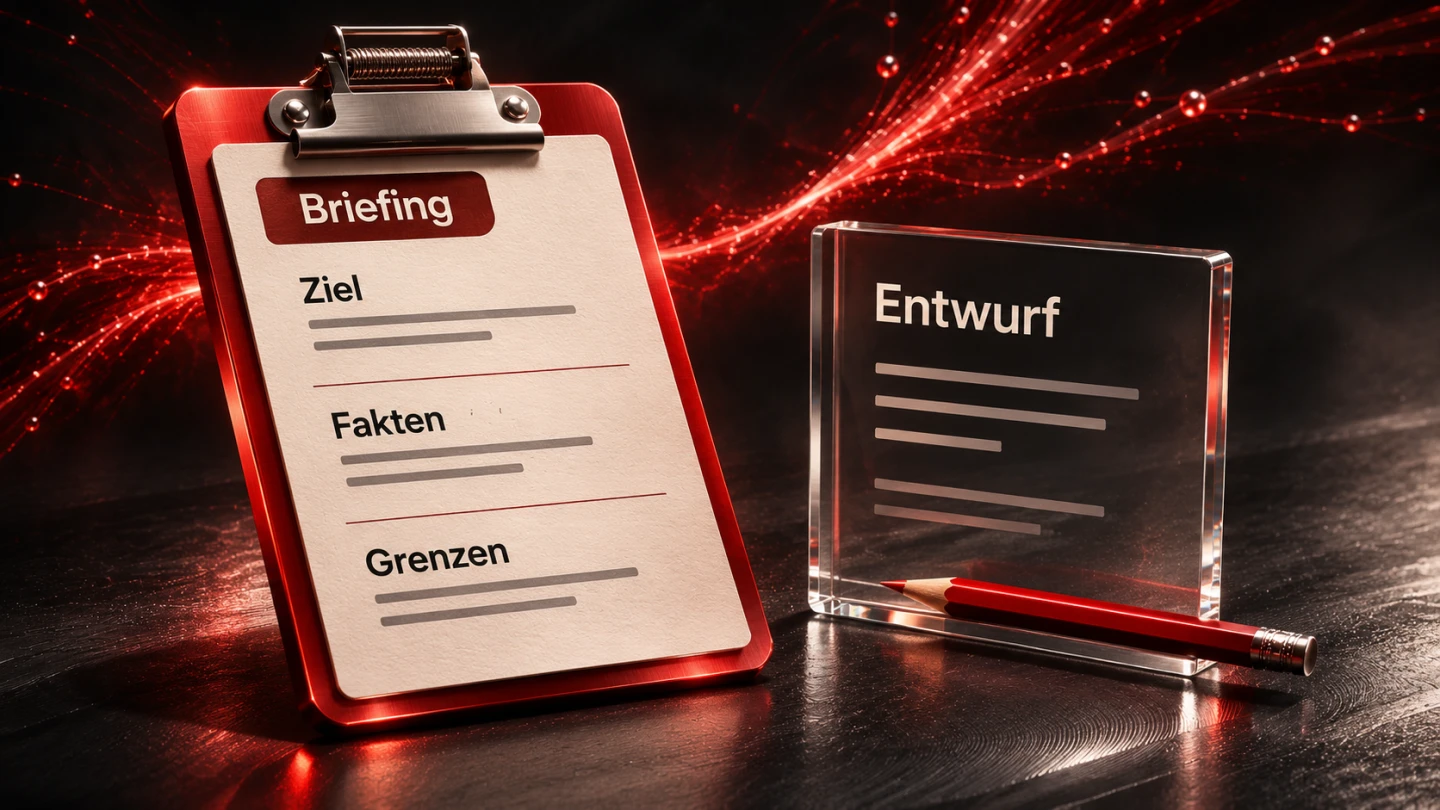
A short brief can hold both formats together. Record the audience, actual question, intended insight, original evidence and suitable next step. In this example, the question is: “How can I tell whether a service page provides enough information for a sensible enquiry?” That gives both pieces a shared subject foundation.
| Brief field | Fictional example | Editorial purpose |
|---|---|---|
| Audience | People responsible for small service businesses | Establish language and assumed knowledge |
| Reader question | What information is missing before an enquiry? | Keep the explanation focused on a task |
| Original contribution | A review model covering offer, trust and contact | Go beyond summarising other sources |
| Journal format | A detailed guide with examples | Explain relationships |
| Newsletter angle | One concrete question for the reader's own page | Provide an immediate entry point |
Record the boundary as well. One article does not have to answer every question about search engines, hosting and legal information. A defined scope makes related internal links easier to select. It also prevents the newsletter from promising more than the individual article can reasonably explain.
A brief is not an unchangeable contract about every paragraph. Research may alter the emphasis. When it does, update the summary and planned subject line too. Otherwise a later message can promote an old version of the topic while the linked article now answers a different question.
3. Develop the specialist article as a dependable foundation
Start with the detailed explanation when its factual basis remains unresolved. In this example, the article first describes the tasks of a service page and examines concrete wording. Only then can the editor judge which individual insight will transfer meaningfully into a short email without losing necessary context.
Distinguish researched information from original working models. A checklist can be useful without becoming a universally binding standard. Identify fictional figures, invented organisations and simplified code examples. Sources should support reviewable claims rather than serve as a decorative list beneath a text whose assertions they do not actually substantiate.
Publication also needs its own search presentation. The title and description should reflect the actual question and value of the article. They are not automatically identical to the newsletter subject. A lasting page title should remain understandable after the immediate occasion or mailing week has passed.
Choose internal references for their relationship to the subject. An article on business websites may link to navigation or understandable forms where these develop the explanation. Numerous unrelated links do not improve usefulness. Refer to destinations that are actually available or will be public at the intended publication time.
4. Write a short message with value of its own
The newsletter needs an independent opening. Our example could begin with a small task: “Open a service page and check whether it explicitly identifies the audience it is suitable for.” The reader immediately knows something they can do. The full article supplies the more complete review model.
Do not make a chopped-off article introduction the default procedure. A text that takes six paragraphs to explain its question does not automatically become a useful email when shortened arbitrarily. Write a complete concise point and explain what additional context the article covers. The message then remains understandable on its own.
A fictional subject might be “What information is missing before an enquiry?” Its preview could add “A quick check for your service page”. These serve different purposes and need not repeat each other word for word. The subject promises neither guaranteed enquiries nor an allegedly universal increase in revenue.
An email also need not introduce every newly published article. Select a few suitable pieces for the particular edition. A broad journal can cover many subjects while one newsletter retains a clear focus. A regular publishing rhythm is compatible with deliberate selection rather than forcing every article into every mailing.
5. Use clear states from draft to approval
The editorial plan should show whether research, text, examples and images are actually complete. “In progress” is often too vague for a longer workflow. A simple sequence can distinguish topic definition, preparation, specialist review, presentation checks and publication approval. Each state needs an observable result rather than a label alone.
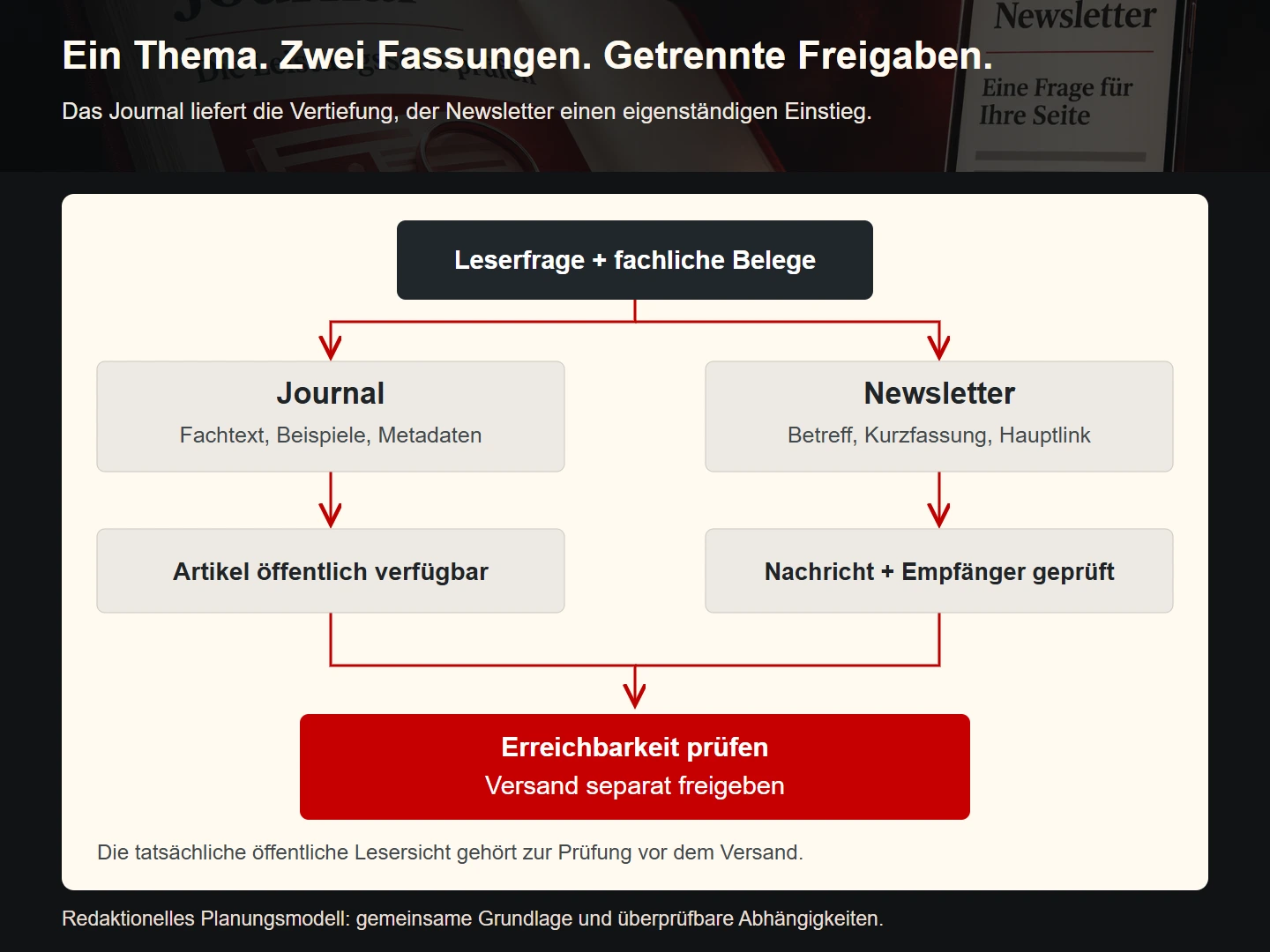
Give the journal and newsletter separate approval. A reviewed article does not establish that the subject is accurate, the destination link works or the recipient selection is appropriate. Conversely, a polished email cannot make an incomplete specialist article ready. The pieces must fit together and individually satisfy their own requirements.
Name an owner for the factual statement and another responsibility for publication itself. In a small team, one person may perform several roles. The tasks should nevertheless remain distinct. During an absence, someone else needs to understand which decision has been made and which stage remains unresolved.
Approval applies to a particular version. If an important number, image or paragraph changes afterwards, revisit the affected check. An old tick in the plan must not quietly apply to a materially different publication. This keeps review connected to the content that readers actually encounter.
6. Build links predictably and correctly
A newsletter link must lead to the promised information. Use descriptive wording such as “Review the requirements for a business website”. The W3C explanation of link purpose describes meaningful link text and its context. A standalone “Here” can make destination choice unnecessarily difficult, particularly when links are navigated separately.
If campaign parameters are used, create them deliberately. Assembling question marks and ampersands manually can produce duplicated parameters or damage existing values. The following example uses the URL API. It is a bounded helper for the organisation's journal paths rather than a general redirect mechanism.
function newsletterLink(path, campaign) {
  const base = 'https://www.agenturzentral.de';
  if (typeof campaign !== 'string' || !/^[a-z0-9-]{1,64}$/.test(campaign)) {
    throw new TypeError('A short campaign identifier is required.');
  }
  const url = new URL(path, base);
  if (url.origin !== base || url.username || url.password ||
      !/^\/(?:en\/)?blog\/.+/.test(url.pathname)) {
    throw new TypeError('Use an own journal path.');
  }
  url.searchParams.set('utm_source', 'newsletter');
  url.searchParams.set('utm_medium', 'email');
  url.searchParams.set('utm_campaign', campaign);
  return url.href;
}

console.log(newsletterLink(
  '/en/blog/professional-business-website-requirements',
  'journal-2026-11'
));
The helper retains unrelated existing parameters and any fragment identifier. Existing campaign parameters with the same names are replaced. The origin and path checks restrict destinations to the organisation's journal. They do not establish that every arbitrary matching path contains a published article. Availability remains a separate publication check.
Use a shared edition identifier rather than a recipient's email address as the campaign value. Parameters do not themselves authorise a particular form of measurement. Whether and how analytics tools are used requires a separate decision. This example creates an address only; it sends neither a message nor measurement data.
7. Separate recipient management from editorial selection
Visiting the journal is not a newsletter subscription. General contact or an existing customer record does not automatically establish advertising consent either. Section 7 of Germany's UWG generally requires prior express consent for advertising by electronic mail; statutory exceptions require separate assessment against their conditions.
The European Commission explains purpose limitation, understandable consent and withdrawal that is as easy as giving consent, among other principles. Our editorial process therefore separates public access to content from mailing, which must use the recipient process established for that purpose.
Editors should not bypass recipient management with an additional privately maintained mailing copy. An unsubscribe must affect the next actual selection. Imports or later changes of provider must not accidentally restore withdrawn subscriptions. Handling these states belongs in the controlled sending process, rather than depending on a note remembered by one editor.
For testing, use designated test addresses or an appropriate preview. An internal review is not a reason to send unrequested messages to genuine customers. The actual dispatch needs an identified approved version and its corresponding recipient selection. A successful preview does not establish that a message was sent or delivered.
8. Check presentation and the complete reader journey
Review the route from subject and preview through to the destination article. Is the topic understandable without the picture? Does the visible link correspond to the page title? Does it open the correct language? A relevant message can become confusing at these transitions even when each component looks polished separately.
Check narrow views, enlarged text and disabled images. An important date must not exist only inside a picture. A decorative visual should not be the sole carrier of the message. Also verify that captions and alternative text describe the actual content and help readers understand the message rather than add unrelated decoration.
A mailing tool's preview covers only part of the possible environment. Record what was actually inspected. Do not claim checks in particular email clients when only a browser rendering exists. Important editions may justify additional suitable views without implying an unlimited testing exercise for every small announcement.
Review unsubscribe, recognisable sender identity and the intended contact routes as well. The reader's task does not end at the main link. A person must understand the relationship to the organisation and be able to change their mailing preference. These are parts of a complete message, not merely items on an internal checklist.
9. Connect calendar slots to meaningful topics
A shared calendar links the article date to a possible later mention. The article need not appear in a newsletter on the same day. A selected edition can bring together several timely pieces. The calendar should therefore express relationships and approvals instead of maintaining two identical lists of dates.
Mix specialist areas across the publishing plan where that breadth helps the audience. A single message still benefits from an understandable thread. An edition about better enquiries might combine content, navigation and form usability. That selection needs a connection rather than simply listing the most recently finished drafts.
Allow time for review and potential correction. A fixed sending date does not complete an unresolved source check. If an article still has a material gap, the edition can use another suitable focus. Record that as an editorial decision in the shared plan rather than allowing the published promise to drift away from the available content.
Observe dependencies on publication timing too. A future article may not yet be publicly accessible. A working internal preview does not establish public availability. Test the actual reader view at the intended time and distinguish it from an authenticated administrative view with access to drafts.
10. Relate evaluation to the reader's task
Decide before dispatch which question an evaluation should answer. In our example, the team might care about the follow-up questions prompted by the checklist. Message volume does not answer that. A recorded link visit alone is not a confirmed improvement to the recipient's business website.
Document definitions. Does a value concern messages, people, click events or completed enquiries? Are the compared time periods equivalent? A metric must not change meaning during interpretation. For small audiences, a few understandable descriptions of actual feedback may be more useful than apparently precise success percentages.
A weak response can have several causes. Topic, timing, wording and relevance can all differ. Change as little as possible for a small comparison. Editions with different audiences and completely different content do not support a clean conclusion that one subject line was solely responsible for the result.
Carry findings into the next brief. A repeated question can justify a new article or an improved explanation. The shared process becomes a learning loop: article, email and actual feedback inform one another. Its purpose is therefore more than increasing the amount of text or links produced each month.
11. Organise corrections and longer-term maintenance
A journal article can be updated later. An email already sitting in an inbox cannot be replaced in the same way as a webpage. Decide how material corrections will be communicated. Important changes may need a clear follow-up, while small improvements in wording do not automatically require another message.
Preserve the relationship between a sent version and the article as it stood then. If a newsletter cites a specific figure, someone should later be able to understand its basis. A dated version note explaining the change is more useful than a constantly overwritten file simply called “final”.
Review important older references periodically. A new article can usefully extend an existing explanation. Add such links where they genuinely belong. Distributing arbitrary new links across every older piece makes navigation harder and takes no professional responsibility for how the surrounding claims may have changed.
Checklist for a shared editorial process
- Define the reader task and each channel's role.
- Create a shared brief with a clear subject foundation.
- Check original evidence, sources and simplified examples.
- Give the journal article its own title and description.
- Write newsletter subject and preview independently.
- Approve the article and email separately.
- Check link destination, language and public availability.
- Use suitable campaign values without unnecessary personal data.
- Respect the established recipient and unsubscribe process.
- Record the views that were actually tested.
- Prepare understandable evaluation and correction procedures.
Common questions about newsletters and journals
Should the complete article appear in the email?
It depends on the reader task. A complete short insight with an appropriate route to detail is often useful. A truncated introduction is rarely a good default. Explain what the reader can already take away and what additional value the linked article provides.
Does every new article need a newsletter mention?
No. Select content for the edition and audience. A broad journal and a focused message can work well together. The selection should make sense against the promised question rather than aim to produce the longest possible list of newly published links.
Does a tracking parameter establish lawful measurement?
No. It is initially part of an address. Which data is subsequently processed and the lawful basis for doing so require separate review. The link helper shown here sends no message and performs no analytics itself.
How should a small team start?
Write one shared brief and develop one article with a suitable short message. Review both approvals and the complete reader journey. Once that workflow is understood, use it for further editions instead of scaling several uncertain steps at once.
Sources and next steps
Sources checked on 9 November 2026. The brief, sample email and link helper are original editorial working models. Sending and measurement need the organisation's established processes.