Prepare understandable content for search and AI answers
Answer reader questions and make evidence traceable without guaranteeing a ranking or AI citation.

Understandable content helps people answer a question and interpret the answer correctly. That task remains whether someone arrives through a conventional results list, an AI summary or a direct link. Good preparation names the subject, prerequisites and sources clearly enough that essential claims do not need to be guessed. It replaces vague promotional language with traceable information.
This guide connects editorial structure with a careful reading of search documentation. Statements about AI Overviews and AI Mode refer specifically to Google Search. They are not extended to every AI system. The original teaching example shows a short CSS answer with its prerequisite. It is neither a real search result nor evidence of an AI citation.
Clarify the question before collecting keywords
A search expression can contain several intentions. Someone looking up a technical term may want a definition, a procedure or help making a decision. Before writing, identify which task the article serves. That choice determines what should appear early. A list of related expressions cannot replace this conceptual work.
Describe the audience's starting point as well. A beginner needs different conceptual bridges from an experienced developer checking one property. An article need not serve every possible audience simultaneously. It should make its emphasis recognisable and explain the prerequisites those readers need.
The central question can become a heading where appropriate. Artificially placing a question before every paragraph does not automatically improve usefulness. The real relationship between question and answer matters. If a heading asks about a dimension, the following passage should not begin with several unrelated promotional sentences.
Name the subject of important claims
Ambiguous references become especially troublesome during selective reading. Saying this solution is fast leaves both the solution and its conditions unclear. Name the subject where an important claim appears. That helps people who read only one section or arrive through a direct reference rather than following the entire article from the beginning.
This does not require mechanically repeating every noun. Sensible references belong to good prose. Pay particular attention where several methods or variants appear. Readers should know whether a qualification applies to every option or only one. That clarity is substantive work rather than a particular keyword density.
A short answer needs its condition
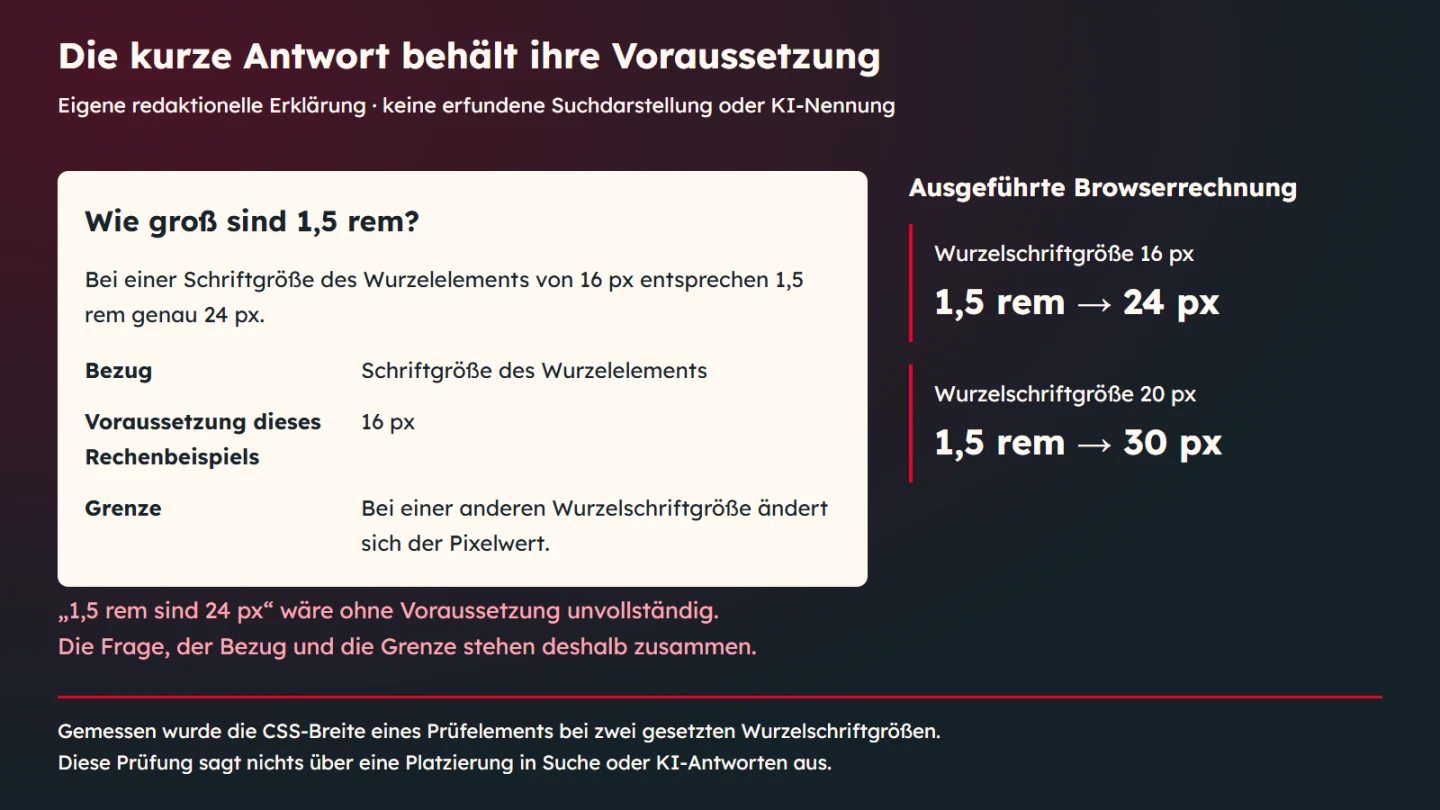
The teaching question asks how large 1.5 rem is. Answering only 24 px is incomplete. The unit relates to the root element's font size. At sixteen pixels, one and a half rem corresponds to twenty-four pixels. At twenty pixels, it corresponds to thirty. The prerequisite therefore belongs inside the short answer itself.
The complete answer says that at a root font size of 16 px, 1.5 rem equals 24 px. It answers the question while preserving its frame of reference. A supplementary explanation notes that a different root font size changes the pixel result. A shorter version should not silently discard that boundary.
The principle transfers to other professional subjects. A price needs its scope, a duration needs its process and a recommendation needs its intended use. Keep the relevant qualification close to the result. A distant generic disclaimer cannot always correct an oversimplified answer box.
The visible HTML example
The extract uses ordinary HTML: a heading, paragraph and description list connecting terms to explanations. It contains no special AI identifier or claimed assessment by a search service. Technical checks inspect the actual content and relationships. The arithmetic is additionally verified in a browser with two root font sizes.
<section aria-labelledby="answer-title">
  <h2 id="answer-title">Wie groß sind 1,5 rem?</h2>
  <p>Bei einer Schriftgröße des Wurzelelements von 16 px entsprechen 1,5 rem genau 24 px.</p>
  <dl>
    <dt>Bezug</dt><dd>Schriftgröße des Wurzelelements</dd>
    <dt>Voraussetzung dieses Rechenbeispiels</dt><dd>16 px</dd>
    <dt>Grenze</dt><dd>Bei einer anderen Wurzelschriftgröße ändert sich der Pixelwert.</dd>
  </dl>
</section>
The original German labels deliberately match the native explanatory image. The description list explicitly connects reference, prerequisite and limit. That form suits the relationships in the information. A procedure might instead need an ordered list, while comparable alternatives might suit a table. Select structure from the information rather than trying to include as many HTML elements as possible.
Use headings, lists and tables deliberately
A heading names the following context. A list reveals parallel items or sequence. A table connects recurring criteria across several entries. Mixing these purposes can produce a neat surface that remains difficult to understand. Identify the relationship first and choose the element afterwards.
| Information task | Useful form | Important check |
|---|---|---|
| Explain a term | Concise definition with context | Subject and scope remain clear |
| Perform a task | Traceable sequence | Prerequisites precede their use |
| Compare alternatives | Table with shared criteria | Units and conditions are comparable |
| Support a claim | Explanation with a suitable source | The source supports that particular statement |
| Show a limit | Named qualification beside the result | The summary preserves it |
A well-chosen structure supports reading. It does not guarantee that a system selects that section. The structure should fulfil its actual purpose first. It remains useful when someone visits directly and no automated intermediary sits between source and reader.
Separate sources from your explanation
A primary source can support a technical definition or current rule. Your explanation connects that foundation to the reader question and an appropriate example. Link to the relevant passage or page where possible. A prominent organisation's general homepage is not precise support for every assertion about its systems.
Distinguish a source-based conclusion from an editorial recommendation. The meaning of rem is a documented technical foundation. Presenting prerequisite and limit in a description list is our editorial decision. Those layers do not need artificial merging. Traceability comes from connecting them clearly.
Check the actual status of time-dependent claims. Product features and search presentations change. A previously accurate description is not automatically current. Record when the source was reviewed. Updating a date without reviewing the substance would merely claim freshness.
Keep Google's guidance within its scope
Google identifies the same foundational SEO practices as relevant to AI Overviews and AI Mode. Its documentation names no extra technical special requirements or special schema.org markup for these features. A page must, among other conditions, be indexed and eligible for presentation with a snippet in Search. Satisfying those conditions still does not guarantee inclusion or serving.
These statements concern the named Google features rather than every AI search product. Do not convert them into an unsupported universal rule. Likewise, a label such as GEO does not establish a particular mechanism. Naming a field of work cannot replace traceable product documentation.
The editorial priority is practical: make essential information available as understandable text and explain its foundations accurately. Additional machine-readable claims should match the visible content. A hidden assertion does not become true through technical formatting. The visible explanation remains the foundation.
Treat discoverability as a separate responsibility
Even clear prose needs an appropriately discoverable page to reach its audience. Useful placement, reachable links and suitable technical delivery matter. These responsibilities differ from language quality. An excellent paragraph cannot repair an accidental access restriction.
Inspect important information in the page actually delivered. Is it available as text? Do title and content agree? Does an internal link reach its intended destination? Do conflicting versions exist? These questions can be addressed concretely. Calling a text AI-optimised does not answer them.
Google's SEO starter guide describes optimisation in terms of helping engines understand content and people find it. That establishes no guaranteed rank. Content, technology and the actual search situation interact. This article addresses understandable preparation rather than replacing a full technical investigation of a website.
Compare summaries with the complete claim
Write the professionally complete core statement first. Then create a short version and compare them. Are subject, condition and scope preserved? In the rem example, the assumed root font size must remain identifiable. A number alone is shorter but less accurate. Brevity should not enlarge the meaning.
The same applies to meta descriptions, captions and highlighted answer boxes. People often encounter these separately from the long text. A careful explanation in the body must not become an unrestricted success claim in a title. Accuracy should connect every visible part.
When AI assists with editing, check the shortened version against the actual foundation. A model can suggest useful wording while also dropping conditions or introducing certainty. Specify boundaries and inspect the output. Fluent prose does not establish that the underlying statement was preserved correctly.
What the executed example proves
The browser check verifies the visible question, existing term relationships and explicit qualification. It also measures an element with a width of one and a half rem under two root font sizes. Results of twenty-four and thirty pixels match the respective prerequisites. This reproduces the calculation used in the explanation.
The check does not simulate a search algorithm or assess the probability of AI citation. It does not establish that a system prefers description lists. The evidence concerns our own explanation. That limited scope is useful because the content and calculation can be checked without claiming an unexamined external success.
Add independent usefulness
An article needs a reason to be read. An original explanation, executed example or reasoned decision aid can provide one. Rewriting existing pages does not automatically add value. Google's helpful-content guidance includes questions about original information, analysis and value beyond the source material.
Independent work does not require invented numbers. A correctly explained counterexample can be valuable. Here, a second root font size shows why the shortened statement would be incomplete. Such boundaries help readers apply knowledge appropriately and can contribute more than another unrestricted success formula.
Evaluate observations without false precision
If an article is later found or cited, that is an observation under particular conditions. When examining an individual case, record the question, time and actual presentation. That does not produce a stable general citation rate. Another query or another time may yield a different result.
Traffic changes also need context. A higher value can have several causes. Without an appropriate investigation, it cannot simply be attributed to a new heading or description list. Establish what was measured and which conclusion the foundation supports. Editorial quality should additionally be assessed through the content itself.
Review related content as one knowledge structure
A useful explanation can connect to a more detailed treatment where readers need it. Link because the destination answers a genuine next question. An article about relative units might point to a complete layout example. It need not repeat that entire subject merely to increase length. The relationship should help someone continue with understanding.
Keep terminology consistent between linked pages. If one passage uses root font size and another says base size, explain the connection where ambiguity is possible. Consistency does not require robotic repetition. It requires that readers can recognise the same concept and see when the scope changes.
Review shared facts when one article changes. A corrected assumption may also appear in a caption, glossary or older summary. Updating only the newest page can leave contradictory explanations elsewhere. A small record of important shared statements helps identify affected content without pretending that every link requires continuous monitoring.
Run a focused content review
For an existing article, first state the most important reader question. Then identify the passage that actually answers it. If no suitable passage exists, the core statement may be missing. If the answer is scattered across disconnected sections, its relationship needs clarification. Begin with the content rather than an assumed preference of an automated system.
Next list the prerequisites. Here, the root font size matters. Another article may depend on a software version or agreed scope of work. Ask whether someone new can identify that prerequisite without knowing the article's history. The editorial team's expertise must not silently become assumed knowledge for every reader.
Finally, consider a likely misinterpretation. What might someone infer from the short answer? If a conditional value becomes a universal value, refine the wording. A source link at the end of the page cannot repair that change in meaning. The statement itself needs to be accurate.
Frequently asked editorial questions
Does every article need an answer box? No. Use one when a short core statement genuinely helps and keeps its limits. A longer trade-off may need a developed explanation. A routinely inserted box without added clarity fulfils a template rather than a reader task.
Should every page include frequently asked questions? Add them when they answer real outstanding questions. Repeating every heading in question form adds little. A visible FAQ also does not establish guaranteed enhanced search presentation. Editorial suitability and possible technical annotation are separate decisions.
Is a longer page automatically better? Detail is useful when prerequisites, examples and limitations require explanation. Extra words without new information contribute little. Evaluate what the audience can understand or decide afterwards. A clear bounded explanation can help more than a long collection of related statements without a focus.
What should be revised first? Start with errors and an unclear central claim. Then address missing conditions, contradictory short versions and poorly connected evidence. Refine structure and prose on that foundation. An elegantly arranged paragraph with an inaccurate claim is not a successful result.
Can a source check prove that the article will be cited? It can establish that a particular foundation supports a particular statement when the check is conducted appropriately. Citation by an external system is a different event. Keep the evidence attached to the property actually examined rather than transferring confidence from one question to another.
A practical handover records the question, core answer, required qualifications and source locations. It also identifies which facts can change and who will review them. This makes future corrections concrete. It does not need to promise continuous observation of every external result or invent a stable optimisation score.
Publication checklist
- The reader question and audience are explicit.
- Important claims name their subject and prerequisite.
- Definitions, procedures and comparisons use suitable structures.
- Sources support the claims attributed to them.
- Original explanation remains distinguishable from source information.
- Short versions preserve material qualifications.
- Title, description and visible content agree.
- Technical discoverability is checked separately from prose quality.
- No ranking or AI-citation guarantee is invented.
- Review date and responsibility for updates are recorded.
For technical examples, record which property was measured. The pixel results here are CSS dimensions of a probe element, not physical-screen measurements or search outcomes. Precision is useful when the meaning of the number is equally precise. A short record of question, assumption, measured property and observed result supports later verification better than a general success label that combines unrelated claims.
Sources and review date
Sources were checked on 9 November 2026. Google explains AI features in Search, foundational SEO practices and helpful content. MDN describes CSS length units including rem. The question-and-answer structure and browser checks are original teaching examples rather than evidence of actual search or AI placement.