Choosing appropriate use cases for structured data
Separate vocabulary, embedding and search features through concrete data sources, executed checks and explicit limits.

Structured data describes content in a form that software can inspect deliberately. A heading remains a heading for readers, while an additional machine-readable description can identify it as part of an article. That relationship is the starting point. Markup should describe the information the website actually presents rather than construct a second, more flattering version behind it.
Implementation involves three distinct decisions: what is being described, which vocabulary fits it and what a particular service requires for its own use. Keeping these decisions separate makes it possible to select a useful small case and check it honestly. This guide uses an original constructed learning article. It is not customer evidence and promises no special search appearance.
Start with the subject actually presented on the page
Begin with the page's main purpose. An expert article explains a topic. A product page describes a particular offer. An event page contains information about a specific occasion. These distinctions matter more than which search feature looks most prominent. The data type should follow the actual content. A desired appearance in a results list cannot justify an inappropriate type.
The Schema.org Article description identifies the type and shows its relationships and properties. That is a vocabulary foundation, not an automatic list of every condition imposed by every search service. A property can exist in the vocabulary without causing a particular service to generate a special presentation from it.
A planning table can initially connect the page type, visible subject and available information. For an article, these might include a heading, an author and a language. Record missing information as a gap. Do not close it with an invented person, an arbitrary date or a fabricated rating. A clear boundary is part of a dependable dataset.
Check whether the page mentions several subjects. An article can discuss a product without becoming a product-offer page itself. Mentioning a company does not turn the whole contribution into a company profile. The description should represent the relationships accurately. For a first use case, one clear assignment is often more helpful than an extensive network of loosely connected objects.
Maintainability is another useful selection criterion. The person updating visible information should be able to trace where the machine-readable version comes from. A one-time copied block can drift apart later. Choose a case with an understandable source and update process. The apparent simplicity of the first insertion should not conceal the maintenance it creates.
Separate vocabulary, embedding format and search feature
Schema.org describes terms and relationships. JSON-LD is one way to embed those descriptions. A search engine's interpretation is another layer. Google's introduction to structured data explains JSON-LD as its usual recommended approach and also identifies other supported formats. JSON-LD is therefore not the only possible form of structured data.
This distinction helps when discussing errors. Syntactically broken JSON is a different problem from an inaccurate article heading. A correctly described page may still appear without a special search treatment. Mixing these layers makes it easy to treat a technical check as comprehensive proof of an outcome it never measured.
At the source date checked here, Google's Article documentation describes applicable recommended properties and explicitly lists no required properties for this type. That does not make empty or arbitrary information useful. It also does not establish the requirements for another search feature. Read the rules for the particular case and current documentation.
Treat documentation examples carefully as well. They may show several properties to explain their use. Copying every property without matching source information would undermine that purpose. Include what actually applies and can be supported. Missing images or author profiles should not be replaced with unrelated or invented information just to resemble an example.
Review the role of a property again when extending an implementation. This avoids adding everything possible and also avoids keeping an uninformative fragment merely out of caution. The decision should follow content, maintained information and the relevant requirements. A longer JSON document is not an independent measure of quality.
A small learning article with matching descriptions
The following example combines a visible excerpt and its JSON-LD block. Both belong to a constructed teaching view. Beispielredaktion is a named demonstration role, not a claim about an actual organization. The heading, short description and language are deliberately simple so their relationship can be inspected without third-party data or a real publication workflow.
<article lang="en">
  <h1>Checking material information clearly</h1>
  <p class="author">Beispielredaktion</p>
  <p class="description">A learning example for checking visible material information.</p>
</article>
<script type="application/ld+json">
{
  "@context": "https://schema.org",
  "@type": "Article",
  "headline": "Checking material information clearly",
  "description": "A learning example for checking visible material information.",
  "inLanguage": "en",
  "author": {
    "@type": "Organization",
    "name": "Beispielredaktion"
  }
}
</script>
This reduced form explains selected mappings rather than providing a complete publication template. It asserts no actual publication date, image or real author address. A production page would require review of its available appropriate information. A teaching example should not silently bypass that collection and verification step.
Property names such as headline and author are technical terms. They are not freely translated for each language version. Their values, however, describe the relevant content. The English teaching version therefore changes its heading, description and inLanguage to match its visible text. Consistency is checked for each version rather than inferred merely because a translation exists.
The chosen description summarizes the teaching article; it does not replace the article's substance. In a real contribution, the body would need to deliver the promised explanation. Accurate metadata cannot transform an empty or inaccurate page into dependable expertise. Visible information remains the foundation of the description.
The example also shows why a shared data source can be helpful. Generating the visible heading and headline from the same editorial field reduces one particular kind of duplicate maintenance. It does not establish complete accuracy. Incorrect source information can appear identically in both places. Common origin and factual truth remain separate review questions.
What the executed comparison actually establishes
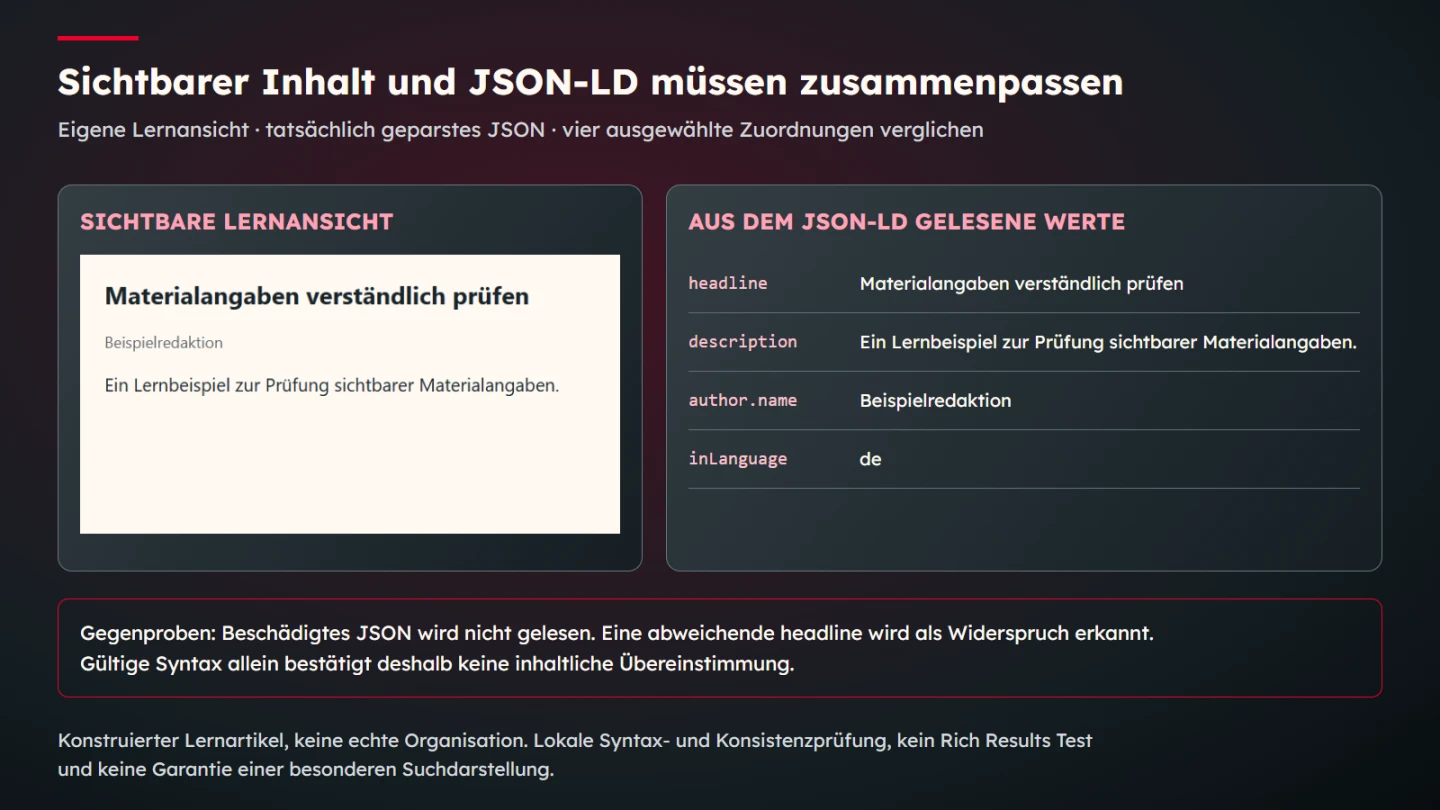
The check reads the exact code published in the article. A browser renders the visible teaching view and the JSON block is parsed as JSON. The heading, description, author name and language are then compared with the corresponding visible information. The English example is checked independently using its own text.
This answers bounded questions: is the block syntactically readable, do selected values match within this example and is the declared type Article? It is not a general validation of the whole Schema.org vocabulary. It also does not check whether a search engine has fetched the page or will display a particular search feature.
Two counterexamples reveal the distinction. An intentionally damaged JSON block fails to parse. A changed headline remains syntactically valid but no longer matches the visible heading. The second discrepancy demonstrates why successful parsing alone is insufficient for the editorial consistency check being performed here.
Both counterexamples remain isolated teaching cases. False information is not published on a real page to create the demonstration. Detecting these differences does not justify a claim that every possible misleading statement will be discovered automatically. Other properties, relationships and content require their own appropriate review.
Name practical checks just as precisely. A JSON parser checks readable structure. A custom comparison checks selected values. An external service evaluates the rules it supports. A human reviews the actual connection with the subject, among other things. A report should state which of these tasks was genuinely performed rather than combine them into an unexplained approval label.
A review table for the actual implementation
Before release, technical and editorial checks need to come together. The table prevents one successful result from covering unrelated questions. It also supports discussion between editors and developers. Each row makes a bounded statement so unresolved issues can be addressed specifically.
| Question | Appropriate evidence | Result boundary |
|---|---|---|
| Is JSON readable? | An executed parser check | Does not establish factual accuracy |
| Does the type fit the subject? | Visible main content and vocabulary | Does not create a search appearance |
| Do the descriptions agree? | Comparison with visible content | Checks only selected properties |
| Are service requirements met? | Current documentation and suitable tools | Does not guarantee actual display |
| Is information maintained? | An update process and renewed review | A past success is not indefinite approval |
| Was the published page encountered? | An actual retrieval or indexing record | Does not follow from a local preview |
Google's general structured-data guidelines require an accurate relationship with visible content and explain that correct markup does not guarantee a special appearance. Both points belong in planning. A test report should therefore not become a promise about how search results will look.
For a production page, the complete delivered response matters too. A template can look correct while another component adds conflicting information. Inspect the whole output rather than one source file in isolation. Several descriptions are not inherently wrong, but their relationships and possible contradictions need to remain understandable.
The same applies to images, dates and authors. If used, they need to belong to the specific publication. An arbitrary company logo is not automatically the article image being described. Today's editing date is not automatically the original publication date. A technical property needs the appropriate real-world meaning rather than a convenient available value.
Maintain and extend without uncontrolled multiplication
Initial insertion is only the beginning. Articles are renamed, descriptions revised and bodies expanded. Establish where information is maintained and how it reaches the output. If two separate places store the same fact, address that duplicate responsibility deliberately. Otherwise divergence becomes a predictable maintenance consequence.
Extend through actual use cases. A suitable navigation path may receive a structured description when its real sequence is known. A real organization can be described when dependable information exists. That does not require inserting every theoretically available type into every page. Actual content remains the deciding criterion.
Ratings and other especially persuasive-looking claims need a clear foundation. This example intentionally includes no stars or invented opinions. Teaching data should not accidentally migrate into a public description. Keep demonstration information separate from actual publication data and inspect every remaining example value when adapting a code sample.
Clear ownership also helps when service requirements change. Documentation for a search feature can change without the underlying vocabulary changing in the same way. Recheck the relevant source when introducing a new feature or substantially revising an old implementation. A previous source date documents a past review; it does not promise future rules.
For a small website, a bounded and well-maintained implementation is often a more useful working foundation. It can be understood, inspected and explained. Scope should grow from real content and applications. Property count does not answer a reader question and cannot replace dependable editorial information.
Make release a traceable decision
Final review connects the visible subject with its delivered description. Record the page considered, the source date and the checks genuinely performed. A short specific note is more useful than an assertion that everything has been optimized. It explains what was confirmed and which questions remain beyond that particular review.
- The selected type fits the actual main content.
- Used values have a traceable foundation.
- Visible and machine-readable values agree within the reviewed scope.
- Language versions are checked against their own content.
- Example values and fabricated ratings are excluded.
- The complete output has been reviewed for contradictory descriptions.
- Current service-specific requirements are interpreted appropriately.
- Tools are named only alongside checks actually performed.
- No special search appearance is promised.
- Updates and maintenance have an identifiable owner.
The learning article's confirmed result consists of readable JSON and agreement between selected values. That statement is small enough to test directly. It provides a dependable basis for further work. Structured data is most useful when it accurately describes existing information and its limits remain as understandable as its technical form.
Investigate a contradiction step by step
Suppose the visible heading changes to Reviewing material descriptions carefully while the JSON-LD still says Checking material information clearly. Both phrases are plausible and the parser can still read the block. The contradiction appears only when the actual values are compared. Start by tracing their sources rather than changing the declared type.
First check whether the values come from separate fields. If they do, decide which source is authoritative and inspect the output again. If both already come from the same field, a cached or additional version might be involved. Check that hypothesis against the actual delivered page. It is not a reason to add more blocks blindly.
A language discrepancy can be investigated similarly. English visible content with a German headline value is not justified by the existence of a German source field. The output should follow the intended content. Inspect language selection where the data is assembled. A general translation relationship in the project does not prove that this output uses the appropriate version.
After correcting the discrepancy, document it narrowly. The reviewed properties now agree. That does not mean a search feature was triggered or guaranteed. Precise wording separates technical correction from later observations about visibility. Both may matter, but each needs its own evidence.
Document mappings before extending them
A small mapping record prevents unnecessary searching later. It names each technical property and its source. In the teaching case, headline comes from the visible main heading, description matches the visible introductory sentence, author.name refers to the stated demonstration editorial role and inLanguage describes the learning view's language. These relationships are more concrete than saying metadata is generated automatically.
For a real implementation, add who owns the source information. Editors may choose the heading while the implementation transfers it into the corresponding field. Confusing responsibility for content with responsibility for format can leave questions unresolved between both groups. An explicit mapping makes the next action easier to identify.
Record intentionally unused properties when their absence otherwise causes repeated questions. The example does not invent real dates or images. That is a content boundary of the teaching view. The same property may be useful for a real publication once a suitable maintained foundation exists. An unused property is therefore neither generally prohibited nor automatically an error.
Review each extension as a new small decision. What information is being added? Where is it visible or otherwise supported? Which subject does it describe more accurately? What check could detect a wrong value? These questions lead to a traceable improvement instead of allowing the dataset to expand merely because a tool offers more empty fields.
Preserve technical spelling when adapting the example as well. JSON property names and strings use double quotation marks; braces define the object. An extra comma after the last property damages the JSON. These characters are not editorial typography. Automatically substituted typographic quotation marks can therefore affect code differently from prose. Check the actual stored code rather than a visually similar presentation. The damaged-JSON counterexample addresses this limited error class.
Sources and scope
Sources checked on 9 November 2026. The linked Google and Schema.org primary sources were opened. The learning page and Beispielredaktion role are constructed. Executed checks concern local syntax and selected consistency. They do not claim an actual Rich Results Test submission or a displayed search result.