Writing clear and concrete service descriptions
Move from the reader's decision to a traceable output, with consistent quantities and understandable boundaries.
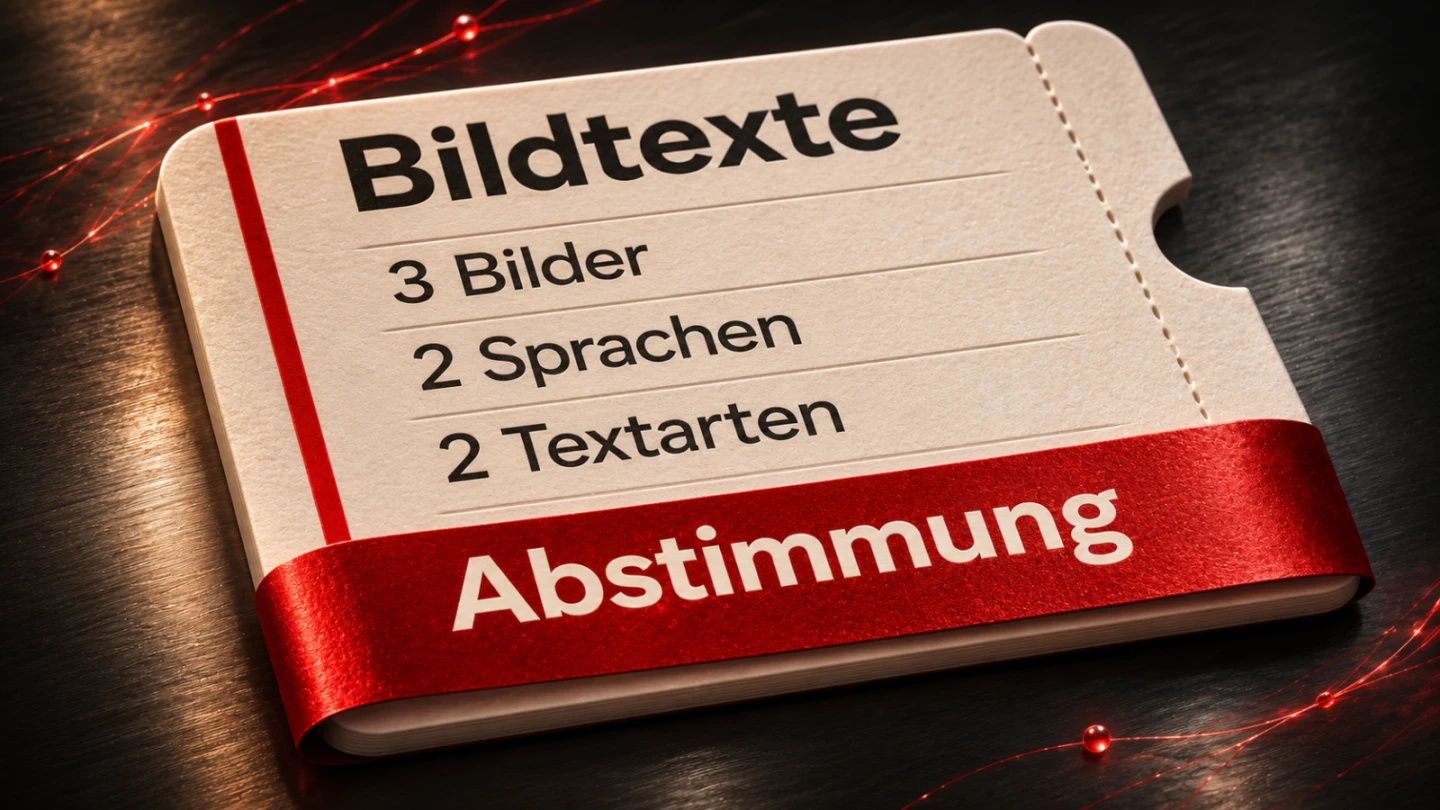
A service description should make clear what someone receives, what information is needed and where the described scope ends. General promises rarely achieve that on their own. Comprehensive support can refer to very different activities. A concrete description instead identifies the subject, work and output, giving readers a basis for deciding whether it fits and for discussing the next step.
This does not mean overloading every public page with implementation detail. Appropriate information belongs in the appropriate place. A short service page and a detailed working brief can use different depths while describing the same task accurately. This guide demonstrates an editorial method through an explicitly constructed example. Its quantities and workflow are teaching parameters, not an actual agency offer.
Begin with the reader's decision
First establish which decision the description supports. Is someone checking whether the service broadly fits? Is a team agreeing a specific amount of work? Is an existing output being reviewed? These situations need different detail. Addressing every question simultaneously without a clear sequence can make the introduction difficult to use.
The GOV.UK guidance on user needs starts with what people actually need from a service. An editorial description can apply a practical question: what information is missing before this person can choose a sensible next step? The answer should follow the actual need rather than only the provider's internal organization.
Internal terminology may need translation into the task. A business may organize work into editorial, design and development functions while a prospective customer wants to know whether existing images can be prepared for a publication. Name that task first, then explain relevant activities. Internal structure matters only where it clarifies responsibility or process for the reader.
Keep the main question available for final review. In the teaching case, it is: which editorial texts are produced for three supplied images and how is feedback handled? This bounds the subject. Photography, retouching and publication are not silently included. That clarity is often missing from a broad title such as professional image support.
Identify the subject so it can be found again
An activity needs a concrete object. Three images is clearer than image material. Working coordination additionally records which three files are meant. The example uses the unique identifiers B01, B02 and B03 for the jointly selected source images. These identifiers do not claim the existence of actual customer photographs.
Such mapping prevents a replacement file from quietly being treated as unchanged material. Changing the image may require a different caption and text alternative. A shared filename alone does not prove identical content. Actual work therefore needs a dependable relationship with the specific approved sources rather than merely a familiar label.
Intended use belongs to the subject too. An image can provide a product overview or a detail within an instruction, affecting its useful description. Saying only that an image receives text leaves that question unresolved. State the context where it is known and keep unknown uses as explicit coordination questions rather than guessing them.
Keep precision proportionate to the document. A short public description need not list every internal identifier; it can explain the type of source material. The working brief supplies the exact mapping later. Those levels still need to agree. The public version should not announce work that the described workflow does not actually include.
Connect the activity with its output
Verbs reveal the work. Review, write, discuss and deliver name distinct activities. Optimize remains broad without a subject and outcome. If a text is revised, explain the relevant considerations and resulting output. Naming activity alone does not establish what will be available afterwards.
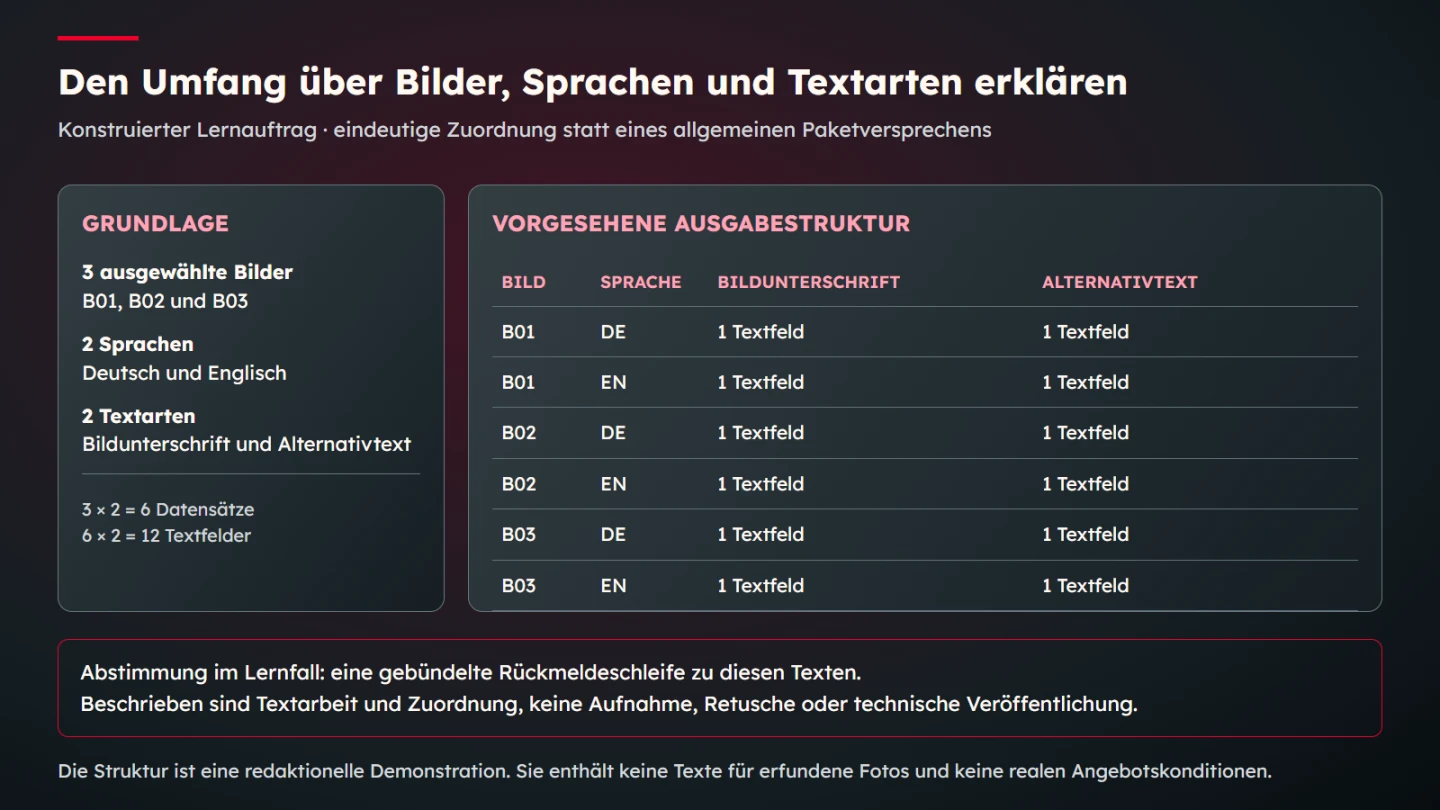
The teaching case produces one caption and one text alternative for each of three images in German and English. That means three captions and three alternatives per language. This assignment is concrete enough to trace. It promises neither a new image file nor technical insertion of the texts into a website.
Captions and text alternatives serve different roles. The WAI informative-images tutorial explains the contextual role of a useful alternative. A visible caption can identify a crop, while an alternative conveys image information relevant to its use. Two differently named fields are therefore not automatically served well by copying the same sentence into both.
Actual writing requires viewing the image. A service description alone cannot generate an appropriate alternative. The intended role in the publication also needs to be known. Inventing visual content would not improve precision. A useful description can state that prerequisite without pretending to deliver finished text for pictures that have not been inspected.
Make quantity and counting units understandable
Quantities are clearer when their units are explicit. Three images, two languages and two text types are distinct dimensions. Saying six texts leaves the calculation uncertain. The example organizes output by image identifier and language, with separate fields for the two editorial text types.
| Element | Teaching-case definition | Meaning |
|---|---|---|
| Source material | B01, B02 and B03 | Three jointly selected images |
| Languages | German and English | Two language versions per image |
| Text types | Caption and text alternative | Two distinct editorial roles |
| Output | Six mapped records with two text fields each | Six captions and six alternatives in total |
| Review | One consolidated feedback round | Feedback concerns the described text output |
The table establishes a traceable counting method. It does not mean the texts have been written or the images inspected. It describes the structure of a constructed learning case. That distinction matters when adapting an example into a working template: quantities and roles need replacement with the actual information.
A package name can still provide a useful introduction. It should summarize rather than hide quantities and deliverables. The following description explains the name. When comparing packages, use consistently explained units so a higher number does not simply result from a different counting convention.
Explain prerequisites as part of the workflow
Many services begin with information another person supplies. Here that includes the selected images and their intended context. A product name needs its correct spelling. A property mentioned in a caption needs a factual basis. Writing should not invent this information to fill a field attractively.
Explain prerequisites through their purpose. A long technical file checklist may be excessive for initial orientation, while a working brief needs the necessary details. State what each input supports. That makes requests understandable and helps missing information be obtained deliberately instead of sending an unexplained list back and forth.
If a prerequisite is absent, identify the next action. The team may need to establish the use or select another image. That does not automatically create a delivery deadline or a promise that every gap will be solved without further discussion. Describe the situation that actually exists rather than generating an implied guarantee through polished wording.
Distinguish assumptions from confirmed facts. A picture appearing to show a material does not establish the actual material. A real description needs the required fact clarified. The service description can name this need understandably, but it does not replace the later factual review of the specific content.
Clarify feedback and changes
A feedback round is flexible language without further explanation. In the learning case, comments on the intended twelve text fields are collected together and considered for one revision of that output. This defines the subject of review. It does not include unlimited additional images or languages within the same stated scope.
Correcting spelling and replacing an entire image are different changes. Both can be justified, but they affect different foundations. Replacing B02 with another picture requires reviewing its mapping again. A clear description makes that a concrete new question instead of hiding it inside a vague word such as adjustment.
The feedback format should support the task. A consolidated list identifying image, language and field is traceable in this example. Contradictory comments from several directions need clarification before revision. The description can explain this coordination without prescribing one organizational model for every real project.
State timing only as precisely as the actual agreement permits. A clear activity does not justify an invented deadline. Real milestones need to fit the known prerequisites and responsibilities. The teaching example deliberately specifies no price, delivery period or response time. Those facts cannot be derived from the wording exercise.
Connect boundaries with the overall service picture
A description does not become precise merely by excluding as many activities as possible. Identify boundaries relevant to a realistic understanding. Here image editorial support could otherwise imply photographic production, so the example explains that taking photographs, retouching and technical publication are not part of the described work.
Put that boundary near the activity. A discreet footnote far beneath a contradictory promise does little to clarify the whole presentation. Heading, summary, imagery and detailed text should communicate the same scope. A picture suggesting an elaborate photo shoot can create confusion if the work only concerns existing captions.
Prefer positive descriptions where they explain more. Editorial texts for supplied images identifies the task directly, followed by a relevant boundary. This keeps attention on the actual service. A catalogue consisting mainly of exclusions would instead hide the benefit and make the core work difficult to locate.
Also distinguish an output from a broader effect. Suitable image texts are the deliverable described here. A search position, increased sales or complete website accessibility does not follow automatically. Such claims require another foundation and should not appear casually in a summary merely because they sound persuasive.
Simplify language without losing meaning
The Microsoft Style Guide on simple words and concise sentences recommends understandable precision. This is useful for abstract chains of activities: name the action directly rather than describing the implementation of the creation of something. Preserve the exact meaning while shortening.
A specialist term can remain when it correctly identifies the subject and is explained where necessary. A text alternative is not simply any description of a picture. Editorial approval is not automatically technical publication. Replacing every term with an approximate everyday phrase can therefore introduce new uncertainty rather than improve clarity.
Review the job of each paragraph. One explains the output, another the source information and another the review process. If several only promise quality, a relevant relationship may be missing. Add the needed information or remove the repeated thought. Synonyms for individual do not resolve a lack of substance.
A friendly voice remains possible. Direct understandable sentences need not feel cold. They can identify the next action and explain an unresolved question. Personality can come from appropriate address and useful guidance. Unsupported superlatives and artificial urgency are not prerequisites for sounding approachable.
Make the handover reviewable
A clear service description enables a concrete completeness check. Each of the six image-and-language combinations should appear in the learning structure. Every record has a caption field and an alternative-text field. That verifies the agreed organization, while judging the actual text requires inspecting the specific image and context.
Do not confuse these checks. A fully populated table can describe an image incorrectly. Conversely, one excellent sentence cannot replace a missing second language version. State the delivered form and the actual considerations used to assess its mapping instead of treating a filled spreadsheet as proof of editorial suitability.
A brief handover note identifies included versions and feedback addressed. Keep unresolved factual questions apparent. That is more useful than a blanket done when a product name remains unconfirmed. A real project should report its actual state rather than claim an output not delivered or hide an unresolved question in an impressive filename.
This article's explanatory graphic therefore presents the assignment structure, not completed captions for invented photographs. It connects source material, languages, text types and handover. It is a bounded editorial demonstration. Actual viewing and writing for real images remain separate work.
Review the publication as one connected description
Read only the heading and summary first. Do they already create an accurate impression? Then inspect the details: are quantities, prerequisites and output understandable? A precise table should not need to quietly correct an exaggerated introduction. The parts should describe the same work at different levels of detail.
- The description answers a concrete decision question.
- Subject and intended use are identifiable.
- Activity and delivered output are distinguishable.
- Quantities use explicit units and mappings.
- Prerequisites appear where they are needed.
- Feedback and changes are explained clearly.
- Relevant boundaries fit the overall presentation.
- No unsupported deadlines, functions or effects are introduced.
- Output structure and editorial suitability are checked separately.
- Examples are not presented as real offers or customer cases.
A useful service description makes a specific task discussable. Here that means texts for three selected images in two languages, clearly mapped and subject to a defined review. Precision comes from those relationships. A broad advertising sentence cannot replace them. The description shows what is meant and which next question still needs resolution.
Derive a short version from the actual information
The constructed starting sentence We provide comprehensive professional image support leaves the central questions open. A bounded revision could say: Captions and text alternatives are produced in German and English for three selected existing images. Each text is assigned to its image identifier and language. One consolidated feedback round concerns these texts. Photography, retouching and technical publication are outside this teaching scope.
This is longer than a package name but answers several connected questions. It identifies material, activity, output and review. Depending on the placement, the first sentence can serve as an introduction while the remaining detail follows in a clear section. The important point is that shortening does not introduce new ambiguity and readers can find the information where they need it.
Only transfer that version to a real offer when its statements actually apply. Three images and one review round are deliberately chosen learning values. Other projects may need different quantities, languages or coordination. The method consists of describing those relationships explicitly rather than copying one example scope without checking it.
A later change then remains discussable. Moving from three images to four changes the quantity structure. Two languages and two text types would create eight mapped records with sixteen text fields. This calculation clarifies organization. It determines neither a price nor a date and does not establish editorial quality. Those questions have their own actual foundations.
Sources and scope
Sources checked on 9 November 2026. The linked GOV.UK, Microsoft and WAI primary sources were opened. The assignment using B01 through B03 is an original constructed teaching case. Quantities and review terms are not actual commercial conditions. No customer images, delivered image texts or measured business effects are claimed.