Developing expert articles from dependable sources
From a reader question to a traceable expert article, using appropriate evidence, checked examples and explicit limits.

A dependable expert article makes its important statements traceable. It uses appropriate sources, describes its own observations precisely and identifies recommendations as reasoned decisions. A long link list alone does not achieve this. What matters is the relationship between a specific statement and the evidence that actually supports it.
This guide develops an editorial workflow through a small technical example: an explanation of email fields in contact forms. The question is what a browser check can establish and which conclusions go beyond it. The example combines documentation with isolated browser observations. No message is sent, no mailbox is checked and no real customer workflow is presented as successful. These limits are part of the method, rather than details added after an impressive claim has already been written.
1. Choose an answerable question
Forms is a subject area. What does an email field check in the browser is a concrete question. Narrowing the task makes research easier and protects the article from unnecessary side claims. The proposed explanation does not need to solve spam prevention, privacy, accessibility and delivery simultaneously. It can identify their boundaries while answering its own question reliably.
Write a short research assignment first: readers should be able to distinguish format validation, required input and actual reachability after reading. This gives source selection a criterion. A newsletter marketing article may be interesting, but does not automatically answer this technical question. Documentation of the relevant input element is initially closer to the object being described. The assignment helps an author resist adding impressive but unrelated material.
Record what the article is not intended to establish. The example claims neither a better enquiry rate nor particular delivery rates. This is an internal editorial decision, not a public construction notice. It helps prevent a later sentence from leaping from one small technical function to broad commercial success. The eventual text should state what the evidence supports rather than advertising every subject excluded during planning.
2. Identify where information comes from
A primary source addresses a subject from a directly responsible perspective. For an HTML element's function, its specification and dependable technical documentation are important starting points. A project observation needs an actual review record. A summary blog can help orientation, but does not replace those foundations when the article makes a precise technical statement. Choose the source according to the claim, rather than treating every familiar domain as equally authoritative for every question.
Being close to the subject does not mean answering everything. Product documentation often describes a function within its own context. A standard explains requirements but does not prove a particular website fulfils all of them. An original test records an observation under specified conditions. The editorial process keeps these roles distinct. Otherwise a source's legitimate authority in one area can be borrowed to support something it never examined.
The example actually consults the MDN email-input reference and the WAI explanation of control labelling. The first supports the function description; the second explains association between a control and its name. Neither is used as evidence that a message was successfully sent. Assigning a narrow role makes each reference more useful, not less.
3. Break statements into small units before drafting
The sentence A correct email field makes the form secure and delivers valid enquiries contains several different claims. What counts as formally acceptable input is one question. Which security measures protect the complete process is another. Whether a message actually reached its destination requires separate evidence. Do not merge them into one unexamined success statement merely because they all involve an email address.
Write small reviewable units instead. One statement says that the selected email field participates in format validation. Another says that the required attribute changes the treatment of empty input. A claim about an existing mailbox is kept separate. This makes appropriate evidence easier to choose and prevents a true fragment from concealing an unsupported extension. It also gives a specialist reviewer a specific question to answer.
For each unit, identify the kind of foundation needed. A documented function needs a relevant passage. An original observation needs a reproducible procedure. A recommendation needs a reason linked to the reader's task. This mapping is not an automated truth machine. It exposes unanswered questions and sentences needing narrower wording. Its value comes from making the editorial reasoning inspectable before fluent prose makes uncertainty difficult to notice.
4. Maintain a simple claims register
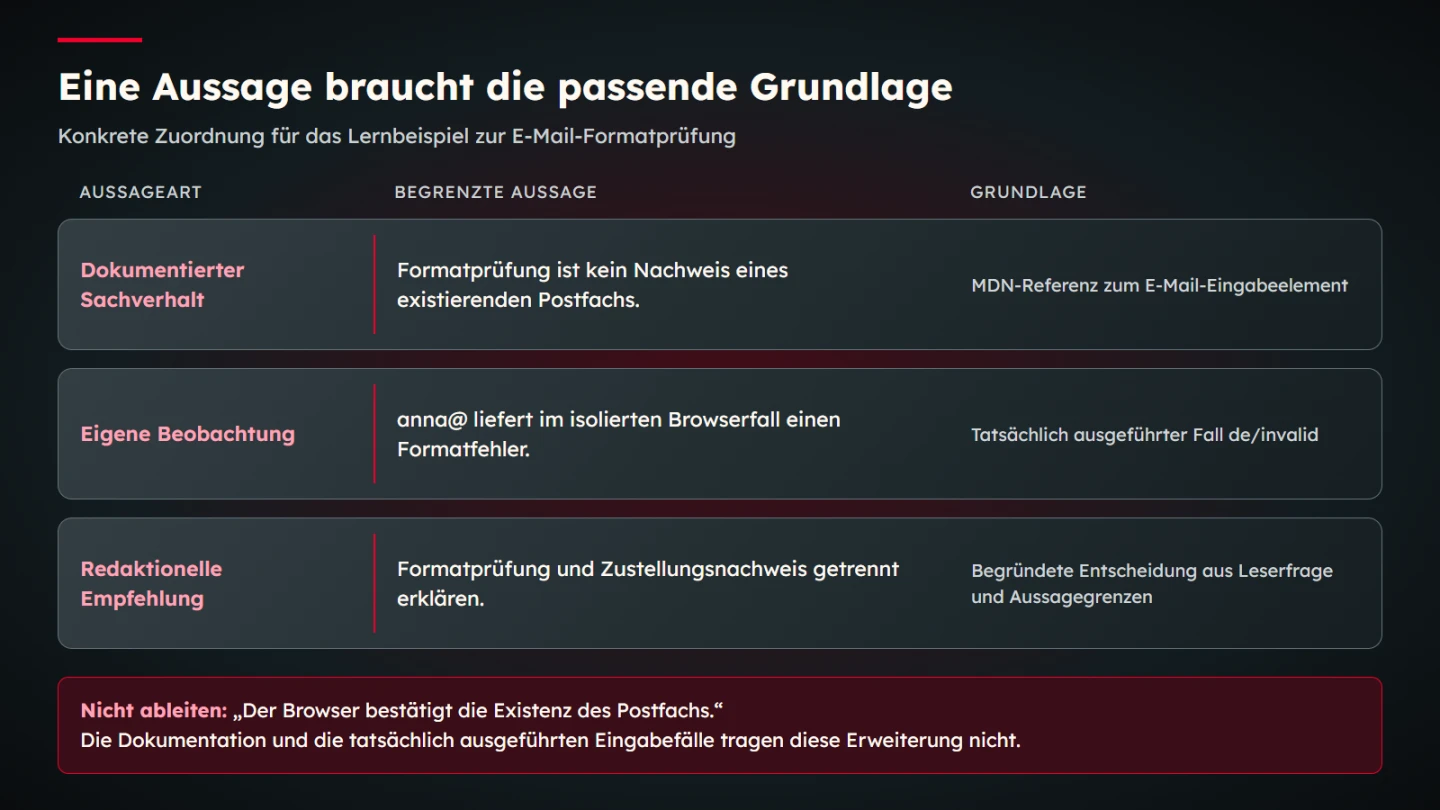
| Statement type | Example | Suitable foundation |
|---|---|---|
| Documented fact | The email input checks a format | Documentation of that specific function |
| Original observation | anna@ is rejected in the isolated test | An executed browser case with expected properties |
| Editorial recommendation | Explain format validation separately from proof of delivery | Reasoning from the reader question and evidence limits |
| Unsupported extension | The browser confirms that the mailbox exists | Not established by the available foundations |
The register can be a short table rather than an elaborate database. What matters is the exact statement, its foundation and intended status. An open point stays open until someone responsible resolves it. It does not become approved because the wording sounds convincing. A useful record also distinguishes a source that has merely been found from one whose relevant passage has actually been read.
Connect sources to individual claims. Five technical references do not tell a reader which supports a particular sentence. Keep that connection understandable in the working material. In the published article, place important references near the relevant explanation. Readers should not have to reconstruct the relationship from a distant collection. This also makes later maintenance easier because a changed source points to identifiable statements.
5. Read the relevant passage
A search-result description is a lead rather than a fully read source. Open the appropriate page and locate the section answering the question. Read the neighbouring qualifications too. A short summary can easily lose the difference between possible in general and possible under particular conditions. The later sentence must preserve those distinctions. If the conditions change the recommendation, they belong in the article rather than only in private notes.
For the email example, a properly formatted address does not automatically establish an existing mailbox or ownership by the user. The MDN reference explicitly describes that limit. The explanation does not turn this into a complete identity-verification guide. It simply avoids misrepresenting format validation. The text stays with the question for which the source was consulted and does not borrow its authority for a neighbouring claim.
Write a short meaning note in your own words. Do not copy long passages into the draft as a precaution. The note identifies what the source contributes to this article. If an important qualification cannot be explained clearly, research is not yet sufficiently resolved. Language polishing by a writing tool must not hide that uncertainty. A smooth sentence is useful only after the author understands what it can legitimately say.
6. Add a bounded original test
Documentation and original observation can complement each other. Here one input with a visible label is sufficient. There is no server call or delivery. The test reads the browser's validation properties. It can show what happens in the particular case without converting the observation into a broader promise. The test's small scope makes its evidence easier to interpret and repeat.
<label for="contact-email">Email address</label>
<input id="contact-email" name="email" type="email"
       autocomplete="email" required>
The three values are an empty input, anna@ and person@example.org. Expected results are a missing required value, a format mismatch and input accepted under the browser's rules. No connection to a mail server is established. In particular, the last address is not asserted to be reachable or to belong to anyone. The example does not need those facts to explain the distinction.
The report records the browser environment and properties read. The label must actually be associated with the control as well. That is another bounded observation, rather than a complete accessibility assessment of a contact form. The learning case establishes a particular relationship whose limits remain visible in the prose. A report that says precisely what it checked is more useful than an unexplained pass badge.
7. Separate observation from inference in the wording
A useful observation sentence names condition and outcome. In the isolated browser case, anna@ produces a format mismatch is more precise than Email addresses are reliably checked. The latter can encourage a much broader interpretation of checking. Specific wording also prevents one case from becoming a general assessment of every browser and form. The description should remain proportional to the work actually performed.
Then state any inference with its reasoning. An explanatory article benefits from treating format validation and proof of delivery as different tasks. That is an editorial recommendation derived from the question. It is not presented as a verbatim instruction from a technical source. A well-supported recommendation can be confident while remaining identifiable as a decision. Readers should understand why it follows rather than being asked to accept an institution's name as sufficient explanation.
Avoid proves, guarantees and complete when their scope is unsupported. Often the solution is to name the object more precisely. Instead of Fully tested, say that the three described input cases were executed in the stated environment. This is not weaker writing. It is an accurate account of the available foundation. Precise limits help readers apply the finding to their own situation without silently inheriting assumptions the author never checked.
8. Deliberately distinguish adjacent subjects
The MDN introduction to form validation distinguishes browser checks from necessary server-side controls. The OWASP input-validation guidance adds a security perspective. These references support the distinction. They do not turn the tiny learning input into a fully protected contact process. The article must not imply that its reference list supplies implementation work never performed.
Decide which adjacent question needs a short explanation. Here it is enough to say that browser validation is neither exhaustive security nor a delivery acknowledgement. Actual server processing deserves another treatment. This keeps the article understandable without concealing neighbouring responsibilities. A blanket security claim would be shorter but less accurate. Good editing sometimes requires retaining a distinction that prevents an attractive simplification.
The technique applies outside technical subjects too. A source about cost does not automatically establish one project's profitability. A legal principle does not decide every case. A published feature does not prove commercial success. Identify the actual question and hold adjacent conclusions to their own evidence. An article can be useful without pretending that one source collection settles every consequence of the topic.
9. Give writing tools a bounded assignment
A writing tool can propose an initial structure from a clarified claims register. Its assignment should include the available foundations and their limits. In this example, it may organize the statement types and explain them clearly. It must not add participants, delivery rates or supplier quotations. Such instructions focus the subsequent review because the author knows which decisions the draft was allowed to make.
Do not provide only URLs and request an automatically authoritative article. If their contents have not actually been read or made available, the working foundation is missing. Record which passages were reviewed and which conclusions appear justified. A tool can assist that preparation, but fluent wording cannot retrospectively perform it. Treat a draft as something to inspect rather than as proof that the research assignment has been completed.
Publication responsibility remains with the editorial process. Open an automatically inserted reference and compare it with its associated sentence. A plausible link can be irrelevant. An appropriate source can still fail to support stronger wording. Review both existence and actual relationship. This prevents a common failure in which a technically valid citation creates the appearance of evidence without carrying the claim placed beside it.
10. Distinguish quotations from original explanation
Use a direct quotation when its exact wording matters to the explanation. Give it a traceable origin and keep its extent appropriate. Many practical articles benefit more from an independent summary with a precise reference. That summary must not extend the meaning or remove a decisive qualification. The author's clearer structure should help understanding rather than quietly changing the source's scope.
Original wording does not make the underlying information source-free. A sentence describing a specific documented function still benefits from a suitable reference. The editor contributes structure, examples and interpretation. Merely rewriting another tutorial sentence by sentence is not a substantial new explanation simply because different words appear. A useful article makes its own question and reasoning visible while acknowledging the foundations it uses.
This example uses no fabricated expert quotations. It explains the documented principles and connects them to bounded original observations. That leaves room for a clear editorial voice. Expertise comes from correct relationships and understandable explanation rather than the number of quotation marks or prestigious institution names. A straightforward description with a relevant source is often more informative than an ornamental quotation added to imply authority.
11. Handle conflicts and missing information visibly
When sources appear different, compare their objects first. Do they concern the same function, time and conditions? A general introduction and a detailed reference can differ in depth without contradicting each other. Do not turn that difference prematurely into an alleged dispute between authorities. Establishing the actual scope often resolves what initially looked like a conflict.
If a real disagreement remains, investigate it or narrow the claim. Working notes identify what remains unresolved. The public text can explain the reliably established part. It needs neither an internal construction notice nor invented certainty. The objective is a defensible sentence. Omitting an unsupported extension is often a better editorial decision than including it with confident phrasing and an unrelated citation.
Missing data is also an outcome. The example supplies no information about delivery, so it gives no delivery percentage. That is stronger than an attractive invented number. The article answers the available question reliably rather than adding another statement because it would look good in a chart. A diagram must follow the same evidence boundaries as the prose and should not smuggle in a stronger conclusion through its labels.
12. Focus specialist review on the important sentences
- Does the article answer an explicitly stated question?
- Does each important factual claim have an appropriate foundation?
- Were the relevant passages actually read?
- Are original observations described with conditions and limits?
- Do recommendations remain identifiable as reasoned decisions?
- Are invented numbers, quotations and project outcomes excluded?
- Does the source support the exact wording rather than merely a neighbouring subject?
- Were code and examples actually checked in the described form?
- Do images, tables and labels preserve the same evidence limits?
Start with sentences whose failure would matter most. Here that is potential confusion between format validation and mailbox existence. An error there would undermine the article's central explanation. Punctuation matters too, but addresses another question. Review language and substance separately, then assess them together. This keeps a polished surface from being mistaken for professional correctness.
Feedback names the specific sentence and missing step. This goes beyond the source becomes actionable when the unsupported extension is identified. The editor can then narrow it, find another appropriate foundation or remove it. A vague request for more expertise often produces additional unverified detail. Precise review instead makes the existing explanation more dependable without expanding its scope unnecessarily.
13. Hand over an article that can be maintained
Keep source date, relevant versions and original test results retrievable. A later documentation change can trigger a focused review. For that, the team needs to know which claim depends on the changed source. A well-recorded article is easier to maintain than one whose foundations exist only in its author's memory. The register should support useful future work rather than becoming an administrative exercise detached from the text.
Distinguish a changed foundation from a changed recommendation. New project needs may justify another design without changing the documented browser function. Conversely, a technical change may affect a previously accurate example sentence. This mapping keeps updates limited and understandable. It also prevents every revision from becoming an unnecessary rewrite of material whose reasoning remains sound.
A finished expert article is therefore more than smooth prose. It connects a concrete reader question to appropriate sources, checked examples and a clear interpretation. That connection makes it useful to readers and to the people who later develop it. It is the practical difference between a collection of plausible sentences and a traceably researched explanation.
14. Hold summaries to the same evidence
Statement limits apply to titles, descriptions and short answers as well. An overextended introduction can undermine a careful body. A title such as How forms recognize real email addresses would go too far here. It suggests mailbox verification that the article does not perform. A suitable title identifies browser format validation instead. The shorter presentation must retain the same important distinction.
Review the metadata description together with the main answer paragraph. What expectation arises if someone reads only those two places? Do they promise a concrete explanation or an unsupported result? A short version need not repeat every qualification in the full article. It must not remove the boundary essential to understanding. Shortening means providing fewer details rather than making a stronger claim.
The same applies to a derived table or diagram. A column named Valid address could be misleading. Accepted by browser format rules describes the actual result more precisely. This accuracy also supports reuse: somebody quoting, summarizing or displaying the passage elsewhere can find the distinction in the relevant sentence itself. No particular search position or inclusion by an answer system is promised.
Sources and scope
Sources were opened on 9 November 2026. The linked WAI, MDN and OWASP primary material was actually consulted. The claims register, input cases and editorial workflow are original learning material. The browser checks concern only the described isolated case and establish neither delivery nor complete form security.