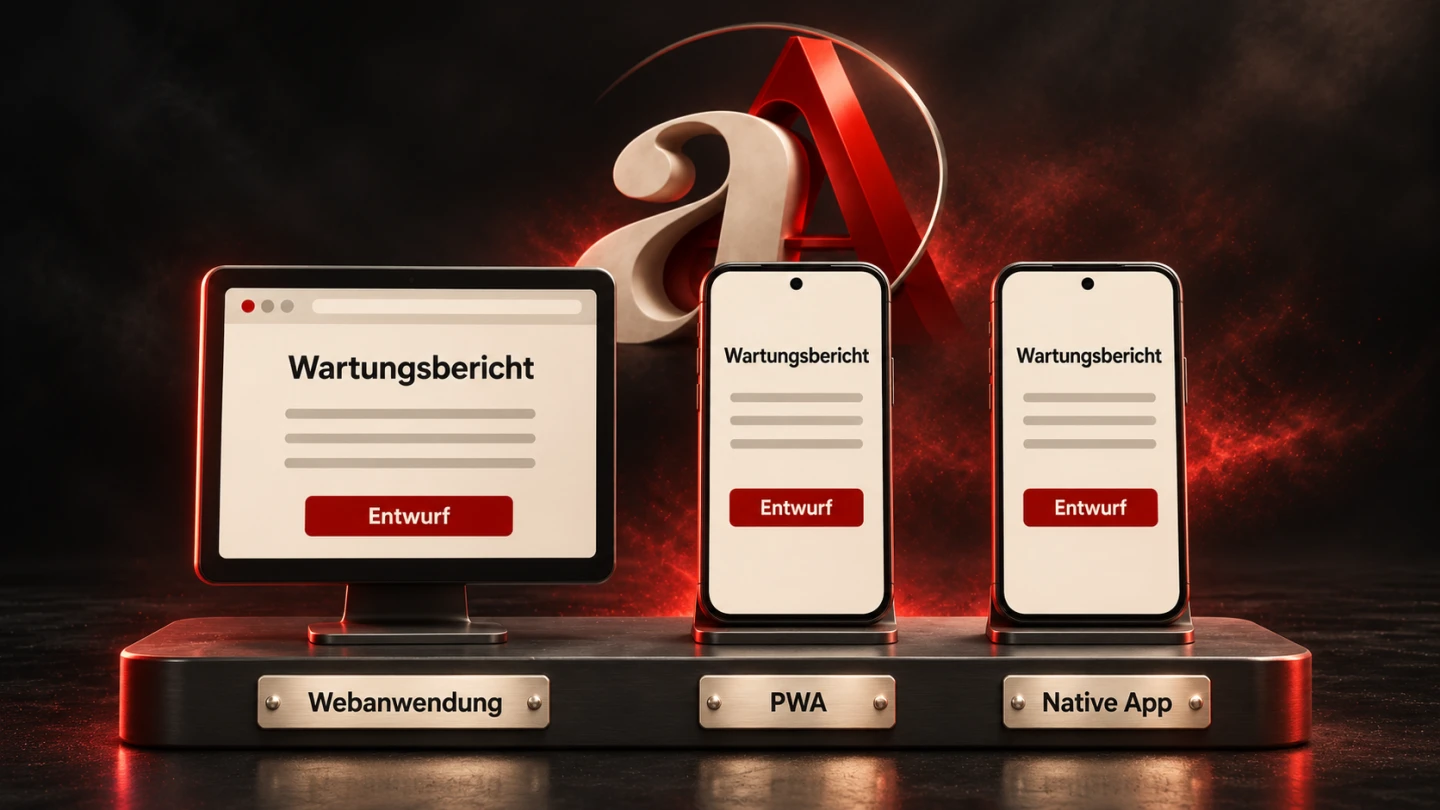
Turn an app idea into a useful first product scope
A fictional tool-lending workflow shows how a broad wish list becomes a coherent initial scope with explicit handovers and responsibility.

A product idea becomes manageable when its first scope solves a specific task completely. The shortest feature list is not automatically the best one. A lending system without a return process will not support dependable everyday work merely because its checkout screen looks attractive. This article shows how to turn a broad app idea into a bounded useful beginning and which decisions should be recorded clearly before implementation.
Translate the idea into a testable task
The starting idea is often broad: an app for a community tool library. That can include a catalogue, reservations, payments, messages, door access and reporting. Those labels do not establish which problem should be solved first. A team can build extensively without reducing an important uncertainty or improving the activity that matters most to its intended users.
Our fictional initial task is more specific: staff at an attended lending location record checkout and return of an individually identified item for a member whose identity has been checked in person. The desired result is a dependable current inventory. This names the audience, place, trigger and outcome. Mobile self-service is not silently included merely because the solution is called an app.
The GOV.UK discovery guide recommends understanding the underlying problem and questioning a predefined solution. Applied here, that includes considering an improved existing work list as an alternative. A new app is an option to assess rather than an already demonstrated need. The first decision should leave room for a simpler way of achieving the same useful outcome.
Separate observations from assumptions
The committee may believe checkout takes too long. Alternatively, uncertainty may arise about who currently holds an item. These are different problems. Before committing to a solution, understand which situations actually cause difficulty and how people currently handle them. Putting a belief in a presentation does not transform it into an observation.
Record the basis for each central statement. “A staff member reports unreadable return notes” is a reported event whose significance still needs investigation. “Every member needs push notifications” remains an assumption without further evidence. Careful wording keeps planning honest and exposes the question that should be investigated next. It also prevents one suggestion from becoming an unquestioned requirement through repetition.
The GOV.UK introduction to user needs focuses on people, their tasks and existing problems. Apply that perspective to actual staff and members. A fictional persona cannot replace evidence about their working conditions. The invented organization in this article illustrates a method rather than supplying that missing research for a real project.
Describe the complete workflow
Follow the activity from its beginning to a meaningful end. A member asks for an item. Staff locate the individual asset, recognize its state, record checkout and later see the open assignment. Return ends that assignment. Only then can the inventory reliably describe the item as available again. Each step contributes to the promised outcome.
Include the case where the item is already unavailable. The first version does not need to operate an automatic reservation marketplace. It must nevertheless avoid falsely confirming the same availability. An understandable rejection is therefore part of the central workflow rather than an arbitrary convenience feature that can be removed without consequence.
The sketch should include human activities as well as screens. In this example, staff verify membership in person. That activity belongs to the service even when it initially remains outside the app. A technically small solution is only substantively complete when these handovers are explicit. Otherwise the apparent simplicity depends on unplanned work that someone must discover later.
Define the first scope explicitly
| Area | Initial example scope | Deliberately separate |
|---|---|---|
| Inventory | Find an individual asset and see its state | Comprehensive public product catalogue |
| Checkout | Record assignment to a verified member | Self-service with automatic door access |
| Return | End an open loan and update availability | Automatic damage assessment |
| Operations | Responsible access and resolution of incorrect entries | Several independently operated locations |
| Communication | Understandable status for lending staff | Push campaigns and social features |
The right-hand column is not a hidden promise for a later delivery date. It records what this initial undertaking does not attempt to solve. Further investigation may show that some of those capabilities are unnecessary. A future wish list should not automatically become a binding remainder of the project. Its entries still need a reason and a suitable decision point.
Cut scope along the useful outcome
A first scope should preferably contain one complete usable activity. Finishing sign-in alone does not establish whether the lending service works better. A sophisticated catalogue is similarly insufficient when open loans cannot be recognized reliably. The useful boundary follows the outcome rather than necessarily following technical layers such as account creation, storage or interface construction.
Our initial audience can be limited to trained staff at one attended location. That reduces the number of operating contexts while preserving the complete task. Checkout and return remain together. Fewer audiences and fewer exceptional scenarios can be a more useful reduction than half a core workflow offered to everyone. The constraint makes the first result coherent rather than merely smaller.
After each proposed reduction, write down whether the intended result remains achievable. If the answer depends on an unnamed workaround, the process may be incompletely described. Either design that workaround as a sustainable handover or revise the scope. Do not let essential work disappear merely because it happens away from the screen.
Investigate the riskiest assumption first
One major uncertainty might be whether assets can be identified reliably during everyday work. If several drills look alike and their labels are unreadable, a modern menu will not resolve the inventory problem. An early exercise involving the actual identification approach and a simple lookup view would then be more informative than designing an opening animation.
The GOV.UK alpha guide discusses testing particularly risky assumptions. For your plan, add what observation would support or challenge each assumption. “People like the app” is too vague. “Staff can identify the specific asset being handed over” is more concrete and directly related to the proposed outcome.
A technical uncertainty can matter equally. If the existing membership system cannot provide a suitable handover, investigate that dependency early. A polished prototype can expose the question but cannot answer it by pretending a connection already works. Record which part has actually been checked and which part remains a simulated step.
Distinguish prototypes, experiments and usable products
A paper workflow helps explore terms and handovers. A clickable interface helps explore the sequence of actions. A technical experiment can investigate an integration or data rule. These materials answer different questions and do not all need to possess the properties of an operational product. Choose the form according to the uncertainty rather than making every experiment equally elaborate.
The GOV.UK prototype guidance distinguishes exploration from production code. Do not deploy an experiment merely because its interface looks convincing. Permissions, persistent storage and dependable error handling need their own implementation and verification. The visible screen is only one part of the work required for real use.
Name the question and stopping point before each experiment. Afterwards decide whether the evidence is sufficient, the approach should change or the project is not worth continuing in that direction. Discarding a prototype can be a useful outcome when it exposes an expensive false assumption early. The value is the decision it enables rather than the amount of prototype code retained.
Make a small state rule concrete
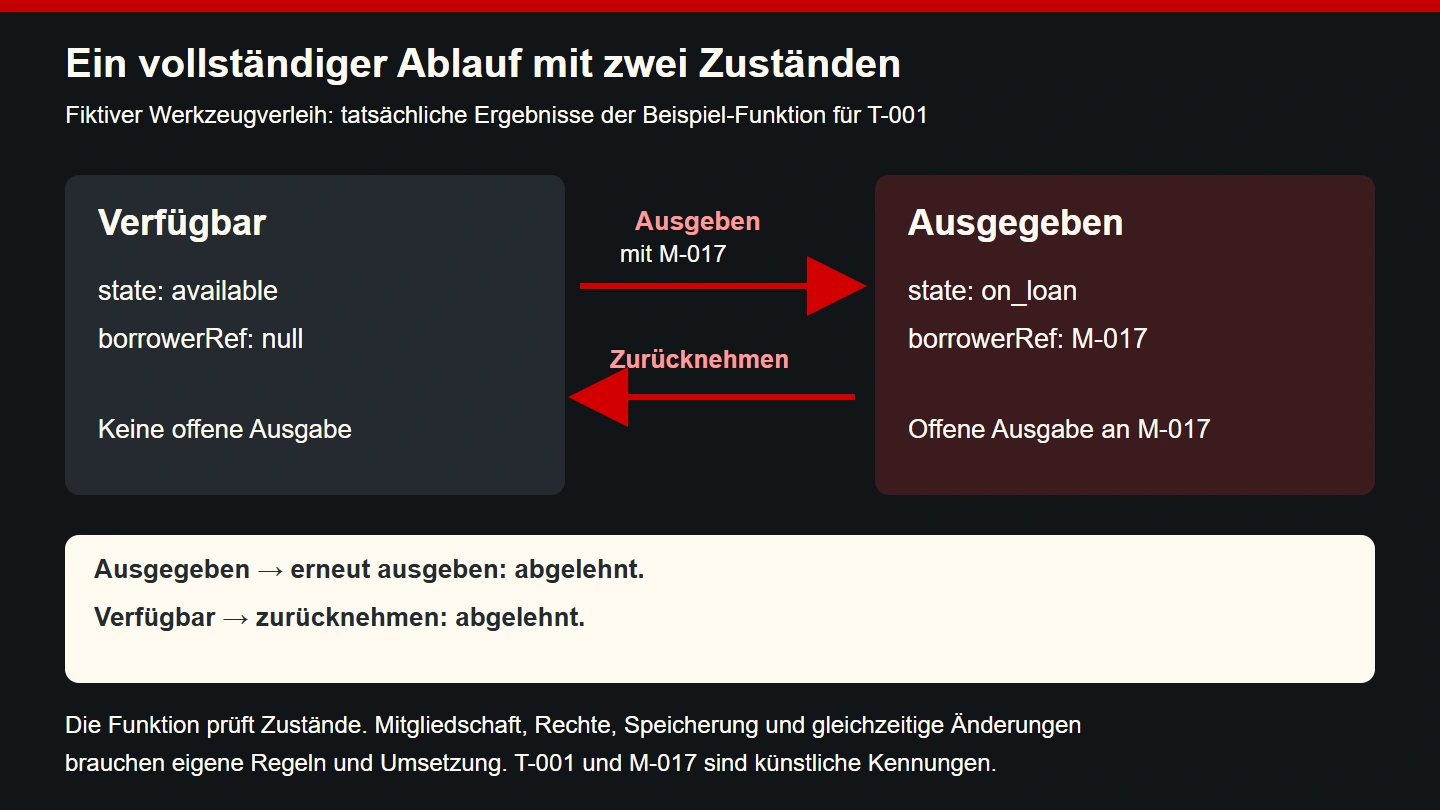
Our initial lending workflow uses two states: available and on loan. Checkout is permitted only from the available state. Return requires an open loan. The following function exposes that limited business rule. Identifiers such as T-001 and M-017 are explicitly artificial example values rather than real assets or membership records.
function changeLoan(item, command) {
  const member = value => typeof value === 'string' && /^M-\d{3}$/.test(value);
  if (!item || !/^T-\d{3}$/.test(item.id)
      || !['available', 'on_loan'].includes(item.state)
      || (item.state === 'available' && item.borrowerRef !== null)
      || (item.state === 'on_loan' && !member(item.borrowerRef))) {
    throw new Error('Ungültiger Beispielbestand');
  }
  if (command?.action === 'lend') {
    if (item.state !== 'available') throw new Error('Gegenstand bereits ausgegeben');
    if (!member(command.borrowerRef)) throw new Error('Mitgliedskennung fehlt');
    return { ...item, state: 'on_loan', borrowerRef: command.borrowerRef };
  }
  if (command?.action === 'return') {
    if (item.state !== 'on_loan') throw new Error('Keine offene Ausgabe vorhanden');
    return { ...item, state: 'available', borrowerRef: null };
  }
  throw new Error('Unbekannte Aktion');
}
The function does not mutate the original object. It returns a new example state or reports an invalid action. That makes the business rule independently testable. It includes no sign-in, authorization or database transaction. A pure function alone cannot coordinate two concurrent requests, even when its state checks work correctly in isolation.
A real application must safely account for current state when committing a change. Otherwise two checkouts could both rely on the same stale starting value. The technical solution depends on the storage system. The product scope must nevertheless require this reliability from the beginning when dependable inventory is its central promised outcome.
Write acceptance conditions rather than vague feature names
“Manage checkout” is a feature label rather than a testable expectation. State instead that authorized staff can assign an available item to an eligible member. The item then appears as on loan. A second checkout is rejected understandably. Recording return ends the open assignment. These statements describe behaviour that a reviewer can assess using specific examples.
Add error cases that matter to everyday work. What happens with an unknown identifier, missing membership reference or inventory changed in the meantime? The first version does not need every imaginable convenience scenario. It must handle expected fundamental problems so people can understand the situation and resolve it through an appropriate route.
The November 2020 Scrum Guide describes a Definition of Done as a shared quality commitment. Your project need not call itself Scrum to benefit from an understandable advance agreement on what counts as complete and usable. Do not confuse borrowing that idea with claiming that a partial set of practices constitutes the entire framework.
Do not postpone essential quality as a wish-list feature
Less functionality does not automatically permit less dependability in the remaining core. If staff cannot tell whether checkout was saved, inventory becomes unreliable. Clear feedback therefore belongs to the task. Suitable access also requires a way to remove it when someone is no longer permitted to work at the lending location. These are consequences of the chosen workflow.
Consider intended operating conditions early. Is the counter cramped? Are small screens used? Are interruptions frequent? Do people have different access needs? GOV.UK's guidance on usability for the intended audience addresses inclusive consideration. The applicable legal assessment in Germany is a separate question rather than something imported from UK service guidance.
Record these requirements alongside the core process. They do not compete on the same level as a future recommendation feature. A product whose primary task is unreliable or unusable for its intended audience does not become a convincing beginning simply because its feature list is short. Scope reduction should preserve the conditions needed for the remaining promise.
Design manual handovers deliberately
A first solution may leave certain steps outside the software when responsibility and workload are sustainable. Identity checking in the example happens in person. An authorized staff member then enters the necessary reference. This avoids an extensive self-registration process initially without pretending an automatic check exists. It is an explicit service choice rather than an omitted piece of implementation.
Examine the manual step carefully nevertheless. Who performs it? Which information is required afterwards? How is a mistake corrected? Work does not become cost-free because it occurs outside the application. Recurring effort belongs in operational planning, particularly when the first product depends on someone consistently completing that handover.
Set a clear condition for reassessment. Replacing the attended counter with self-service changes the product concept. Simply exposing the same staff screen publicly would not be enough. Identity, authorization and physical handover would need a new design. Recording this boundary now helps prevent a future expansion from being mistaken for a harmless visibility change.
Prioritize without false precision
A simple priority list can consider contribution to the outcome, uncertainty and dependencies. Reliable state change directly supports inventory in this example. Visual status treatment supports operation. Recommending similar tools does not solve the initial core task. Write down these reasons so different stakeholders can discuss the actual trade-off.
Avoid arbitrary scores that imply an objective calculation. Multiplying roughly guessed benefit and effort does not produce precision that the inputs lack. Plain-language reasoning and marked assumptions may communicate the decision more honestly. Numerical models can be useful when their meaning and evidence are clear, but a score alone should not conceal unresolved disagreement.
A good priority entry also names dependencies. The return view can end the correct transaction only when a unique open loan has been recorded. That relationship affects implementation order. It provides more information than attaching the same “highest priority” label to both capabilities while leaving their connection unexplained.
A decision matrix for additional requests
| Request | Assessment question | Example decision |
|---|---|---|
| QR recognition | Is manual identification sufficiently unambiguous? | Investigate recognition first |
| Push reminder | Is it essential to checkout and return? | Separate future hypothesis |
| Inventory export | How does necessary working evidence remain accessible? | Assess early as an operational need |
| Multiple locations | Is the initial task limited to one site? | Exclude additional responsibility rules |
| Error correction | How is an incorrect entry resolved traceably? | Include an appropriate resolution path |
These answers are decisions for the invented example. Another organization can reasonably reach different priorities. The matrix preserves the rationale instead of replacing professional assessment with a supposedly universal ranking of app features. Revisit an entry when evidence changes, rather than treating the first categorization as permanent truth.
Plan an experiment with suitable observations
Before a trial, specify the task participants will attempt and the observation that matters. In the example, staff might need to find the correct item and recognize an already open loan. Use suitable artificial scenarios or an explicitly organized trial with appropriate information. Do not retroactively claim ordinary discussion as a user test that was never conducted.
The GOV.UK collection on measuring success provides methodological starting points for goals and observation. It does not supply invented target rates for our project. First describe the problem and starting position clearly enough for a later change to be assessed meaningfully. A convenient percentage chosen without that basis can obscure the real question.
Document what actually happened. A stated colour preference differs from an incorrect asset assignment. A successful exercise with a few participants does not establish dependable operation under every condition. The result should bound the next decision rather than automatically announcing comprehensive success. Explain which uncertainty the trial reduced and what remains unresolved.
Include operations and responsibility in scope
A first production use needs someone responsible for resolving inventory errors and maintaining the application. Decide how necessary information is backed up, access is managed and problems are reported. The arrangement should fit the actual scope. It should not disappear from the plan merely because only a small group initially participates.
Name the fallback as well. If the trial stops, everyone must know which inventory record is authoritative and how open loans continue to be handled. Two conflicting parallel lists create another problem. A deliberate handover protects continuity of the actual service rather than treating the software trial as separate from real lending activity.
These decisions help effort and scheduling discussions more than screen count alone. A small interface can contain demanding data rules. Estimate behaviour, handovers, verification and operations together. Otherwise a project may appear unexpectedly large only because essential nonvisual work was never included in the first description.
Hand over a concise scope agreement
Summarize the audience, task, included steps, deliberate limits, quality expectations and open decisions in an understandable agreement. Add who answers domain questions. Two participants should be able to use it to assess the same example workflow consistently. A long collection of isolated wishes is often less useful than a short end-to-end process with clear conditions.
Record subsequent changes explicitly. When another audience or site is added, assess the effect on the agreed core. Avoid silently appending requests while leaving the original deadline untouched. Conversely, do not relabel a defect as a later convenience feature when it prevents the already agreed workflow from functioning.
A bounded scope creates a shared decision basis. It supports focused learning while preserving dependability in the task actually undertaken. Those results establish a defensible next step. They are more useful than treating the first version as a miniature copy of every feature the eventual product might conceivably contain.
Checklist before the first implementation brief
- The initial audience and concrete task are named.
- Observations and untested assumptions are separate.
- The workflow reaches a complete substantive outcome.
- Deliberately excluded capabilities are documented.
- Risky assumptions have appropriate early investigations.
- A prototype is not presented as an operational product.
- Acceptance conditions include essential error cases.
- Authorization, usability and data reliability are considered.
- Manual handovers have clear ownership.
- Trial, review and fallback are planned.
Frequently asked first-scope questions
Is the first scope always an MVP? The term has different uses. A concrete agreement matters more: is the deliverable an experiment, prototype or dependable usable beginning? Name the expected result instead of relying on the abbreviation to establish shared understanding.
Must every future feature be prepared architecturally? Clarify visible constraints and important dependencies. That does not require fully implementing every possible future. A reasoned extension path differs from unused complexity built in anticipation of needs that have not been established.
When should scope be reopened? When an important assumption is disproved, the core workflow fails to achieve its intended result or a new dependency becomes known. Revise the decision with an understandable reason and adjusted expectations for effort and timing.