Analyse long documents with AI: evidence, exceptions and clear boundaries
From the main manual to its appendix: a practical workflow with targeted tests and a deliberately limited technical reference check.
A substantial manual can be uploaded quickly. A fluent summary may then appear persuasive. That does not establish whether a hidden appendix reference, an amended table or a qualification in small print was considered.
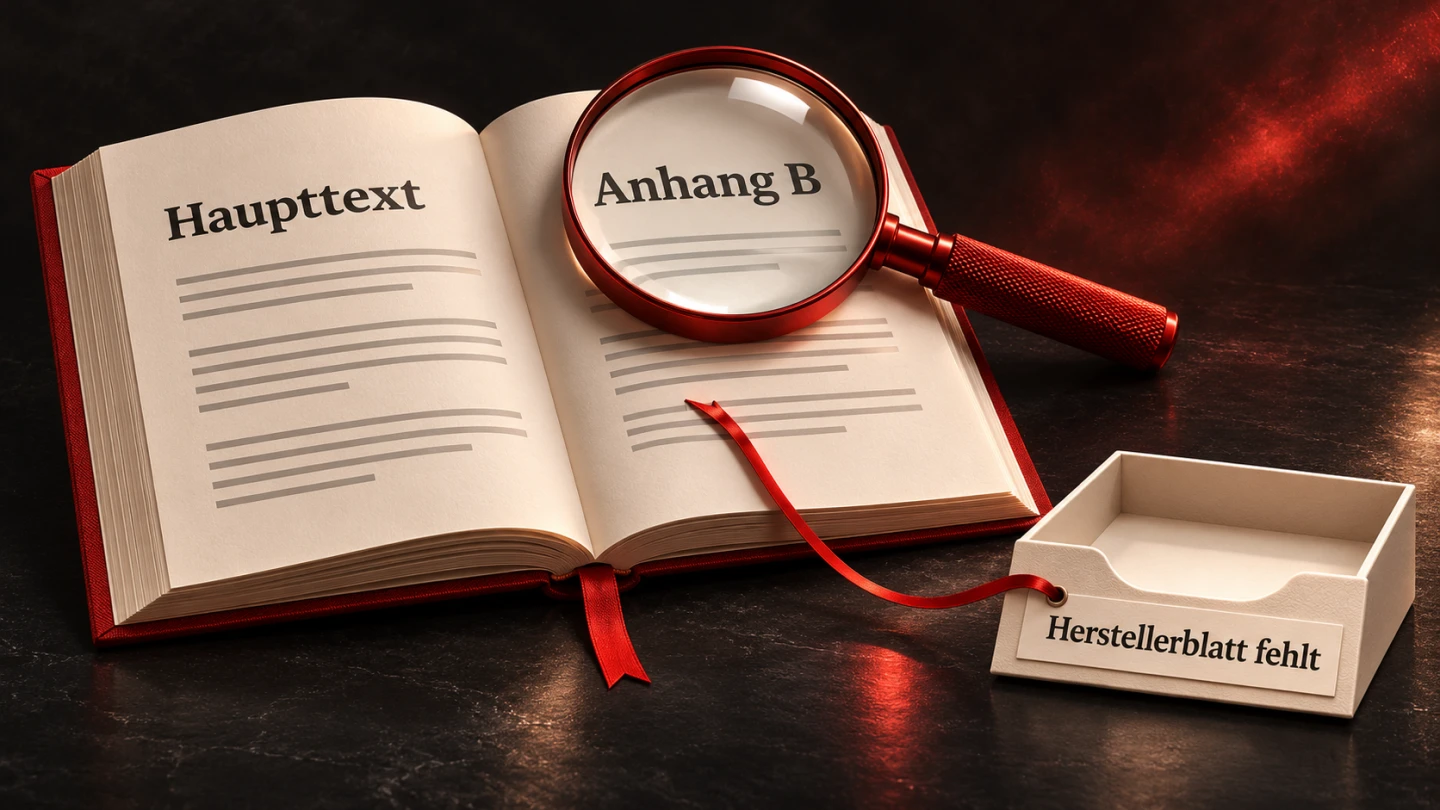
This guide develops a workflow around a fictional technical document collection. A manual contains a general inspection instruction. An appendix refers a particular model to another manufacturer's sheet. The example teaches document reasoning and provides no real maintenance instructions. Primary sources were checked on 9 November 2026. No current performance benchmark for a particular product is claimed.
1. Define the question before uploading
“Summarise these documents” may produce an overview. It is often too broad for a specific decision. Do you need to identify a change, support a claim or compile a complete list of requirements? Those tasks call for different checks.
Our example asks whether the general monthly inspection also applies to Model B. A useful answer must consider the general rule and appendix reference together. A summary of the opening chapters alone could therefore answer incorrectly.
Describe the result you need. A thematic outline may be sufficient for initial orientation. Incorporating findings into an operational instruction requires an inspectable basis for every consequential statement. Intended use determines the necessary depth.
Bound the collection as well. “Not found in the supplied material” differs from “does not exist”. Preserve that distinction in the assignment and output.
Include the decision the answer should support. Someone choosing which additional document to request needs a different result from someone preparing a general briefing. A concise explanation of that decision can prevent extensive analysis of irrelevant chapters.
2. Establish an understandable collection
Prepare a small document inventory. Include a unique identifier, filename, version, approval status and role. A current manual and a historical change note must not silently receive the same authority.
Where several versions exist, establish the relevant time period. The approved current version may govern a present workflow. A comparison, however, specifically requires retaining the earlier edition.
Identify appendices and supporting files explicitly. An appendix is not inherently less significant than the main text. Here it carries the decisive qualification. A filename such as “Supplement” says little about its substantive importance.
Check whether the supplied collection is actually complete. If the manual points to an absent manufacturer sheet, record that gap. AI should not replace its contents with general prior knowledge.
Record exclusions deliberately. A report might cover the operating manual but exclude service bulletins not provided by the owner. Knowing that boundary helps readers interpret both positive findings and statements about missing information.
3. Separate file access from content capture
A file can be accepted without every relevant detail becoming visible through the selected processing route. Scans, embedded graphics and complex tables require particular attention. This concerns access to the information before reasoning begins.
The OpenAI file-input documentation distinguishes processing by file type and endpoint. In the described Responses API, for example, embedded charts in non-PDF documents are not all supplied as visual context. Do not generalise that API behaviour to every chat interface.
Compare selected captured passages against the originals. When a table has several columns, headers and values must remain associated correctly. In a scan, one misrecognised character can change a model identifier.
Conversion to another format needs review too. It may expose images while changing page numbering or layout. Preserve the connection to the original instead of treating the converted file as an unquestioned replacement.
Inspect difficult locations rather than only convenient opening paragraphs. Footnotes, rotated tables and diagram labels often require a different check from ordinary prose. The sample should reflect what the actual question depends on.
4. Make locations unambiguous
| Reference | Possible difficulty | Practical addition |
|---|---|---|
| PDF page | Differs from printed page number | Provide both when necessary |
| Heading | Occurs several times | Add document identifier and section path |
| Table | Value separated from its column | Retain row, column and unit |
| Extract | Exception appears in the next paragraph | Carry necessary neighbouring context |
| Appendix | Points to another document | Record target document and missing access |
This table describes common review difficulties rather than a complete citation standard. Choose references that allow another person to find the passage in the actual collection.
A checked page reference may be especially useful for scanned material without stable text anchors. For changing web documents, retain the captured version and precise heading. A filename alone rarely suffices when many versions exist.
Preserve enough information to distinguish a quoted passage from a similar passage elsewhere. Repeated maintenance terminology can make a superficially convincing citation point to the wrong product or edition.
5. Distinguish capacity from effective use
A large accepted input initially establishes that substantial material can be supplied. It does not prove that every decisive passage will appear in the answer with the right relationships. Evaluate that through your own task.
The research paper Lost in the Middle examined the position of relevant information under particular experimental conditions in 2023. Its findings concern the models and tests studied then. They are not a current ranking of today's ChatGPT or Claude configurations.
A cautious practical question follows: does the selected workflow find relevant information at different locations in your material? Test this using known references. Do not transfer a historical percentage to a current product.
Compare tasks needing one passage with tasks requiring connected passages. Finding an accurate detail in one chapter does not demonstrate recognition of a contradiction spanning several documents.
Keep claims about capacity separate from claims about completeness. They can both matter, but they answer different questions. Procurement specifications should avoid turning an input-limit figure into a promise that every detail will be understood.
6. Collect evidence before synthesising
A useful first assignment requests an evidence table for the particular question. Each entry records document identifier, location, relevant extract and significance. Final wording follows afterwards.
Anthropic's guidance on long-context prompting includes clear document organisation and locating relevant passages before analysis. Test which arrangement works with the selected model and material in your own workflow.
An evidence table does not prevent errors automatically. Its value is visibility: a reviewer can inspect whether the eventual statement rests on an appropriate passage. A free-standing summary without references makes that harder.
Do not request unnecessarily long extracts. A short checked passage with sufficient context is often more useful. For real third-party material, usage rights and permitted quotation extent need separate consideration.
Keep the table focused on the question. Copying every paragraph into a new document recreates the original reading problem. Evidence selection should reduce the review burden while retaining the material necessary to assess the conclusion.
7. Keep the rule and exception together
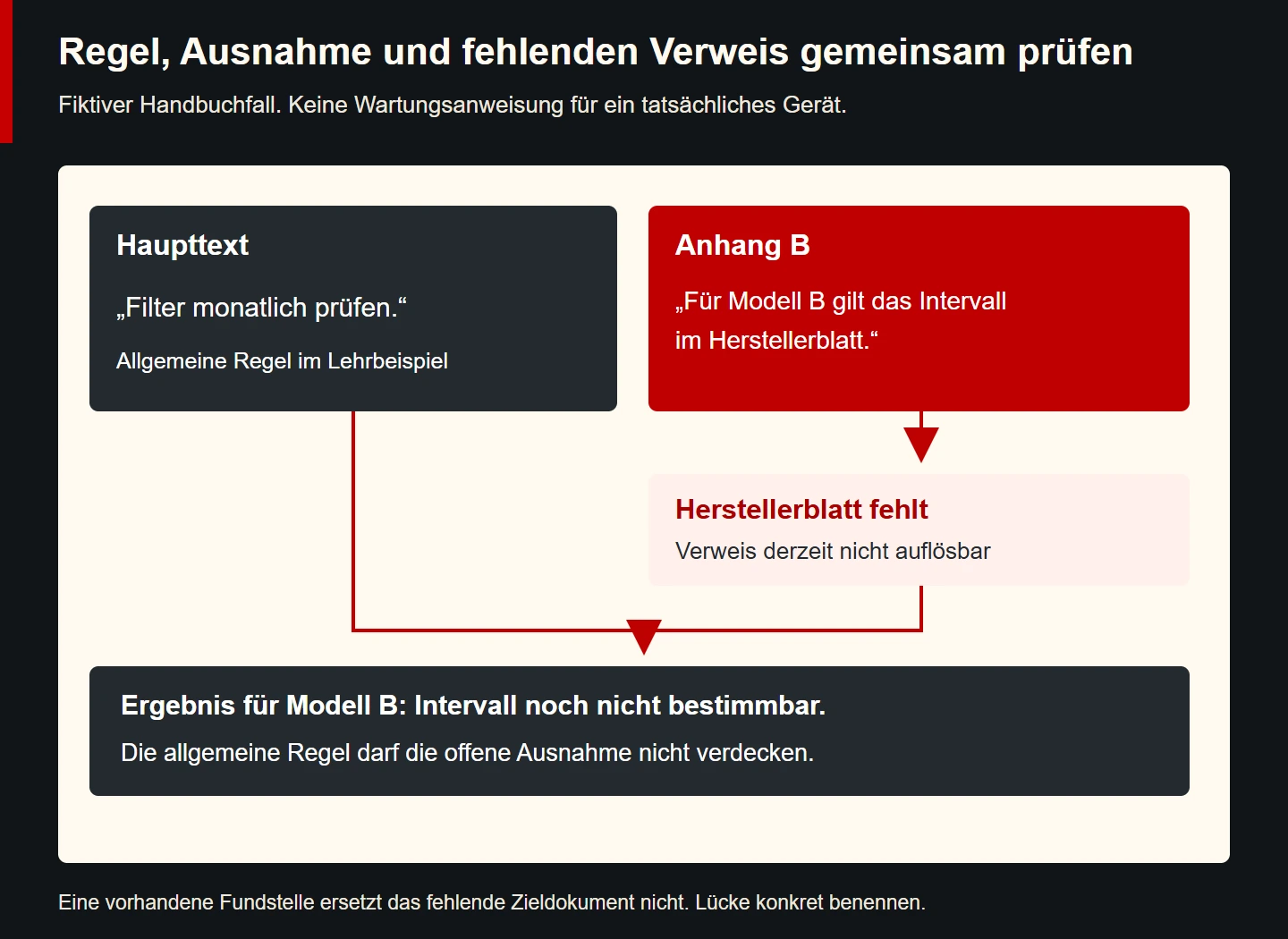
The fictional main section says: “Inspect filters monthly.” The appendix says: “For Model B, use the interval in the manufacturer's sheet.” Both sentences are original teaching examples and concern no real equipment.
The Model B question cannot therefore be resolved from the first sentence alone. The relevant manufacturer sheet is missing. A suitable answer identifies the reference and absent document rather than applying the general interval without qualification.
This relationship can disappear during splitting. If the main section and appendix are summarised separately, their connection must later be restored explicitly. Two individually readable summaries do not automatically produce a sound overall decision.
Check cross-reference language such as “except”, “notwithstanding” and “see appendix”. Searching only for the desired technical term can miss qualifications expressed differently.
Also examine whether the exception concerns a different version or scope. Similar model names do not establish identical applicability. Preserve identifiers exactly where they determine which instruction is relevant.
8. Divide by meaning rather than length alone
A working section should contain the unit needed to answer the question. Table headers and units belong with the values. A paragraph after a rule may contain a decisive exception. Cutting at a fixed character count can break that connection.
Manageable units can still help with large collections. Preserve document identifiers, section paths and relationships to neighbouring passages. A shared inventory can show which subquestions have already been addressed.
Distinguish local questions from cross-document reasoning. Finding one value differs from identifying conflicting instructions across several sources. The latter workflow must bring relevant results back together.
Summaries are selective too. If a short summary becomes the next input, an omitted qualification may disappear permanently. Keep original passages accessible for consequential claims.
When combining partial findings, review the joins themselves. A transition such as “therefore this applies to every model” may introduce a broader conclusion than any original passage supports.
9. Understand search as a selection mechanism
A search solution can be appropriate for repeated questions across many documents. It selects relevant passages for answering. This differs from supplying the entire collection in one input.
The OpenAI File Search documentation describes semantic and keyword search over supplied files. That is one technical option rather than a prerequisite for trying the method manually.
Search needs its own evaluation. Does it select the right model and version? Does the exception appear? Flawless phrasing based on poorly selected passages can still produce the wrong answer.
Separate retrieval failures from reasoning failures. If the appendix was never selected, more elegant wording provides little help. If both passages were available but combined incorrectly, improve the analysis stage.
Use known missing-information cases when testing search. A system should recognise that a target document is absent instead of returning a merely similar passage as if it resolved the question.
10. Carry a small evidence record
An answer can preserve its supporting locations as structured data. This original record identifies a source version and particular location. It does not prove the source true and is not a universal standard.
{
  "documentId": "handbuch-v2",
  "locator": "anhang-b",
  "quote": "Für Modell B gilt das Intervall im Herstellerblatt.",
  "status": "weiteres-dokument-erforderlich"
}
The German teaching record marks another document as required. Its status explains why the question remains unresolved. A reviewer can request the missing manufacturer sheet rather than rely on an apparently complete unsupported answer.
Real applications may add page references, file checksums and reviewed version information. Those fields preserve the connection to a source. They do not replace professional interpretation of the passage.
11. What a technical reference check can establish
The JavaScript below only checks whether a non-empty extract occurs in a registered original passage. It looks up the document and location through Maps. It makes no AI request or substantive judgement.
function referenceExists(ref, registry) {
  if (!ref || typeof ref.documentId !== "string" ||
      typeof ref.locator !== "string" ||
      typeof ref.quote !== "string" || !ref.quote.trim()) return false;
  const document = registry.get(ref.documentId);
  if (!(document instanceof Map)) return false;
  const passage = document.get(ref.locator);
  return typeof passage === "string" && passage.includes(ref.quote);
}
A pass means only that the specified text occurs at the registered location. An accurately copied sentence may still be irrelevant or misleading without the next paragraph. Keep these limits visible.
Production systems need further checks, including suitable error handling and text-encoding treatment. The example deliberately keeps its purpose narrow and provides no security guarantee.
Do not present this helper as a citation-quality score. It establishes a limited relationship between strings. Assessing whether a passage supports the answer requires checking its meaning and surrounding material.
12. Preserve gaps and contradictions
Distinguish at least three situations: a value was found, a value was not found within the examined scope, or two relevant passages conflict. Each requires a different next step.
Missing material may simply need to be requested. A contradiction requires examining time periods and scope. A responsible specialist may need to decide which source governs the particular case.
Ask for a specific boundary in the answer. “Not sure” is vague. “The manufacturer sheet for Model B is absent from the supplied collection” explains the actual obstacle.
Avoid automatically calculated confidence percentages without defined meaning. A precise description of missing evidence is often more useful than an apparently exact number.
13. Test the whole workflow against known answers
| Test case | Deliberate difficulty | Expected observation |
|---|---|---|
| One clear value | Direct location | Correct value and reference |
| Appendix exception | Connect distant passages | Qualification retained |
| Missing target source | Unresolvable reference | Gap identified specifically |
| Similar model identifier | Easily confused variants | Correct variant association |
| Amended version | Historical and current editions | Relevant period respected |
Prepare expected answers independently of the AI being assessed. An unchecked generated reference can reproduce the same mistake. Start with a few carefully chosen cases and expand them when failures appear.
Evaluate the route from file to answer. If text capture loses a table row, the failure precedes reasoning. Diagnosis should identify that stage.
14. Produce a clear answer from the evidence
The final response should answer the question first and then explain its basis. In this example, the interval for Model B remains undetermined from the supplied collection because the appendix points to a missing manufacturer sheet.
Follow with the two relevant references and next useful step. Readers need not inspect every intermediate operation, but should be able to trace the central conclusion to its sources.
Separate direct document statements from your recommendations. Improving document organisation may be worthwhile without being an instruction contained in the manual. Identify it accordingly.
Editing also needs final review. “Not evidenced in this collection” must not become “false” through shortening. A qualified rule must not turn into a universal commitment.
15. Review coverage separately
A correct reference only answers part of the quality question. Establish whether every aspect needed for the decision was examined. For Model B, that includes the general rule, appendix qualification and referenced source. An answer can contain two genuine citations while overlooking the missing third component.
Prepare a small list of necessary subquestions independently of the eventual answer. Which model is involved? Which version applies? What limits the rule? Which additional source is required? Associate each item with a finding or an explicit gap.
Consider the consequences of different failures too. A mistaken model identifier can matter more than an omitted explanatory aside. Do not hide a decisive omission inside an average score improved by many correctly repeated minor details. Record the actual review scope so a later reader understands whether the work examined selected chapters or the complete collection.
16. Long-document checklist
- Is the question defined together with its intended use?
- Are documents, versions and appendices identified?
- Were critical tables and images checked against originals?
- Are page numbers and locations understandable?
- Are rules, exceptions and cross-references preserved together?
- Are retrieval and interpretation assessed separately?
- Does every consequential claim have suitable evidence?
- Are absent sources and contradictions identified specifically?
- Was the workflow tested against independently prepared cases?
- Do the final summary's boundaries match the evidence?
17. Frequently asked questions
Is uploading the entire file enough?
That depends on the task and processing route. A successful upload establishes neither complete capture nor correct analysis. Check decisive passages and the relationships your actual question requires.
Is splitting always preferable?
No. It can make work manageable while breaking important connections. Divide by meaning and recombine cross-document findings with original references.
Are citations automatically correct?
No. Verify the document, location and actual content. Even a genuine extract may fail to support a conclusion if an exception or different version was overlooked.
When is search worthwhile?
It can help with recurring questions over a larger maintained collection. Establish responsibility, source versions and suitable tests first. A one-off upload and an ongoing document service are different projects.