AI-generated images: assess rights and document the intended use
For agencies and businesses: actual rights assessment, traceable image versions and clear limits on exclusivity and disclosure.

An AI-generated image is not automatically free to use merely because no camera or conventional photographer was involved. Publication raises several separate questions. Were the inputs permitted? What agreement applies to the image service? Which human contributions are identifiable in the result? Does the image contain protected third-party expression, recognisable people or misleading claims? Only the particular intended use brings these questions together into a reasoned decision.
Jurisdiction and review date: Germany and the European Union, checked on 9 November 2026. This article explains an editorial workflow. It does not replace legal assessment of a particular image. The suggested records are practical implementation recommendations rather than a statutory universal form.
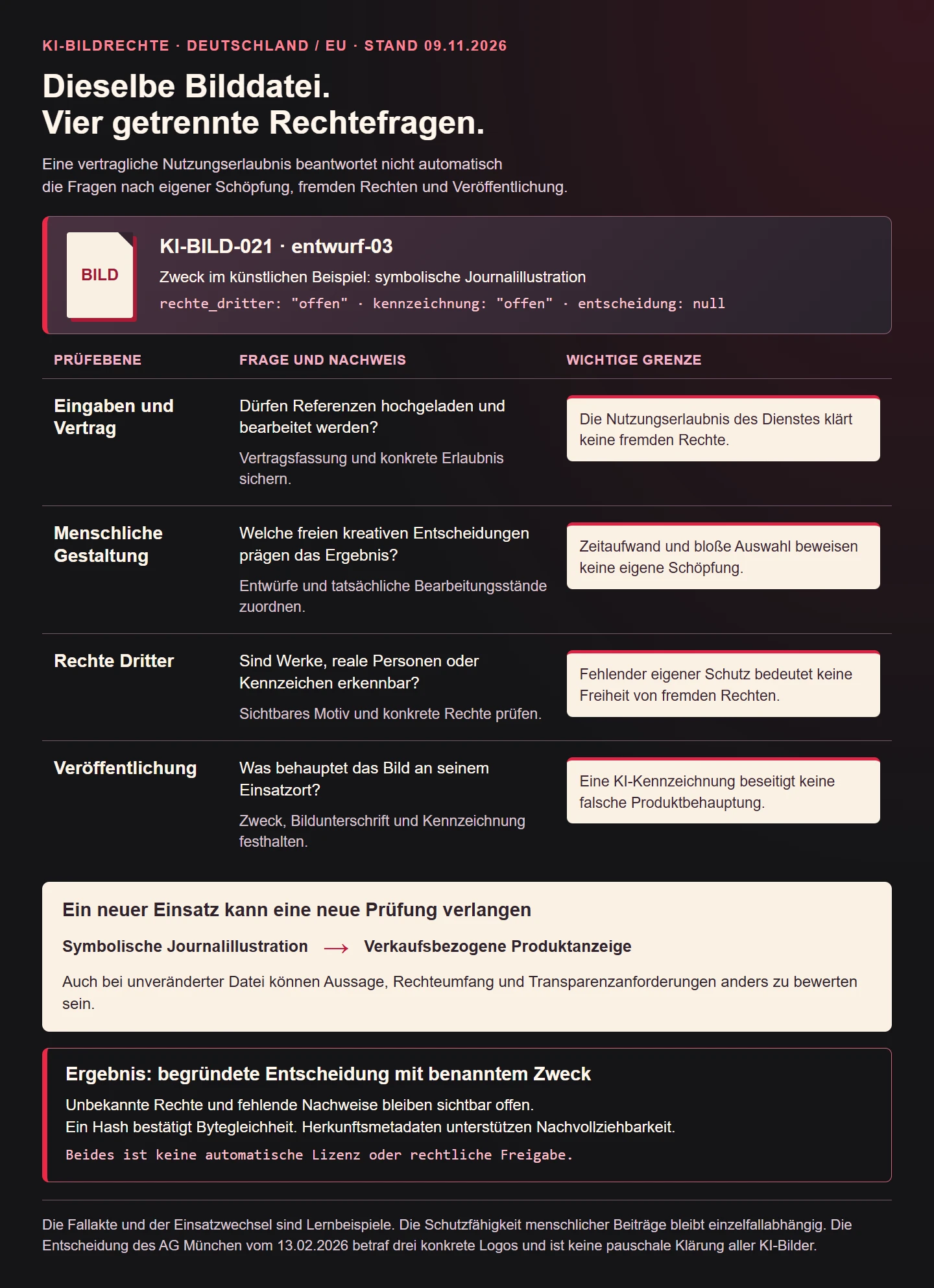
Distinguish four rights layers for the same image file
The first layer concerns inputs and contract terms. It includes uploaded photographs, sketches, brand material and the agreed service. The second asks whether identifiable human creative contributions give the result its own copyright protection. The third concerns third-party rights within the output. The fourth concerns the publication context, including any applicable transparency requirements.
A positive answer at one layer does not decide the others. Commercial-use permission from a service does not establish whether a recognisable person may appear in particular advertising. Conversely, the absence of your own copyright does not permit unrestricted imitation of somebody else's work. Separating these questions prevents a sentence from a help page becoming a supposed blanket clearance.
| Layer | Assessment question | Relevant evidence |
|---|---|---|
| Inputs and agreement | Are upload, modification and intended use covered? | Licence, permission and the applicable contractual version |
| Human creative contribution | Which free creative decisions shape the result? | Drafts, editing stages and a reasoned assessment |
| Third-party rights | Which people, works and distinguishing signs are recognisable? | Specific review and required rights clearance |
| Publication | What does the image claim in its intended context? | Image, placement, caption and disclosure decision |
Copyright requires a personal intellectual creation
Under section 2(2) of the German Copyright Act, works must be personal intellectual creations. Section 7 connects authorship to the creator of the work. Generative software does not thereby become a human author. A result generated entirely by a machine lacks the required personal creation.
The German Patent and Trade Mark Office's brochure on intellectual property in the digital world explains this distinction in its AI and copyright section. Where AI acts as a tool within human creation, protection depends on the individual circumstances. Entirely manual production is therefore not the only conceivable protected process. Equally, many generation attempts or choosing the most attractive proposal does not alone establish a secure copyright position.
The practical question is which particular expression can be traced to a person's free creative decisions. The assessment concerns the result. A long list of general adjectives may describe a commission rather than the actual creative expression. A service invoice establishes expenditure but does not automatically establish personal intellectual creation.
Interpret a recent court decision within its scope
In its judgment of 13 February 2026, case 142 C 9786/25, the Munich local court denied copyright protection for three particular AI-generated logos. It examined their creation and the supplied instructions. General open-ended directions, mere selection and correction of obvious errors did not establish the necessary human creative influence in those cases.
The judgment does not rule out human copyright whenever AI is used. It requires creative influence that is sufficiently objectively identifiable in the particular expression. This is an individual decision of a local court. This article claims neither a final higher-court resolution of every creative process nor independently established finality of that judgment. Keeping the actual creative decisions and corresponding editing stages is nevertheless a useful practical response.
Separate contractual permission from statutory exclusivity
A statement such as “commercial use permitted” can matter in the relationship with an image service. It must first be read in the actual agreement and its conditions. Does it cover the selected offer and correct contracting party? Are reference images, customer delivery, certain industries or public galleries addressed separately? Answers must not be borrowed from another subscription or an older help page.
Section 31 of the German Copyright Act distinguishes, where copyright exists, between non-exclusive and exclusive rights of use and their temporal, territorial and substantive limits. A service cannot eliminate unrelated parties' rights merely by using ownership terminology. Nor does that language automatically create enforceable copyright against the world in an otherwise unprotected output.
Agencies consequently need a clear description of what they deliver. They can supply the design and documented permitted uses. Broad copyright exclusivity should only be promised where it can actually be supported. Confidentiality, contractual non-distribution commitments and statutory exclusive rights are different instruments. Their practical value and enforcement depend on different legal relationships.
Check reference material before uploading it
A legitimately purchased photograph is not automatically cleared for every subsequent processing step. Its licence may allow website publication while leaving questions about modification, onward supply or use in an image service unresolved. Uploading also gives another service access to the file. The agreement and planned processing need to fit together.
The same applies to customer material. A customer can possess a file without holding all necessary rights. “This is our image” therefore needs clarification: who created it, what uses were licensed and which modifications are allowed? Confidential unreleased products and photographs of people can introduce additional requirements. A shared project folder is evidence of access, not necessarily evidence of permission.
The text and data mining provision in section 44b is not a blanket substitute for this assessment. It has its own conditions and purpose. A debate about model training does not automatically authorise uploading a particular third-party photograph as a reference and publishing the resulting image. Training, reference use and output publication need separate consideration.
Examine the output for third-party expression
A synthetic result can reproduce protected elements of an existing work. Section 23 addresses adaptations and transformations. Whether sufficient distance exists or consent is required depends on the particular expression. It does not establish a fixed rule such as changing thirty percent of the pixels.
Begin with what is actually visible. Is there a recognisable composition, distinctive character, almost identical arrangement or even another person's signature? Running the generator again does not prove legal independence. Similarity search tools can provide clues, but a search returning no match does not prove that no third-party rights are involved.
When a particular artistic effect is needed, describe factual design properties such as lighting, perspective, colour balance, material and composition. That gives a more precise direction. It does not automatically excuse an output that still reproduces particular protected expression. The actual published image still needs examination, including details introduced during later edits.
Take recognisable people and personal inputs seriously
A wholly fictional person and a recognisable imitation of a real person are different situations. A name, portrait reference or distinctive features may deliberately target a real identity. Labelling an image AI-generated does not remove personality rights. Apparent endorsements, intimate contexts and participation in events that never happened require particular care.
Section 22 of the German Artistic Copyright Act provides the starting point for distributing and publicly displaying portraits. The exceptions in section 23 have conditions and a limitation protecting legitimate interests. Advertising featuring a recognisable person therefore requires a specific assessment rather than an automatic appeal to that person's public profile.
Processing personal reference data also brings the General Data Protection Regulation into consideration. Legal basis, purpose, recipients and the chosen service are separate questions. Consent to a conventional team photograph does not automatically encompass every synthetic alteration for arbitrary later advertising. The required permissions and information depend on the actual proposal.
Assess trademarks and product claims in context
AI images can contain familiar logos, packaging and product shapes, whether by chance or because of the inputs. Commercial use can engage the conditions of section 14 of the German Trade Mark Act. Not every depiction of a mark is automatically unlawful. Possible confusion or exploitation of a well-known mark nevertheless requires more consideration than saying that the software added it by itself.
An image without a trademark can still make a misleading commercial statement. A fictional manufacturing facility, nonexistent certification or synthetically improved product feature can change the impression of an offer. Section 5 of the German Unfair Competition Act addresses misleading commercial practices under its conditions and expressly includes visual representations.
A decorative metaphor should therefore not be positioned as actual evidence of performance. A fabricated before-and-after image or medical outcome has a different meaning from an explicitly symbolic illustration. A short AI disclosure does not automatically cure a misleading main claim. Technical polish and commercial truth are different checks.
Assess disclosure by role and the image's effect
The current AI Act consolidated as at 27 July 2026 distinguishes several obligations in Article 50. Providers of certain systems generating synthetic outputs must supply machine-readable marking under the relevant conditions. Deployers have disclosure obligations including those concerning deepfakes. These layers must not be treated as interchangeable.
The deepfake definition is not limited to convincing celebrity faces. Under Article 3(60), it also encompasses content resembling real objects, places, entities or events that would falsely appear authentic or truthful. A realistic invented visit to an actual event may consequently raise different questions from an identifiable physical metaphor. The intended publication context is part of that assessment.
For evidently artistic, creative, satirical or fictional works, Article 50(4) provides an adapted form of disclosure. This is not a complete disappearance of transparency. The separately stated editorial-control exception concerning certain texts cannot simply be transferred to images. General application, particular provider transitions and the actual image case need to be distinguished. An internal policy of identifying synthetic illustrations may be useful without being described as the exact statutory rule for every image.
Use provenance evidence for what it can establish
A workflow record containing instructions, references and editing steps helps answer later questions. It should connect to the actual files used. A filename alone is inadequate if several images are later saved under the same name. A hash can compare an exact byte version. It does not prove a licence or human creative authorship.
The C2PA explanations of Content Credentials describe signed provenance and editing information. Such information can support traceability. It is not universal legal clearance and does not guarantee that a depicted event happened. Missing metadata does not itself disprove a stated origin either. The question is which verifiable information exists and what it actually establishes.
Technical validation and substantive evaluation should therefore remain distinct in the record. A valid signature can support integrity of recorded assertions. The people responsible for publication must still evaluate the relevant rights and the claim being communicated. Neither a credential symbol nor an integrity checksum should be presented as an automatic licence badge.
Keep an image record tied to its intended use
The following fictional data example shows an unfinished editorial assessment. It contains no invented clearance or supposed rights holder. An agency can use such a record as a shared reference between design, project management and publication. German keys are retained in both language versions to refer to the same example.
{
  "lernfall": true,
  "bild": "KI-BILD-021",
  "fassung": "entwurf-03",
  "zweck": "symbolische Journalillustration",
  "referenzen": [],
  "vertragsfassung": "noch zu dokumentieren",
  "menschliche_beitraege": "noch zu beschreiben",
  "rechte_dritter": "offen",
  "kennzeichnung": "offen",
  "veroeffentlichungsorte": [],
  "entscheidung": null
}
In a real record, the original output, selected edited version and published variants belong together. Reference material is linked to its origin and particular permission. Service and model versions should only be identified as precisely as they are actually known. An unknown model version should remain unknown rather than being invented afterwards.
The decision should state its scope. Clearance for a symbolic journal illustration cannot simply be transferred to a persuasive product advertisement. A new use calls for another look at representation and claim. That remains true even when the image file itself is unchanged. The same bytes can communicate a materially different message beside a different headline.
Four learning cases for editorial decisions
Physical metaphor: an invented glass network illustrates data processing. It depicts no real person and claims no actual customer case. Inputs, agreement and third-party expression still need examination. The metaphorical role should fit the article and its caption.
Modified customer portrait: an existing photograph is moved into another professional situation. Possession of the file and general publication permission may not be enough. The purpose of the alteration, personal connection and agreement need clarification before upload.
Synthetically extended product: an image shows a connector or material property absent from the product being sold. The problem includes the false commercial statement. A technically perfect depiction would not remove that error or make the feature available to the customer.
Logo promised as exclusive: a selected AI result is to be supplied as a permanently protected exclusive brand design. Human creative expression, other distinguishing signs and the intended trademark strategy need separate consideration. A paid image package does not automatically answer these questions. All four cases are fictional and illustrate different assessment triggers.
Checklist before publication and customer delivery
A concise handover should identify the image, agreed use and unresolved issues. Design approval and legal assessment should remain distinguishable. A customer who only confirms colours and cropping has not necessarily made a comprehensive statement about personality rights or reference permissions. Equally, an agency should not promise worldwide legal certainty after examining only a particular German publication context.
An unresolved issue needs a concrete next action. If permission for a portrait alteration is missing, establish who can obtain it and which representation it must cover. Where the proposed use has no sound basis, a different image may provide a suitable solution. That alternative should address the actual problematic identity, reference or claim rather than merely changing random pixels while preserving the same issue.
Published variants also need attention. Tight cropping can turn an incidental sign into the focal point. Removing a caption can turn an illustration into apparent factual evidence. Adapting a format for advertising may introduce another purpose. Preserve the relationship between original and delivered variants and check which version the actual website displays. A correct project-folder decision does not help if a different file is published later.
The record itself should not unnecessarily distribute personal or confidential information. Contracts, names, unpublished reference photographs and detailed instructions do not automatically belong in public captions. Internally, an identifier can point to protected supporting evidence. Public information should serve understanding, transparency or relevant rights notices. The fact that a contractor needs the finished image does not automatically mean they need every confidential document behind it.
Finally, a model provider's general training transparency report does not automatically resolve whether a particular result reproduces another work or which permissions existed for a customer photograph. The assessment should distinguish established facts, particular concerns and remaining uncertainty. A reasoned decision identifies both its basis and its limits.
- Describe the image and the particular intended use together.
- Review references, sketches and personal connections before submission.
- Save the actual agreement applicable to the selected service.
- Document human creative decisions through editing stages.
- Examine recognisable third-party works, marks and people in the result.
- Separate fictional illustration from actual product and performance evidence.
- Assess disclosure by organisational role and the image's effect.
- Link original, edited version and published variants unambiguously.
- Keep unresolved rights questions visibly open and assign their clarification.
- Reassess advertising, new channels and changed claims.
This produces a record that explains decisions and boundaries. It supports responsible use of AI images and a clear publication handover while leaving the legal assessment where it belongs: with the actual image, rights and intended context.