Employee photos during employment and after departure
Germany and EU: assess actual uses and distinguish historical judgments from present-day GDPR rights.
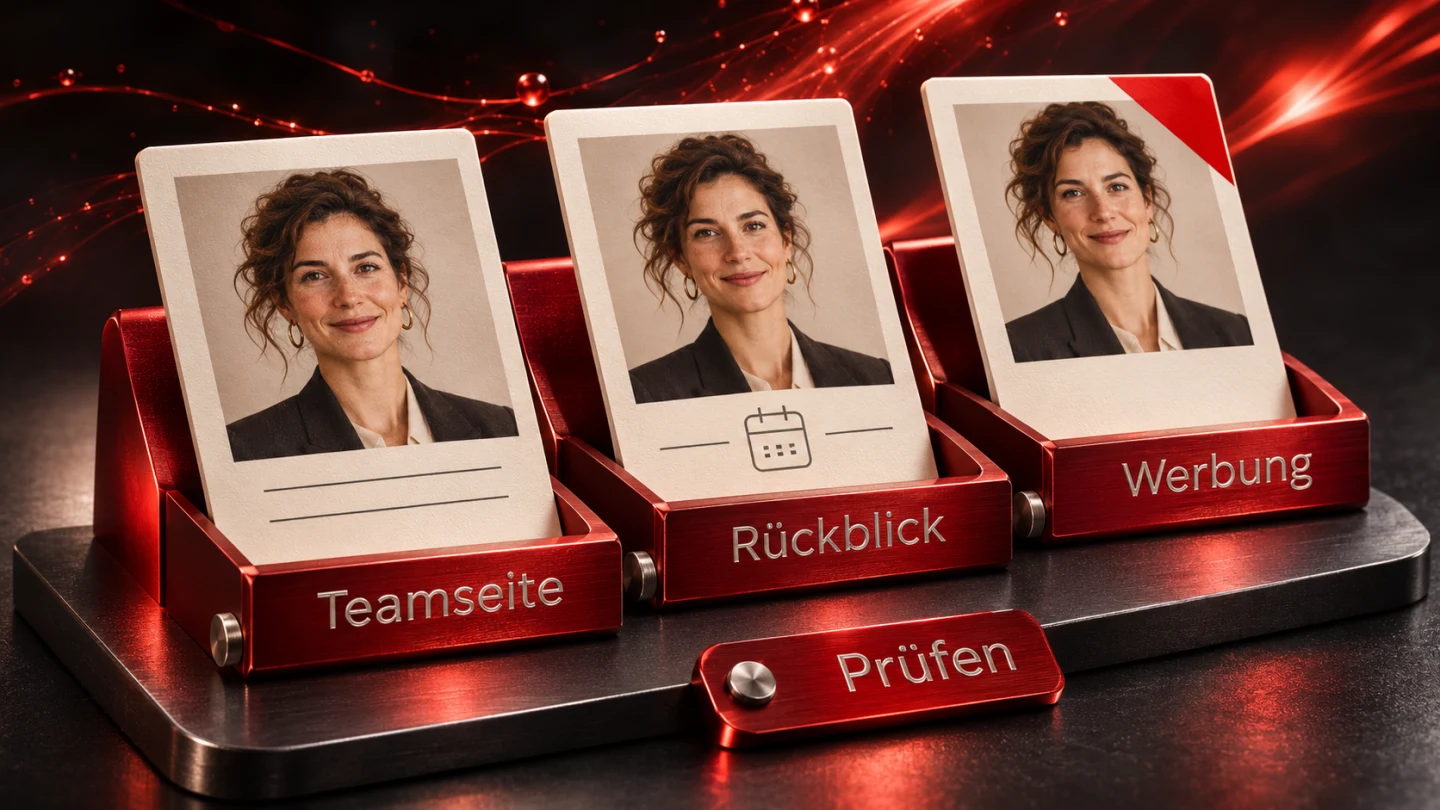
Employee photographs need an understandable relationship between the person, the purpose and the actual place of use. During employment, the freedom to consent deserves particular attention. Departure adds questions about current team representation, existing publications and individual rights. Sound organization therefore begins before the photo session and already provides a route for later changes.
Describe the use more precisely than employee photo
A portrait beside a current contact role serves a different purpose from a photograph in a company history. A recruitment campaign can associate the person particularly strongly with the employer. The same file may appear in several such contexts. Calling it an employee photo does not establish what is actually published or which expectations accompany the publication.
Describe the specific location and message of each use: a current team page, a project report with a recognizable date or a new advertisement. Include visible names, role descriptions and surrounding text. Later assessment needs the complete presentation. An unchanged image can communicate something different when its caption or crop changes.
Keep the legal layers separate
Section 22 KunstUrhG addresses consent for distributing and publicly displaying portraits. Section 23 KunstUrhG specifies exceptions and their limits concerning legitimate interests. This creates no blanket permission for every workplace group photograph. How those provisions interact with data-protection law needs assessment in the actual publication context.
Publishing an identifiable employee also processes personal data. The GDPR contains rules on purpose limitation, lawful grounds, consent and individual rights. Organizational review therefore cannot stop at asking who owns the image file. Paying the photographer does not settle the rights of the pictured person.
Take freedom of choice at work seriously
Section 26(2) BDSG requires consideration of workplace dependency and the actual circumstances when assessing consent. It also identifies possible indicators of free choice and requirements concerning form and information. A signed statement consequently does not replace examination of how agreement was obtained.
The EDPB Guidelines 05/2020 expressly discuss the imbalance between employers and employees. They do not exclude freely given consent in every circumstance, but require genuine choice without adverse consequences. For a photo project, someone declining participation therefore needs a genuinely workable alternative.
An alternative might be a team representation without a portrait or another appropriate description of the role. It should not publicly identify someone as having refused consent. Avoid pressure immediately before the session as well. A manager waiting for the final signature while everyone stands in front of the camera creates a different decision context from a clear explanation and advance choice.
For consent within section 26(2)'s scope, the provision specifies written or electronic form unless particular circumstances make another form appropriate. Information about purpose and withdrawal must be provided in text form. That should not become a blanket statement that every conceivable photograph always requires a handwritten paper signature. The actual processing and applicable requirements remain decisive.
Explain distinct purposes understandably
Before consent is requested, planned publication should be recognizable. A team page, printed leaflet and paid social-network advertisement can have different reach and context. An indefinite statement covering all present and future media gives little insight into the actual choice. Specific options also help the editorial staff responsible for later use.
The EDPB consent summary dated April 2026 explains specificity and genuine choice, among other requirements. It is an accessible orientation rather than a template contract for every photography project. A concrete statement must fit the actual activity. Short wording can be precise, while a lengthy form can still fail to explain where the picture will appear.
Do not merge photographer permissions with personal rights
The photographer agreement defines rights granted in the image. Section 31 UrhG permits different limits by content, territory and time. Possessing a portrait file therefore does not automatically license every future campaign. Also determine whether alterations, crops and delivery to commissioned service providers fall within the agreed scope.
Keep the employee's agreement and photographer licence as distinct evidence. Withdrawal or a new use may affect different participants and measures. Editors should be able to identify which record concerns image usage rights and which concerns the person depicted. A single green field marked rights completed would conceal those different foundations.
Follow changes during employment
Use can change before anyone leaves. A person may move to another role or no longer wish to appear as the principal contact. An old team card can then be inaccurate even though employment continues. A new advertising context likewise cannot simply inherit an earlier basis without examination. These changes belong in the same maintenance process as replacing the photograph itself.
During substantial revisions, inspect what image and text communicate together. Copying an earlier project portrait onto a current careers page may imply a personal endorsement or present-day role. Assessment therefore involves more than comparing file hashes. Purpose, context and the basis supporting that use remain important.
Treat withdrawal and departure as different events
For processing based on consent, GDPR Article 7(3) provides a right to withdraw at any time. Withdrawal does not retrospectively make earlier lawful processing unlawful. Withdrawing must be as easy as giving consent. An internal process should therefore provide an accessible contact and understandable handling, rather than demanding a justification as a prerequisite for the GDPR withdrawal.
Departure first changes the employment context. Which publications are affected also depends on the previous purpose description and scope of the agreement. The Saxony-Anhalt authority's guidance on departing employees distinguishes personal presentation from other image uses and emphasizes case assessment. A current portrait card tied to the person's company role particularly deserves renewed attention.
Do not turn an older judgment into a current blanket rule
The Federal Labour Court judgment of 19 February 2015, 8 AZR 1011/13, concerned continued publication of an advertising video after employment ended. It considered an unlimited declaration and short illustrative sequences, among other facts. In that case, departure alone did not automatically terminate consent. The historical example helps explain why the specific publication purpose matters.
However, the judgment preceded GDPR applicability and reasoned within the framework then in force. Its discussion of reasons for withdrawal must not become a general present-day barrier to Article 7(3). A current case needs the relevant current rules and its own facts. Copying a sentence from an older judgment does not perform that assessment.
Organize departure as an editorial review task
Personnel staff need not disclose an entire personnel file to the editorial team. A narrow notice that a role or associated image use needs review may suffice. Decide who receives that assignment and how the relevant photographs can be identified. It should not disappear into a general inbox with no accountable handler.
The editorial team then inventories actual uses, starting with current team and contact pages and continuing through other known channels. Disputed or uncertain uses receive appropriate legal support. This distribution of work is an organizational suggestion. It does not establish an identical statutory deadline or automatic deletion decision for every individual image.
Record completion by use. A report that a photo was removed may mean only one page changed while the same crop remains in another language edition. A short confirmed list of actual locations is more useful than an undifferentiated completed flag. Give the affected person an understandable account of the work performed and any remaining justified review points.
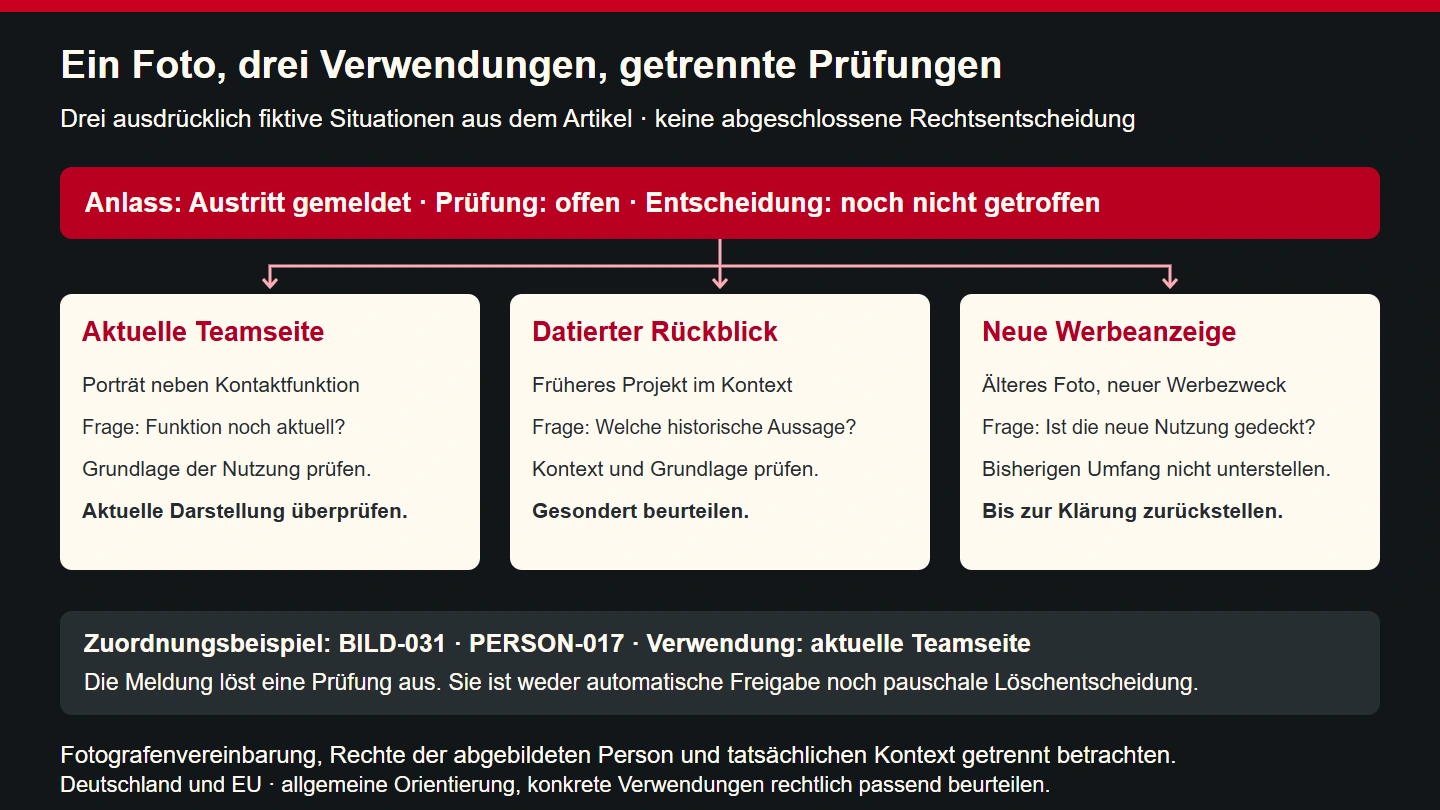
Separate three fictional situations
| Fictional situation | Important question | Editorial next step |
|---|---|---|
| Portrait beside a current contact role | Is the presentation still accurate after departure and does its basis continue? | Review the current team representation and arrange necessary changes |
| Dated retrospective about a previous project | Which particular historical message and basis remain? | Assess context, interests and continued use separately |
| New advertisement using an older employee portrait | Does the new advertising purpose fall within the existing basis? | Hold the proposed new use pending clarification |
These are invented learning cases, not completed legal decisions. They illustrate that one file type does not establish one use. Naming a folder archive does not automatically make a company retrospective privileged public-interest archiving either. The actual purpose and applicable conditions still require examination.
Build an inventory of uses
A small inventory links image identity, depicted people and actually known publication locations. Unnecessary private information is not required. An internal reference may suffice if authorized staff can reliably resolve it. Record the actual version and surrounding text as well. This supports later changes much better than an unordered collection of consent forms.
{
  "lernfall": true,
  "bild": "BILD-031",
  "person": "PERSON-017",
  "verwendung": "aktuelle Teamseite",
  "fassung": "Portraet quadratisch",
  "anlass": "Austritt gemeldet",
  "pruefung": "offen",
  "entscheidung": null
}
This expressly fictional organizational record uses German keys and values. It makes no legal decision and deletes no file. In particular, the departure notice does not automatically prescribe the same measure for every photograph. A decision is added after specific assessment. Later technical support should preserve that separation between an event notification and a substantive decision.
Include technical variants and language editions
An image can exist as an original, crop, thumbnail and responsive size variant. German and English pages may describe the same person differently as well. Changing only the visible large picture might consequently be incomplete. Review includes embedded variants and the places where they remain reachable, particularly with older media collections and external delivery services.
Also inspect captions, alternative text and structured person information. Replacing a portrait file while leaving its name in alternative text can preserve an incorrect association. Editorial correction therefore considers image and text together. A changed file hash establishes a file change, not automatically the accuracy of the complete team page.
Assess group photos and crops as distinct versions
A different crop may make a person barely visible or especially prominent. Technical editing can therefore alter more than pixels: it can change the message. Other recognizable people and the photographer agreement also matter when evaluating a new version. A change should be assessed against the actual publication purpose rather than assumed harmless because it is easy to perform.
Obscuring someone requires more thought than a weak effect over the eyes. Clothing, role, surroundings and accompanying text can still identify them. Choose a measure appropriate to the context. An organizational workflow can propose a new version, but should not mark it anonymous or legally complete without actually inspecting it.
Handle printed and distributed material separately
An online edit differs from dealing with printed copies. New print orders, remaining stock and copies already distributed cannot be changed by one identical technical operation. Record which new uses should stop and how existing uses require legal and practical handling. Possessing printed stock is not a blanket licence for unlimited further print runs.
Newsletters and external publications also require distinctions. A delivered message cannot be replaced like the company's own team page. That does not remove every subsequent question. Review controllable web archives, future distribution and any required communication with recipients or providers. Do not promise complete technical recall of every copy already distributed.
Identify withdrawal, objection and erasure correctly
Withdrawal concerns processing based on consent. Objection under Article 21 has different conditions and contexts. An Article 17 erasure request is assessed under its own grounds and exceptions. Handling should first understand the person's concern and establish the actual basis of the affected use. The subject line of an incoming message does not alone determine the appropriate assessment.
After consent is withdrawn, its processing cannot simply be relabelled under another basis without explanation. EDPB guidance addresses this issue expressly. Any other processing that may legitimately continue needs its own sound assessment and transparency. Wanting to retain an especially attractive image is not, by itself, a complete legal basis.
Consider search systems and further recipients
A change at the company's own origin can reach downstream delivery and search systems with delay. Review directly controlled locations and the additional measures actually required. Article 17(2) addresses reasonable measures concerning public personal data under its conditions. It does not guarantee instantaneous removal of every internet copy.
Article 19 concerns notifying recipients of rectification, erasure or restriction under its conditions, with limits for impossibility or disproportionate effort. Document the required work rather than giving an indefinite assurance that every occurrence has disappeared everywhere. A verified change under the company's control and an outstanding external process may need different statuses.
Keep evidence distinct from continued public use
After a publication changes, limited evidence about handling the case may remain necessary. That is a different purpose from public advertising. Define access, purpose and necessary duration for such records separately. A possible evidential need does not automatically justify leaving the portrait on a publicly accessible careers page.
Conversely, indiscriminately destroying all necessary information can make handling impossible to explain. Determine which minimal records establish what happened and which retention or deletion requirements apply. Consider actual obligations and, where relevant, legal claims. An unlimited complete shadow collection of every photograph would not be a careful default.
Keep responsibility and communication clear
A practical process names an accountable contact and suitable editorial, technical and legal participants. Personnel staff need not personally search every published image variant. Technical staff should not alone decide whether a particular consent continues. Bring their contributions together and close each use with an understandable record.
Tell employees where to raise questions or request changes. Ask only for information necessary to handle the case. Someone should not need to circulate every portrait file again through an insecure general distribution list when a dependable internal association already exists. An accessible process supports both individual rights and editorial maintenance.
For information about measures taken on requests under Articles 15 to 22, Article 12(3) generally requires action without undue delay and within one month. It permits two further months under its stated conditions, with notice and reasons within the first month. This procedural rule is not blanket permission to continue a substantively unlawful image use until that deadline. Record the request, necessary immediate measures and response dates together.
Checklist for capture, publication and departure
- Give every use a specific purpose and known publication location.
- Document photographer permissions separately from personal rights.
- Assess freedom of choice in the actual employment circumstances.
- Avoid detriment or public identification following refusal.
- Make consent scope and information understandable and demonstrable.
- Turn role changes and departure into assigned review tasks.
- Assess current team images together with their surrounding text.
- Identify withdrawal, objection and erasure appropriately.
- Include language editions, crops and technical variants.
- Track printed and external uses separately.
- Keep limited evidence distinct from public publication.
- Explain actual measures and remaining questions clearly.