Logos: distinguish copyright, trademarks and usage rights
What designers, businesses and later suppliers should clarify at handover and when the design or its use changes.

A business receives a new logo as a vector file and pays for the agreed design work. Those are important steps. They do not answer every legal question: who created which elements, what use was authorized, whether a future supplier may change the sign and whether earlier trademarks or business identifiers conflict with its intended use.
These questions concern different layers. An agreement with a designer cannot remove rights belonging to an unrelated third party. Trademark registration does not replace an agreement covering a protected design either. This guide separates copyright, contractual usage rights and rights in commercial identifiers. It describes a traceable project review for Germany and the European Union. Legal sources were reviewed on 9 November 2026. It does not provide individual clearance for a particular logo.
Ask four questions about the same design
For practical work, avoid treating everything as one vague category of logo ownership. The visible sign stays the same while the legal questions may have different answers. A simple design can potentially matter as a trademark without that establishing its copyright protection. A highly creative design may qualify for copyright and still conflict with an earlier commercial identifier.
| Layer | Key question | Typical evidence |
|---|---|---|
| Authorship and protection | What personal creative contribution exists? | Creation records and a considered assessment |
| Usage agreement | Which rights did the commissioning party receive? | Traceable agreement with the authorized rights holder |
| Identifier conflicts | Which earlier rights may be affected? | Research and legal assessment of the use |
| Technical delivery | Which exact version is supplied? | Versioned files and variant inventory |
The final row is organizational, not a separate intellectual property right. It nevertheless matters. Reviewing draft03 is of limited value if a substantially different version is later used. Documentation should connect the assessed sign to its actual use. A filename alone is less dependable than an identified version with a visible representation and a traceable record of delivery.
Calling something a logo does not establish copyright
Section 2 UrhG includes applied art among potential protected works and requires a personal intellectual creation. That does not make every company sign protected automatically. Whether a particular design meets the legal requirements depends on the case. Neither a high invoice amount nor a lengthy design process substitutes for examining the actual contribution.
Project records should make it possible to understand which person made which creative choices. Sketches, versions and an account of the developed form can help. They do not automatically prove protection, but they explain the process better than an unsupported claim that everything was original. Where several people contributed, keep their contributions and relevant agreements distinguishable rather than combining them into an unexplained ownership assertion.
Using AI does not settle this question categorically. A service may generate files or assist development without establishing which personal human creation is expressed in the result. Technical provenance and account ownership are not substitutes for that assessment. Equally, a lack of copyright protection must not be mistaken for an absence of every other right affecting the sign.
Distinguish authorship from permission to use a work
In an ordinary German design commission, copyright is not simply sold like a physical object. Section 29 UrhG distinguishes its general non-transferability, subject to the stated inheritance exceptions, from permissible grants of usage rights. An agreement should therefore explain what may be used rather than vaguely promising a complete transfer of authorship.
Section 31 UrhG addresses nonexclusive and exclusive usage rights as well as territorial, temporal and subject-matter limitations. A nonexclusive right does not generally exclude other authorized users. An exclusive right also has to be understood within its permitted scope. The word exclusive should therefore be connected to the agreed use and the rights the grantor can actually provide.
Discuss intended media with the business: website, app, stationery, advertising, signs and product packaging. Consider additional group companies and implementation suppliers too. This list is an organizational aid, not an individually drafted contract. An unclear agreement should not be supplemented by assuming that payment for a file automatically authorized every future imaginable use. Identify uncertainties while the parties can still resolve them deliberately.
Address modification and author credit explicitly
A logo rarely appears at only one size. Teams may need a small symbol, a dark-background version or an arrangement for narrow spaces. Clarify the treatment of such modifications before delivery. Section 39 UrhG contains a rule applying absent another agreement and an additional good-faith exception. It does not justify a simple assertion that every modification is always forbidden or invariably allowed.
Recognition of authorship is another question. Section 13 UrhG addresses recognition and the choice of an author designation. The intended practical approach should be handled traceably in the commission. A small letterhead and a detailed designer portfolio publication are not automatically identical contexts. They may require distinct practical arrangements.
Avoid broad promises that one short sentence has disposed of all moral rights. Concrete situations are more useful: who may prepare a monochrome version, whether a new agency may rearrange the typography and which version the designer may display as a reference. The answers should match the actual agreement rather than exist only as informal recollection in a project conversation.
Source files are a distinct delivery item
An exported graphic and an editable source file perform different technical jobs. Specify what will be delivered and which dependencies exist. If the working file contains linked fonts, library elements or other components, they must not be passed on without considering the relevant permissions. A usable handover requires an appropriate technical description and a clear account of the permitted use.
Conversely, possessing the source file does not establish the complete scope of permission. Someone may technically be able to modify everything while holding only limited rights. A hash identifies a documented file; it certifies neither authorship nor freedom from conflicts. File verification and rights assessment support one another while remaining different activities with different evidence.
Examine third-party components before promising exclusivity
A logo can contain elements from fonts, symbol collections, templates or supplied illustrations. The relevant licence is the one applying to the component actually used. Permission suitable for a design application does not automatically establish every form of onward delivery, modification or use as a business identifier. Do not claim those permissions without checking them against the planned use.
An exclusivity promise needs particular care when a generally available component forms part of the design. A designer cannot simply promise exclusive control over something others are also entitled to use. Record the original contribution and applicable limits. For fonts, the visible logo artwork, delivery of a font file and embedding that font in an app are technically different uses that deserve separate attention.
This review should not invent a universal hierarchy of licences. Some expressly permit a particular use, while others limit it. Retain the relevant licence version and its connection to the component. A link to the supplier's current home page may later fail to show the terms that applied when a component was acquired or the design was produced.
Trademark rights concern a sign in commercial context
Section 4 MarkenG identifies several routes by which trademark protection can arise. They include registration and, under particular conditions, recognition through use and well-known status. Both “only registered signs have rights” and “every first use immediately creates comprehensive protection” are therefore oversimplifications.
A proposed application also needs consideration of registrability. Section 8 MarkenG identifies absolute grounds for refusal, including lack of distinctiveness or exclusively descriptive indications in the relevant circumstances. The provision contains further rules and exceptions. A fashionable graphic style or an available domain does not reliably answer these legal questions.
The form of protection should fit the sign. A word mark and a particular figurative combination are different subjects of protection. The official DPMA explanations clarify that registration of a combined word-and-device mark does not simply create a monopoly over an unprotectable descriptive word within it. Adding graphics therefore does not remove the need for a differentiated assessment of the wording.
Do not confuse goods, services and classification numbers
A trademark comparison considers more than two images placed side by side. Relevant goods, services and the legal circumstances also matter. Section 14 MarkenG distinguishes identical signs for identical offerings, likelihood of confusion and separate protection for reputed marks. A visible graphic difference does not automatically exclude conflict.
The same provision makes an especially useful distinction: goods and services are not similar merely because they appear in the same class. They are not dissimilar merely because they appear in different classes. A classification number organizes information; it does not create an automatic legal safety distance. A table of different numbers cannot replace individual similarity assessment.
Before researching, describe the actual intended offerings. A broad label such as everything digital is too imprecise. Software, consulting and retail activity can involve different relationships. A business model change may justify another review. Assess the design with its intended commercial use rather than treating its graphic appearance as entirely independent of that use.
Consider earlier rights despite your own registration
The DPMA description of examination and registration states that the application procedure does not examine whether earlier trademarks or third-party identifiers conflict. A registration certificate therefore does not settle every conflict question. A later opposition or related procedure can still have substantial consequences for the business.
Research should identify the exact version of the sign and relevant territories. Identical spellings alone may be insufficient. Similar forms, linguistic variants and the relationship between offerings can matter. Database search capabilities and the legal significance of a result are separate tasks. An interface that returns records does not itself resolve whether a planned use is permissible.
A search returning no result is not proof of worldwide availability. Record the date, databases, terms and visible limits of the investigation. This makes the state of work traceable. Expert assessment is sensible for an important company identifier or a difficult result. An automated traffic light should not derive binding legal clearance from a simple count of matches.
Include business identifiers and European territorial effects
Unregistered commercial designations must not disappear from consideration. Section 5 MarkenG addresses business identifiers and work titles. Section 15 MarkenG governs protection of commercial designations, including likelihood of confusion. Looking exclusively for registered marks can therefore leave part of the relevant assessment unanswered.
EU trademarks are governed by Regulation 2017/1001 in its consolidated version of 1 December 2025. Their unitary character generally gives them equal effect throughout the Union. Articles 8 and 9 address earlier rights and rights conferred by an EU trademark. This creates a different territorial framework from a purely national review.
Use beyond the territories examined requires its own consideration. A German agreement permitting worldwide use does not automatically create worldwide freedom from third-party identifier rights. Similarly, a European register result does not answer every question in another country. Keep contractual scope and territorial conflict assessment explicitly separate rather than allowing similar wording to hide their different functions.
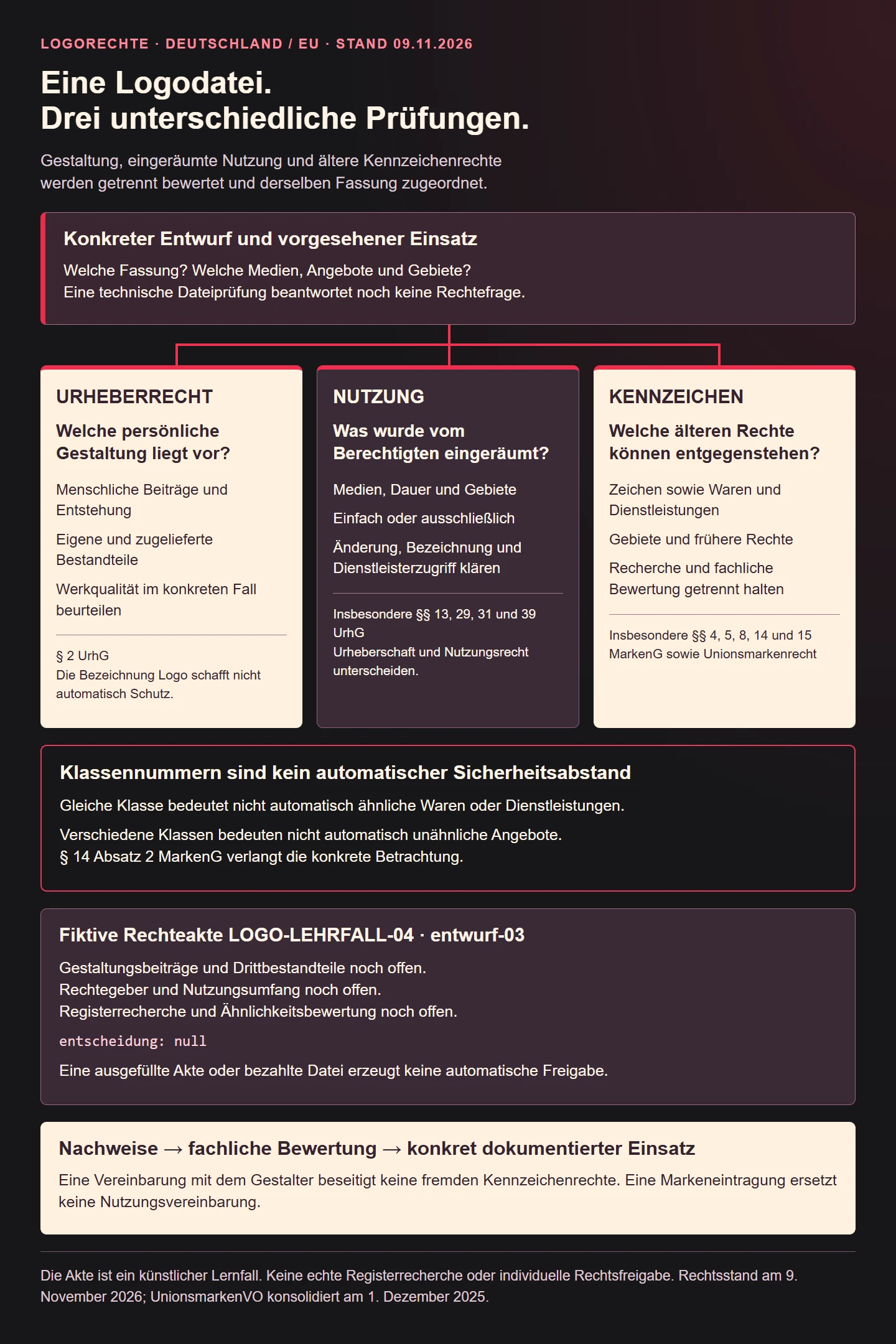
Represent the actual state in a rights record
The artificial record below preserves unanswered questions rather than pretending clearance exists. It identifies a draft version and separates creation, the usage agreement and identifier review. No real company or sign has been searched. Empty fields mean an undocumented fact, not an absence of risk. The German field names are kept identical in both language versions.
{
  "lernfall": true,
  "projekt": "LOGO-LEHRFALL-04",
  "version": "entwurf-03",
  "rechtsraum": "Deutschland und Europäische Union",
  "pruefstand": "2026-11-09",
  "urheberschaft": {
    "menschliche_gestaltungsbeitraege": null,
    "drittbestandteile": null,
    "nachweise": []
  },
  "nutzungsvereinbarung": {
    "rechtegeber": null,
    "rechteumfang": null,
    "exklusivitaet": "offen",
    "bearbeitung": "offen",
    "weitergabe_an_dienstleister": "offen",
    "quellendateien": "offen",
    "belege": []
  },
  "kennzeichenpruefung": {
    "zeichenvariante": "entwurf-03",
    "waren_dienstleistungen": null,
    "gebiete": null,
    "registerrecherche": "offen",
    "nicht_registrierte_rechte": "offen",
    "aehnlichkeitsbewertung": "offen"
  },
  "entscheidung": null
}
Filling in more fields would still not create an automatic legal decision. The record supports responsible assessment. A documented grant from the designer may coexist with an unresolved similarity question. Preserve that intermediate state. An overall result should not turn green merely because a vector export succeeded or a document was attached to the folder.
Maintain versions and later modifications together
After approval, teams often create variants for small icons, dark backgrounds or multilingual applications. Record which changes the agreement covers and which need renewed discussion. A technical color correction is not automatically equivalent to a new shape or added wording. The actual design and applicable rights determine the necessary assessment rather than a generic label such as minor update.
New suppliers need traceable instructions too. Do not pass on an editable file with an unexplained promise that everything is allowed. Include relevant usage conditions, variants and limitations in the handover. Confidential contracts do not need to become public. Internally, however, responsible people and supporting records should remain identifiable and accessible when questions arise.
Coordinate design decisions with legal assessment
Consider typical misunderstandings before internal acceptance. A commercially usable stock symbol may be available for inclusion in a design without being exclusively available to that client. Conversely, an independently developed drawing with clearly granted usage rights may face a difficult earlier trademark. These situations require different evidence and potentially different remedies rather than one generic assurance of ownership.
A successful trademark search does not settle every authorship question either. A third-party illustration might have been included even if the proposed company name produced no notable matches. Research records cannot replace creation records. Give each layer a responsible person and a traceable assessment state. That makes later questions easier to resolve without broadly shifting responsibility to someone else.
Bring legal assessment into the process early enough. Once signs, packaging and a substantial website have been produced, a conflict can require extensive changes. This does not mean registering every first sketch immediately. A considered sequence can move from suitable design directions through preliminary and deeper assessment to committed use.
Separate decision states can support that sequence. Design selected means the version fits the creative brief. Usage agreement documented describes the relationship with the rights holder. Identifier assessment completed refers to another review with a stated scope. These labels are suggested project organization, not statutory status terms. None should imply a broader approval than the work actually performed.
A form must not automatically convert completed fields into clearance. Information can be incorrect and assessments incomplete. The recorded decision should identify who assessed which use and what limits apply. This helps when the business later expands or another company wants to adopt the sign. Technical delivery should then be tied to that identified decision and exact version.
Checklist before sustained use
- Identify the exact design version.
- Trace human contributions and supplied components.
- Do not infer copyright or other rights from the word logo alone.
- Agree appropriate uses, territory, duration and exclusivity.
- Address modification, author credit and supplier access concretely.
- Identify source files and delivered dependencies.
- Check font, symbol and template licences against actual use.
- Record goods, services and relevant territories for identifier assessment.
- Consider earlier registered and relevant unregistered rights.
- Assess research findings and limits instead of claiming automatic availability.
- Revisit the review when the sign or its use changes.
A dependable logo commission combines design with verifiable permissions. Keeping the layers distinct prevents technical delivery from being mistaken for comprehensive clearance. It also supports future modifications and supplier changes. The essential relationship remains the one between the exact sign, agreed use and legal situation actually assessed.