Develop landing pages for concrete offers
Move from an agreed offer to an understandable page by aligning content and action with the actual service.

A landing page for a concrete offer should help visitors make a decision. It explains who the service is for, what result belongs to it and what happens next. An impressive visual surface can support that work. It cannot replace an unclear offer. Someone may leave with a general impression of professionalism while still not knowing whether the service fits their project.
This guide moves from defining an offer to building an understandable page. The HTML example uses an explicitly hypothetical editorial review. It is not a published Agentur Zentral service commitment and does not describe a real client engagement. Technical checks concern the actual component, its headings, its fragment destination and keyboard activation. They make no claim about measured growth in enquiries or sales.
Which decision should the page support?
Start with a concrete reader question. Does someone need to establish whether existing content is suitable for revision? Should a team enquire about a workshop or commission a tightly scoped review? Those situations require different information. Wanting more contacts is too vague as an editorial foundation. It describes a business goal without yet identifying the visitor's task.
Determine the expected knowledge level. Someone already searching for a specific procedure needs different explanations from someone still trying to understand a problem. The page need not teach the entire subject. It should explain the prerequisites needed to decide about this offer. An unexplained technical term can obstruct that decision even when the rest of the copy sounds polished.
Write down the intended next step before designing. Requesting a conversation, checking documents and concluding a contract are different actions. A prominent control should make clear which one actually follows. Once that decision is explicit, the amount of text, supporting evidence and page structure can be chosen for a reason.
Give the offer a verifiable core
A useful offer statement connects audience, subject and result. It should be concrete enough to invite a meaningful question. Saying that a service moves a business forward digitally leaves many possibilities unresolved. Explaining that existing content will be reviewed and open professional questions documented in an annotated list names an identifiable object of work.
Separate activity from output. Analysis describes an activity. A review report, agreed structure or functioning application describes something that can be handed over. Both often belong on the page. Readers need to understand what happens and how the agreed scope becomes recognisable. A long list of verbs does not automatically answer the second question.
Avoid commitments the actual process cannot support. An initial check can provide findings without solving every problem. Advice can clarify options without guaranteeing a later approval. Precise limits do not weaken the page. They establish more appropriate expectations for the real next step and help people judge whether to proceed.
Prerequisites belong in the explanation
An offer may depend on documents, access or prior decisions. If those conditions materially affect suitability, make them visible before an enquiry. The teaching offer requires authorised source texts. That is a different piece of information from its output. It should not disappear into an ambiguous footnote or be implied only after someone has completed a contact form.
Describe prerequisites concisely and in terms of preparation. Which documents are needed? Who should participate? Which systems must be available? An internal task list helps visitors only if they can infer something they need to do. Do not publish arbitrary implementation details as supposed customer benefits.
If a prerequisite can be clarified through a preliminary conversation, explain the actual route. The page should not imply that a fixed package can be booked immediately when suitability and scope are still subject to individual assessment. Presentation and the operational process need to agree.
Organise the page around unanswered questions
| Reader question | Suitable content | Typical clarification |
|---|---|---|
| Am I in the right place? | Concrete problem and audience | Starting situation and use |
| What will I receive? | Output and service scope | Delivery format and limits |
| What is required? | Essential prerequisites | Documents and participation |
| Why is it credible? | Accurate evidence and explainable approach | Provenance and scope |
| What happens next? | Described next step | Action destination and subsequent process |
This order is a working basis rather than a compulsory template. A complex offer may need prerequisites earlier. A familiar service may require a shorter introduction. Ask which question is actually open at each point. A section earns its place by supporting that decision rather than filling a slot in a standard page pattern.
Headings should identify their sections. WAI explains their role in content organisation and navigation. A line made visually large is not automatically a semantic heading. Use appropriate HTML elements and a coherent hierarchy so the organisation remains understandable outside the purely visual presentation.
A small actual component for the teaching offer
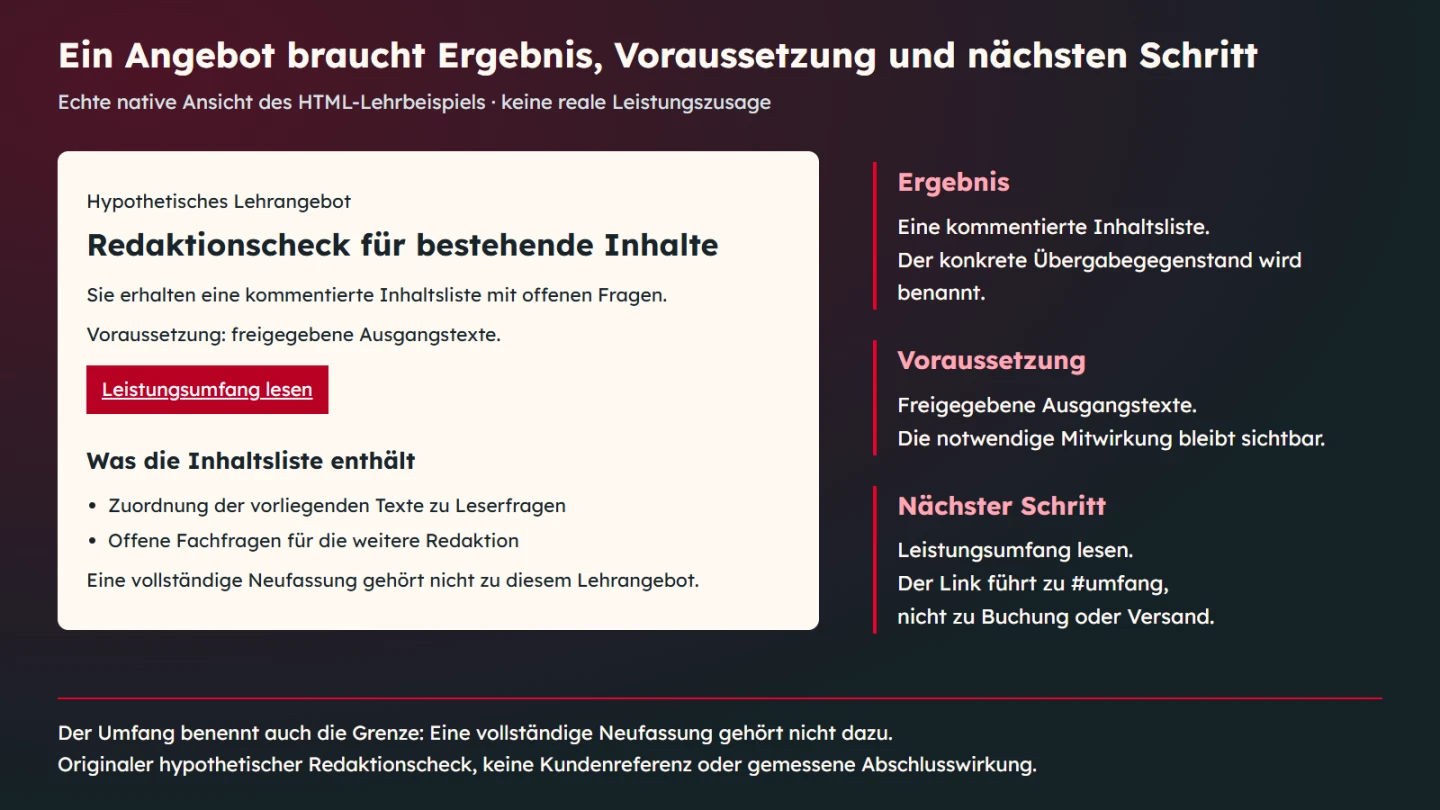
The hypothetical editorial review separates three pieces of information. The output is an annotated content list. The prerequisite is authorised source text. The next step leads to the described scope on the same page. The extract contains no sending or booking functionality, so its link text does not promise either action.
<main>
  <p>Hypothetisches Lehrangebot</p>
  <h1>Redaktionscheck für bestehende Inhalte</h1>
  <p>Sie erhalten eine kommentierte Inhaltsliste mit offenen Fragen.</p>
  <p>Voraussetzung: freigegebene Ausgangstexte.</p>
  <a href="#umfang">Leistungsumfang lesen</a>
  <section id="umfang" aria-labelledby="umfang-titel">
    <h2 id="umfang-titel">Was die Inhaltsliste enthält</h2>
    <ul>
      <li>Zuordnung der vorliegenden Texte zu Leserfragen</li>
      <li>Offene Fachfragen für die weitere Redaktion</li>
    </ul>
    <p>Eine vollständige Neufassung gehört nicht zu diesem Lehrangebot.</p>
  </section>
</main>
The code intentionally keeps the original German teaching content so it matches the native explanation. It describes a list connecting existing texts to reader questions and identifying unresolved professional questions. Complete rewriting is excluded. Those details make the hypothetical boundary visible without pretending that the extract is an actual commercial offer.
The component was checked at viewport widths of 360 and 960 pixels. Its link is keyboard reachable and activates the existing fragment destination. The section has its named heading. No horizontal overflow occurred in those checks. These results concern the stated component properties rather than establishing complete accessibility of a landing page.
A real page adds other responsibilities: surrounding layout, images, contrast, focus indication and potentially forms. This extract provides an inspectable content relationship. It does not replace integration or verification of the entire actual contact process.
Match the action to its destination
Read the service scope creates a different expectation from commission now. Choose wording from the real destination. The WAI explanation of link purpose describes recognisable destinations through link text or its programmatically determined context. On an offer page, wording that is understandable directly is especially helpful.
Several links can support a useful action if their context remains clear. There is no general requirement to reduce a page to exactly one clickable element. An explanation or a relevant supporting document may be necessary for the decision. What matters is that the central routes do not contradict each other or imply different levels of commitment.
A prominent element should not suggest more certainty than the process provides. Opening an enquiry does not confirm an order. A requested appointment is not necessarily a reserved appointment. Connect the actual state to the next action rather than using increasingly forceful language to conceal an unresolved process.
Evidence should support the claimed benefit
A genuine work sample can show the service's subject. An explanation can reveal how decisions are made. An authorised client statement can contribute a particular experience. These kinds of evidence perform different jobs. A decorative number without provenance replaces none of them. Publish claims whose foundation actually exists.
A project example should make clear what was done. A design does not by itself establish increased revenue. A quick technical check does not prove long-term user experience. Where a result applies only under specific conditions, include those conditions. A limited concrete statement is more defensible than an unrestricted promise of success.
When public references are unavailable, an independently created demonstration can explain the approach. The teaching offer is one such device. It shows a content structure and is explicitly not presented as a real engagement. Invented people, logos or ratings would destroy that distinction and cannot replace missing evidence.
Text and images should support the same decision
Choose images for their explanatory contribution. A real product detail can identify the object. A native process diagram can explain a handover. A staged illustration can introduce a subject if it is not mistaken for documentary evidence. An arbitrary consultation scene says little about the actual limits of a service.
Before-and-after views should use the same content and comparable conditions. Otherwise, the more attractive version may simply contain better imagery or more complete material. Label the changes. An inspectable example helps people understand the work rather than merely see two different-looking surfaces.
Keep essential offer information available as actual text. A service list burned into a cover image is difficult to maintain and may become unreadable at small sizes. The page should communicate its core meaning without requiring a purely visual interpretation of a promotional image.
Contact belongs to the service experience
If the page leads to an enquiry, check the whole route. Which information is genuinely needed? Who receives the enquiry? What happens afterwards? Visitors should not provide unnecessary details merely because a generic form includes them. Required fields follow from the concrete processing step.
WAI's form-labelling tutorial explains how controls and their labels relate. A placeholder alone is not a dependable persistent explanation. Place helpful instructions where they are needed. Error and success messages must reflect the actual system state. A message displayed in a browser does not itself prove that a contact request was delivered.
Check the organisational continuation too. A technically transmitted enquiry can still remain unanswered when nobody owns it. That responsibility need not appear as internal administration on the public page. It does need to exist in the actual workflow if the promised next step is to happen.
Keep search descriptions aligned with the page
A clear title and accurate description help people identify an offer. They should name the same service as the visible content. A narrow review should not become a complete solution in a search snippet. Precision begins before the visit and continues through the heading, introduction and action.
Google describes helpful content in terms of information intended to benefit people. That does not establish a mandatory word count or a guaranteed ranking for an offer page. Explain the questions sufficiently for the decision. Repeated keywords with no additional information do not make an undefined service more understandable.
Explicit terms and clearly connected facts are also useful when systems summarise content. Scope, prerequisites and limits should not be scattered across contradictory sections. This cannot guarantee citation by an AI system. Accuracy remains worthwhile regardless of how someone first encounters the page.
Check understanding before optimising a number
Ask someone unfamiliar with the draft to explain who the offer suits and what they would receive. Then ask what preparation is required and what a click does. Their response can reveal particular gaps. It is not representative evidence of general purchase probability and should not be reported as such.
Revise the identified ambiguity directly. If the output cannot be named, it may need a more precise description. If an enquiry is understood as a purchase, the action wording needs correction. More colour or a larger button does not automatically solve those content problems.
If actual usage data is later evaluated, define the event and the basis of the analysis. A click is not the same as a suitable enquiry. A higher count can have several causes. Without an appropriate study design, an observed change cannot simply be attributed to one edit in the text.
Maintain one coherent offer over time
When scope, process and prerequisites describe a real service, someone needs to maintain them. A sales decision can affect the page as much as a technical change. Review images, metadata, documents and contact routes whenever relevant terms change. Otherwise, incompatible versions of the same offer can coexist.
A practical handover asks whether audience and problem are clear, output and limits are specific, prerequisites are visible and evidence matches the claims. It checks whether the central action reaches its stated destination and whether narrow presentation and keyboard operation work. It also identifies who handles the subsequent enquiry. Connecting these decisions makes the page dependable.
Resolve the offer before polishing its wording
If the page remains vague despite good prose, speak with the people responsible for delivering the service. Ask for the smallest useful output that can be defined. What is handed over? Which decision does it enable? What work is explicitly excluded? These answers form the page's foundation. Without them, editing merely makes an unresolved offer sound more attractive.
Where genuine enquiry experience exists, review recurring misunderstandings. Perhaps people confuse review with implementation or expect a fixed price before scope is known. Such observations can improve the explanation. Do not publish them as statistical frequencies unless an appropriate analysis actually supports that claim.
Record the decisions in a short offer brief covering audience, subject, output, prerequisites, limits and next step. This gives writing, design and enquiry handling a shared foundation. It does not require exposing internal administration publicly. Its purpose is to ensure that visible claims reflect agreed decisions rather than assumptions made independently by different contributors.
Questions to ask before handover
Does the page need a price? It needs information appropriate to the actual offer and decision. Where scope is determined individually, explain the genuine clarification step. Inventing an entry price does not help. Specific legal information duties depend on the offer and sales route and require assessment for that situation.
How long should it be? Long enough to explain the decision accurately. A familiar bounded service may need less content than a complex project with several prerequisites. A fixed paragraph count does not answer the question. Check whether people can understand suitability, output and next step without guessing important qualifications.
What can be shown without a public project reference? An explicitly identified original demonstration can explain output and approach. A sample structure is useful when it is not dressed up as evidence of a nonexistent customer success. Use real extracts only with an appropriate basis and accurate presentation.
Finally, read the page as someone new to the offer. Set aside knowledge gained in internal discussions. Which statements depend on background the visitor does not have? Add those missing relationships. More promotional adjectives rarely solve this problem. Concrete answers connect the offer to a decision someone can actually make.
Checklist before approving the offer page
- Name the concrete output and scope of the offer.
- Explain prerequisites and required source content visibly.
- Connect the next step to a descriptive working link.
- Distinguish teaching examples from actual customer evidence.
- Actually check headings, keyboard navigation and narrow views.
Sources and review date
Sources were checked on 9 November 2026. WAI explains headings and content organisation, recognisable link purposes and form labels. Google Search Central discusses helpful content. The offer structure and hypothetical editorial review are original teaching examples created for this article.