Trust elements: project references, reviews and accountable evidence
Explain origin, contribution and the boundaries of evidence without inventing success claims.

Trust on a website develops when a specific question receives an appropriate piece of evidence. One visitor wants to know whether a displayed design comes from work that was actually completed. Another is checking whether a function behaves reliably. Someone else needs information about collaboration or measurable business results. These questions require different evidence. An attractive project image can show a design. On its own, it establishes neither a successful functional test nor an increase in revenue.
This guide therefore develops an approach to evidence rather than a collection of decorative trust symbols. It explains how to classify project references, customer reviews and technical records and how to present them clearly. The technical examples come from original teaching examples in this article series. They are explicitly not client references. Sources were checked on 9 November 2026. For the legal discussion, the particular scope of each provision matters.
Start with the unanswered question
A reference should reduce a particular uncertainty. Before selecting a logo, photograph or quotation, write down the question that remains unanswered at that point in the page. On a design page, it might be: What does an actually developed icon system look like? On a page about form development, the relevant question could be: Which interactions have been checked? When commissioning work, responsibilities, deliverables and the experiences of other customers may also matter.
This sequence prevents a common weakness. Trust elements are often collected before their relationship to the actual service has been established. A large number of recognisable brands attracts attention. However, if readers cannot tell whether an organisation was a customer, supplier, event partner or simply the maker of a tool, the display provides little dependable information. Explain the relationship directly beside the element. A short factual description is more useful than an unsupported quality claim.
Assign one statement to each proposed element. Then formulate the narrowest claim that the available evidence genuinely supports. Only after that should image selection, placement and visual treatment follow. If there is no appropriate evidence, narrow or remove the claim. Adding another decorative badge does not solve the information problem.
Distinguish four kinds of evidence
| Evidence | What it can show | What needs separate investigation |
|---|---|---|
| Work specimen | The visible execution of a particular object | Comprehension, usability and effects on the intended audience |
| Functional record | An executed interaction under specified conditions | Other devices, additional interactions and actual product operation |
| Customer review | The experience communicated by a particular person | Transferability and representative conclusions about other projects |
| Outcome analysis | A defined result within a documented measurement approach | Causes, alternative influences and transferability |
This is an editorial classification, not a universal ranking. An authentic customer comment may answer a question about collaboration better than a technical report. For a claim that a form resets after a particular keyboard interaction, the corresponding functional test is more relevant. What matters is the fit between the question, the claim and the evidence.
Different kinds of evidence can complement each other while remaining distinguishable. A customer compliment does not become a measurement report because a percentage appears beside it. Similarly, a technically correct example does not turn the author's own judgement into an independent certification. Readers should be able to identify which kind of support they are being offered without reconstructing the relationship themselves.
Describe an actual work specimen accurately
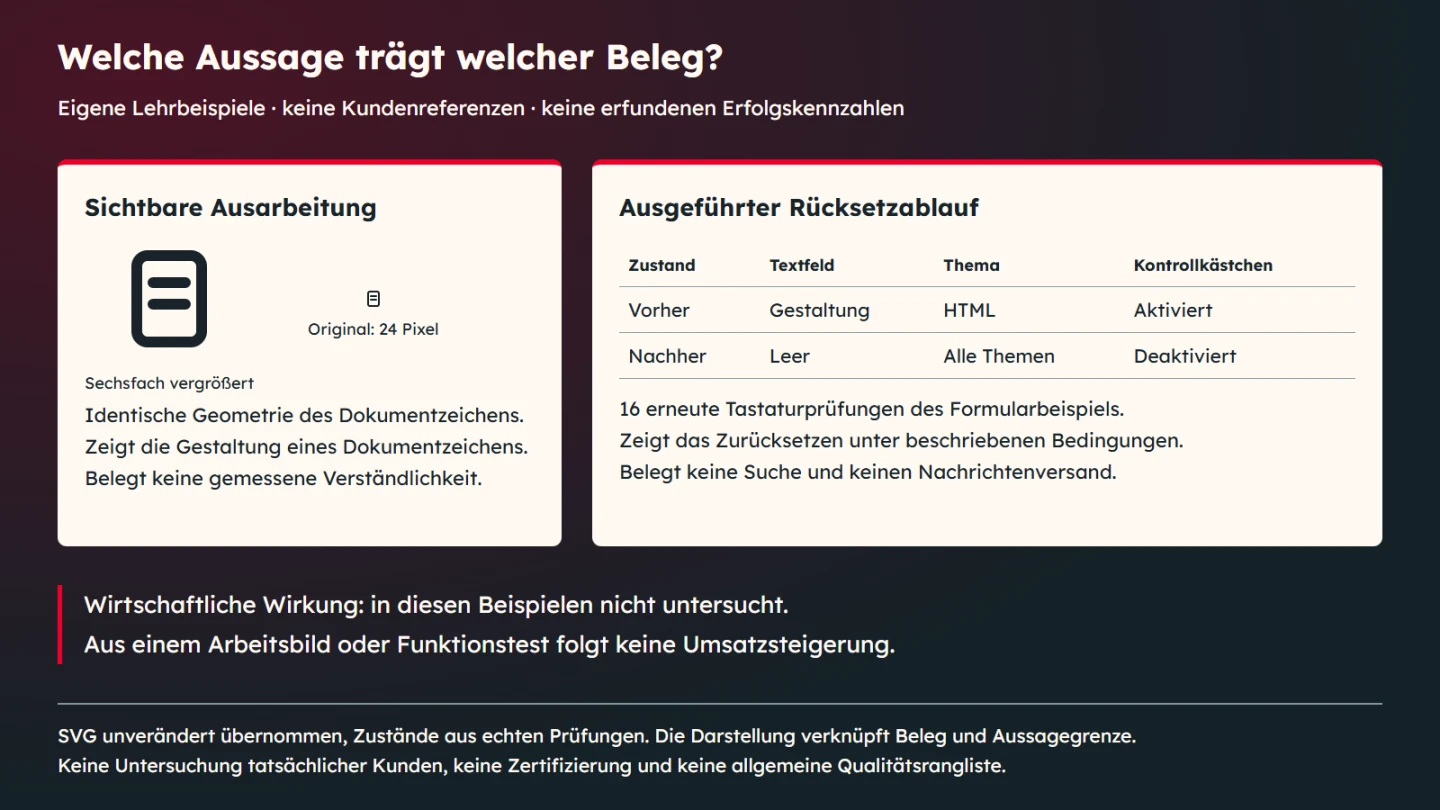
The icon system in our own teaching example includes a document symbol constructed in a coordinate space measuring 24 by 24 units. Its lines use a width of two units and rounded ends. A substantially enlarged view can explain that construction. A version displayed at its actual size answers a different question: What does the delivered symbol look like at 24 pixels?
Both views are useful. Neither establishes that everyone understands the symbol. That would require a different investigation, such as tasks with suitable participants and an evaluation approach defined beforehand. Nor does clean geometry establish that the symbol improves brand recognition. No such effect was investigated in this teaching example.
A precise caption therefore identifies the object, its origin and the scale at which it is displayed. The document symbol can be described as an original SVG specimen, with the enlarged view explicitly labelled. Cropping must not conceal important limitations. Showing one symbol does not document an entire design system. This boundary helps prospective customers assess the visible detail without attributing additional work to it. It also makes the specimen useful as an explanation rather than an invitation to infer untested benefits.
Move from an image to an executed test
A second original teaching example contains labelled native form controls and a reset button. In the recorded checks, keyboard interaction entered the text Gestaltung, changed the subject selection to HTML and enabled a checkbox. The reset button was then activated. The recorded states afterwards show an empty text field, the original selection and an unchecked checkbox.
This is a narrow, inspectable functional record. The check was performed for both article languages at two widths and in light and dark presentation. A forced-colours mode was also emulated. Together these conditions produce 16 documented combinations. That number describes the combinations executed. It is neither a success rate nor a representative investigation of every browser or assistive technology.
The example's scope is particularly important. It performs no search and sends no message. A successful reset interaction therefore cannot be advertised as evidence of a working search engine or secure message delivery. A project description should make precisely that boundary visible. Readers can then decide whether the documented behaviour answers their actual question. The fact that a record is technically detailed does not grant permission to extend its conclusion to unrelated functions.
Place evidence beside the relevant claim
The following explanation connects the two original teaching examples to the limits of their conclusions. The left section uses the actual SVG geometry. The right section reproduces states from the existing test record. No fictional success metric is added. Business effects were not investigated in these examples and are therefore left unresolved.
This spatial relationship is an important design principle. An image beside a headline can imply more than its caption explains. If a technical test sits beneath a statement about revenue growth, readers may infer a connection that the test does not support. Place evidence beside the narrow claim it actually addresses and explain its limits where people encounter it. A general qualification at the end of a long page often does not create a clear relationship.
The same principle applies to mobile presentation. When columns stack, the explanation must stay attached to the correct specimen or result. A meaningful desktop arrangement can become ambiguous if captions, claims and evidence are reordered independently. Review the reading sequence as carefully as the visual composition.
Build references around an accountable project description
A useful project description identifies the original question, the author's role and the result actually produced. For shared work, clarify which contributions came from which participants. If only the interface was designed, a statement implying complete technical implementation is inappropriate. If an existing brand was supplied, the presentation should not suggest that the brand itself was developed as part of the assignment.
Then select a manageable number of relevant details. For mobile navigation, the open state with visible controls may be informative. For an editorial system, the interesting evidence might be structured input and the view generated from it. An attractive home page does not, by itself, document either task. Select material according to the contribution being described rather than visual impact alone.
Evidence also needs a time reference. An historical view can correctly document earlier work even if the current product looks different. Label it accordingly. Avoid wording that presents an old state as the current live interface. A later change of operator or an external redesign does not erase the earlier contribution, but it does require readers to understand which version they are seeing.
Treat customer statements as reported experiences
A customer statement communicates an experience. Readers therefore benefit from knowing the speaker's role, the project context and the specific observation. A statement about clear communication is more informative when its relationship to the collaboration is understood. General praise can be authentic while still providing little help with the decision currently being made.
Do not edit statements in ways that remove conditions or qualifications. Shortening must preserve meaning. Selecting a brief passage from a longer answer should not create the opposite impression. Internally retain the original wording, the approved version and the agreed context of use. Check the relationship between the person's name, role and photograph separately rather than treating them as interchangeable decorative details.
One positive experience does not establish the average satisfaction of every customer. A selected collection is not automatically representative either. Descriptions such as independently verified or representative require corresponding support. If the company selects the statements editorially, the presentation should not imply a complete neutral account of the market. Factual information about origin provides more clarity than another graphic quality seal.
Keep the legal scope of consumer reviews precise
Section 5b(3) of the German Act Against Unfair Competition contains an important information rule for consumer reviews made accessible by a trader. Relevant information concerns whether and how the trader ensures that the published reviews come from consumers who actually used or acquired the goods or services concerned. This discussion concerns the consumer-review situation described in that provision. It should not be presented without analysis as an identical obligation for every possible business-to-business project testimonial.
The Act's Annex also distinguishes misleading claims about the authenticity of consumer reviews in item 23b from fabricated or correspondingly misrepresented consumer reviews in item 23c. For editorial presentation, an essential practical consequence is to avoid claiming a verification that never occurred. Describe the procedure actually applied and its boundaries. A tick beside the word verified is not a substitute for an intelligible process.
This explanation deliberately remains within those provisions. It does not infer a general obligation to publish every opinion received or make a blanket claim covering all review systems. For a specific implementation, the procedure, the public claims and other applicable rules must be considered together. The linked original statutory text allows readers to inspect the legal basis described here.
Give numbers a defined object and method
A number looks precise as soon as it is displayed prominently. It becomes informative only when its meaning is defined. For a loading-time result, relevant details include the measured event, test conditions and statistic used. For enquiry counts, the period, counting rules and treatment of repeated contacts need clarification. Without these details, readers cannot tell what the number describes.
Before and after does not establish a cause either. Campaigns, demand, prices and tracking can all change between two periods. A temporal improvement should therefore not automatically be attributed to design. First describe the observed change. A stronger causal claim requires an investigative approach suitable for that purpose.
Missing results are also an information state. In this article's own teaching examples, enquiries, revenue and actual user comprehension were not measured. No substitute value is invented. Acknowledging that boundary does not weaken the existing technical record. It preserves its precise meaning and prevents it from being confused with a different kind of success claim. A qualified result is often easier to assess than a larger claim whose method remains invisible.
Make evidence accessible and understandable
Important evidence should not exist exclusively as text inside an image. Explain the central information in surrounding text and choose appropriate alternative text. The W3C guidance for informative images emphasises their informational purpose and context. Alternative text should therefore communicate relevant meaning rather than merely announce that a graphic or screen is present.
For complex test results, the fuller explanation can sit alongside the image. Alternative text points to the meaning of the illustration while the interaction remains available as readable prose. Narrow layouts must preserve the connection between claim and evidence. A tiny unreadable test record does not become a useful explanation just because its original file contains many details.
Use descriptive links, for example to the method being discussed or the complete example. A generic learn more gives little indication of the destination. A small selection of well-explained evidence is usually easier to inspect than a carousel containing numerous unlabelled logos. The important information should remain discoverable without guessing which visual element might reveal its context.
A release checklist for each reference
- Is the specific claim written down and does the evidence address it directly?
- Are origin, contribution and the documented point in time clear?
- Are teaching examples distinguished from actual client projects?
- Have usage scope and necessary permissions for names, images and statements been established?
- Do shortened customer statements preserve their original meaning?
- Does a verification claim describe only the procedure actually applied?
- Are metrics explained through their object, period and method?
- Are effects that were not investigated left explicitly unresolved?
- Can readers understand the essential information without the image?
- Is someone responsible for later corrections?
The checklist is an editorial working aid, not an automatic legal clearance. It can expose missing foundations. If a quotation's origin remains unclear or a claimed number cannot be reproduced, do not use that element as evidence until the issue is resolved. A more polished visual treatment does not close the factual gap. Reviewers should be able to point to the basis of the statement rather than merely approve how convincing it looks.
Recheck the collection when circumstances change
References age in different ways. A screenshot can remain accurate as an historical record. A statement about current services can become incorrect when responsibilities or functions change. Define events that trigger another review, such as a product change, a new role for the quoted person or a different measurement method. The review should focus on meaning rather than simply replacing dates.
A simple internal record is useful: claim, evidence, origin, date of the documented state, permitted use and responsible person. This record does not need to be fully public. Information material to the reader's decision should nevertheless remain understandable at the reference itself. Internal documentation and public presentation serve different purposes and should support each other.
When correcting an element, first examine the claim. Perhaps only a caption is unclear. Perhaps the evidence does not support the statement at all. In the second case, cosmetic changes are insufficient. Narrow or remove the statement. A maintained collection is one in which each reference retains a clear meaning and new information is incorporated responsibly. Adding more examples is useful only when their origin and relevance remain inspectable.
Sources and boundaries
Google's guidance on helpful and reliable content discusses original information, clear sourcing and identifiable expertise among other considerations. It provides no guarantee of a particular search position. Here it supports the editorial decision to explain origin and the limits of a claim.
The W3C tutorial on informative images explains communicating essential image information according to context. The legal discussion refers to section 5b(3) of the German Act Against Unfair Competition and items 23b and 23c of its Annex. The original SVG and form examples are limited technical teaching records. They are not customer reviews and establish no business outcomes.