BFSG: clarify scope and define the accessibility review
Germany and EU orientation: specific facts, complete numerical thresholds and a reviewable brief without automatic legal clearance.

Whether Germany's Accessibility Strengthening Act applies to a digital offering cannot be determined reliably from the size or visual design of its website. Start with the actual product or service, intended audience and business role. Only then can a useful assessment brief be defined. This guide explains which information is needed and how to bring legal classification and technical investigation together without confusing their different responsibilities.
Describe the actual offering
Begin with what people can genuinely do through the service. A website might provide information only, support the conclusion of a consumer contract, contain a shop or form part of an expressly listed service. “Business website” does not establish those distinctions. A contact field also needs its context before a complete legal classification is possible. The interface element alone cannot answer the question.
Record the provider, audience and sequence leading to the intended outcome. For ordering, understanding the service includes product selection, cart, sign-in, payment and confirmation. For appointments, establish which declaration the user makes and how it relates to a contract. Describing only the visible home page misses the operations that may matter most to the assessment.
Section 1 BFSG identifies particular products and services. It does not automatically turn every digital business offering into a covered case. Conversely, one component of a larger presence can contain a relevant function that a blanket assessment overlooks. The task is to establish what exists before assigning a label.
Examine products and services separately
The Act distinguishes, among other things, covered consumer hardware and specified services. A service provider must first identify the relevant category. Examples include electronic commerce, specified consumer banking services and other expressly listed areas. One organization can hold several legal roles, so a conclusion about one part of its activity need not settle another.
An online shop can provide a relevant service even when its goods do not themselves belong to the listed product categories. The Federal Accessibility Agency's electronic-commerce FAQ explains this distinction. Classifying the shop and classifying the goods offered through it are different questions.
Do more than record “we sell goods”. Document the digital steps available to consumers. Manufacturing, importing or distributing covered devices needs its own assessment if the business also does those things. A statement about the web service does not replace evaluation of product obligations. Keep each conclusion attached to the activity it actually concerns.
Assess the consumer relationship through actual use
Section 2 BFSG defines consumers and electronic-commerce services among other terms. The latter includes the specified digital services connected with concluding a consumer contract. Calling an organization B2B is insufficient when the actual process also addresses or permits consumers. The assessment needs the real offering rather than its preferred marketing description.
Compare audience statements, contractual terms and available functions. Can private individuals order? Is access genuinely limited to business customers and how is that implemented? Are there separate offering areas? Record uncertainties as classification questions rather than resolving them through a convenient headline. Evidence and intended restrictions should agree.
A concrete walkthrough helps define the assessment brief. Describe which person with which purpose uses which route. This does not claim that invented people actually behaved that way. The scenario exposes the facts necessary for legal evaluation. It also helps distinguish the relevant transaction from unrelated material on the same domain.
Create an initial classification inventory
| Information | What to record | Why it matters |
|---|---|---|
| Provider and role | Responsible organization and type of offering | Associate duties with the appropriate actor |
| Audience | Consumers, business customers or mixed use | Assess the actual relationship |
| Functions | Orders, appointments, payment, accounts and documents | Understand the relevant process |
| Integrations | External booking, payment or supplied content | Clarify handovers and responsibility |
| Potential exceptions | Business figures, earlier contracts or particular content | Assess a specific basis rather than a blanket claim |
This inventory is working material rather than an automatic declaration of obligation or exemption. Its value is that informed assessment can begin with facts instead of broad assumptions. Missing information remains explicit and has an owner. A complete-looking form should not silently treat an unanswered question as a negative answer.
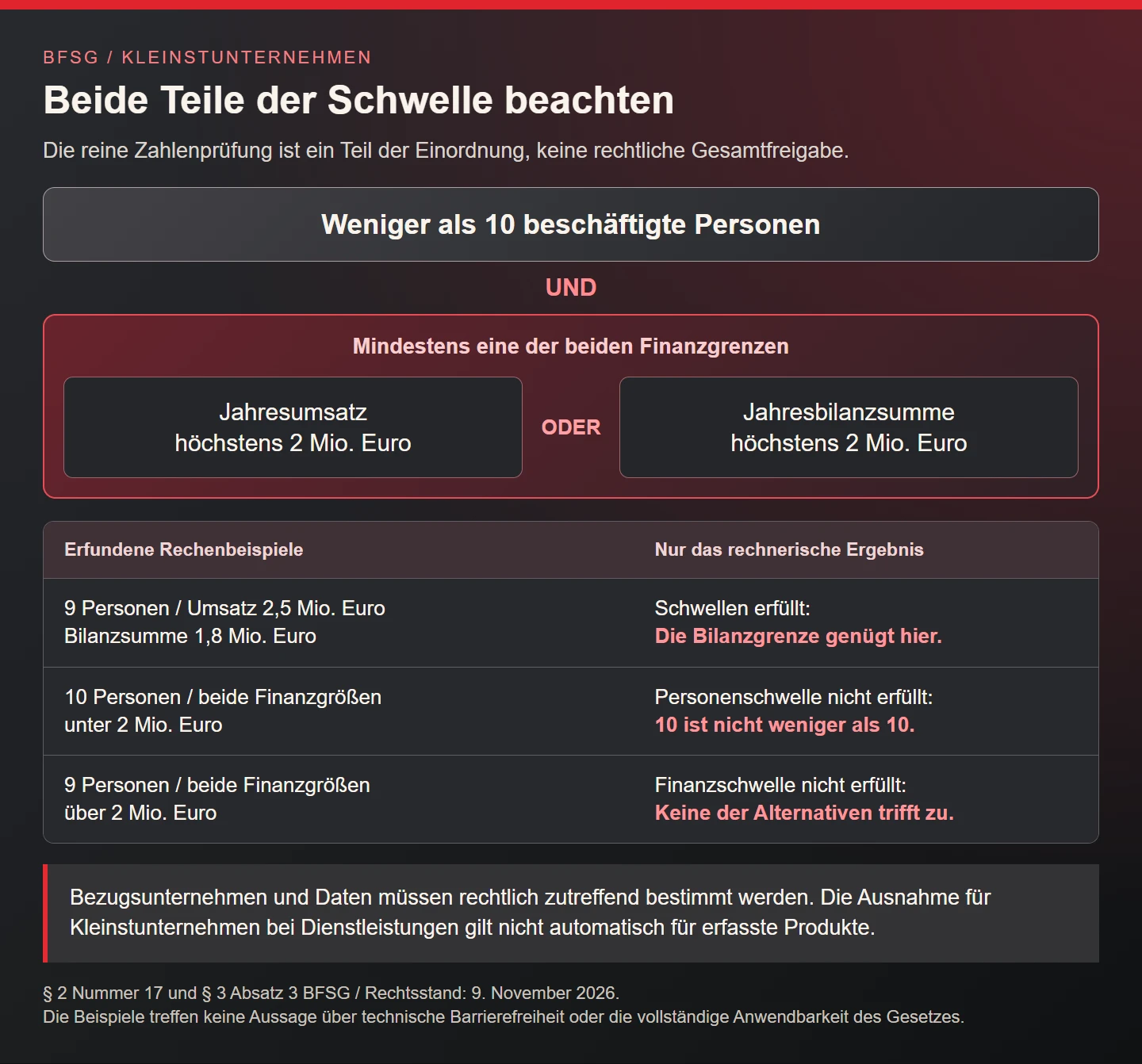
Read the microenterprise definition completely
Section 2(17) BFSG specifies fewer than ten employed persons together with either annual turnover no greater than two million euros or an annual balance-sheet total no greater than two million euros. The alternative between the two financial measures matters. Looking only at turnover can therefore produce the wrong numerical conclusion.
Section 3(3) BFSG contains the exception for microenterprises offering or providing services. This is not a blanket exception for every activity of a small business, particularly covered products. Establish the appropriate organizational boundary and correct inputs for the actual case before relying on the calculation.
| Invented figures | Numerical threshold result | Limit of that statement |
|---|---|---|
| 9 persons, turnover EUR 2.5 million, balance-sheet total EUR 1.8 million | The stated numerical thresholds are met | Organization and service still need classification |
| 10 persons, both financial figures below EUR 2 million | Fewer than ten persons is not satisfied | Other questions or exceptions remain undecided |
| 9 persons, both financial figures above EUR 2 million | Neither financial threshold is satisfied | No statement about technical conformity |
| Workforce count or necessary financial information missing | No defensible final calculation | Resolve missing facts first |
The table illustrates arithmetic using fictional figures. It is not a business assessment. Actual decisions need evidenced figures and the legally appropriate unit of consideration. Do not convert one qualifying example into an assumption about all small teams or treat unknown information as zero merely to complete a calculation.
Do not treat older websites as universally exempt
The launch year of an entire online presence does not itself establish a general grace period. Section 1(4) BFSG identifies particular excluded content, including specified older office files and qualifying archives under the stated conditions. Content type and the relevant conditions matter. An actively maintained shop does not become an unchanged archive merely because the business was founded years ago.
Record the actual position for relevant files and functions. Was a document published before the relevant date or created later? Is it an unchanged archive area or a continually revised instruction? Those facts must be available before an exception can be assessed. File names and folder labels alone may not establish the required history.
Third-party content is likewise not a convenient label for every integrated feature. The statutory exception includes conditions concerning financing, development and control. A deliberately selected component of the organization's own contract journey should not be dismissed as someone else's irrelevant problem without assessment. Its practical and legal role needs to be understood.
Associate transition rules with the specific subject
Section 38 BFSG addresses particular transitions for previously used products and existing service contracts. The date 27 June 2030 is relevant to specified circumstances. It is not a general deadline allowing every existing website to remain unchanged until then. Treating all older digital material alike would ignore the actual statutory distinctions.
If a transition rule is being considered, identify the contract or item, relevant date and provision. Technical staff can help gather those records. The legal reach is then assessed for that case. A calendar reminder without this association does not establish a basis for relying on a transition.
Avoid mixing different transition situations. A statement concerning an existing contract does not automatically apply to a newly added online feature. Changes to the offering can create a new assessment need. Record that relationship in ongoing maintenance so an old conclusion is not silently reused beyond its original facts.
Do not prematurely limit technical review to the cart
The Federal Accessibility Agency's FAQ expresses the view that general requirements and monitoring rules for covered offerings point towards considering the whole website or app. This is a published interpretation, not grounds for treating every digital asset of an organization as identical without assessing the actual service boundary.
For the review brief, do more than inspect the final cart button. Relevant information pages, search, sign-in, assistance, error states and necessary documents belong in the inventory. Align the eventual scope with the offering's legal classification. A narrow screenshot collection should not be presented as a complete examination of an interactive service.
The BFSGV sets general and supplementary service requirements in sections 12 and 13. For electronic commerce, section 19 BFSGV additionally covers supplied identification, authentication and payment functions among other matters. An uncluttered home page does not demonstrate those properties.
Document legal classification and technical findings separately
A technical report can establish that a particular field lacks an accessible name or a dialog cannot be reached by keyboard. That finding alone does not establish every legal rule applicable to the organization. Conversely, an exemption assessment does not make the usability problem disappear. Both questions need their own evidence and conclusion.
Maintain two related parts: the reasoned classification of the offering and the actual technical report with its scope. Each names its date, owner and unresolved points. This reveals whether the outstanding issue concerns applicability or implementation. It also prevents technical staff from being expected to certify organizational facts they have not investigated.
A concise structured record may be adequate for a small team. It should not use a blanket green label when only selected pages were examined. Explain bounded evidence as bounded evidence. That makes later extension easier and prevents unsupported assurances based on a partial review.
Name technical criteria with their version and basis
Section 4 BFSG ties a presumption of conformity to relevant harmonized standards with published references and the requirements they cover. Merely naming a familiar standard does not establish those conditions. An actual review brief must identify the version, relationship and scope being used.
The Federal Accessibility Agency's general FAQ explains the relationship between statute, ordinance and technical standards. The edition used here states July 2025. Retrieving it in November 2026 does not itself turn that published edition into a new official reference for harmonization.
Do not state categorically that WCAG 2.2 AA means complete BFSG compliance. Technical criteria can substantiate important web requirements while additional information or service duties need separate consideration. A report should explain exactly what was examined. Clear naming is more useful than a broad compliance slogan whose boundaries nobody can identify.
Use automated tools as part of the review
The W3C evaluation-tools overview explains that not every accessibility question can be automated. A clean tool run is therefore not complete conformity certification. It is even less capable of deciding legal applicability based on company and service facts that the tool has never received.
Practical evaluation combines automated findings with suitable manual work. Select checks according to the agreed scope and actual functionality. An interactive ordering process needs relevant states examined. One screenshot demonstrates neither keyboard operation nor response to invalid input. Record which state and operation a finding actually concerns.
The W3C conformance-evaluation and reporting guidance also distinguishes performing an evaluation from using a report generator. Completing a reporting form does not replace the underlying examination. Evidence should support the statements entered rather than being inferred from the appearance of a finished document.
Prepare information about the service
Section 14 BFSG refers to the information in Annex 3, which must be publicly accessible in an accessible form. It concerns the actual service and how relevant requirements are met. Copying another organization's text does not reliably describe your own process. The record should follow the offering rather than a generic template chosen only for its heading.
Prepare the factual basis: which service is described, how does it operate, which requirements were considered and how, and which competent market-surveillance authority should be identified? Align the information with actual implementation and legal assessment. Do not let published statements become detached from later changes in the service.
Do not automatically equate service information with a public-sector accessibility statement or product CE marking. Those instruments have different conditions. A standardized heading does not settle their correct application. Identify which obligation the document addresses before deciding what it should contain and how it should be maintained.
Do not infer undue burden from a quotation alone
Sections 16 and 17 BFSG address fundamental alteration and disproportionate burden under specified conditions. The Act provides for assessments and further differentiated obligations. An unexpectedly expensive quotation is therefore not an automatic exemption from the entire Act. Establish the actual facts and affected requirement rather than using the price alone as a conclusion.
Where that issue is relevant, appropriate expertise should assess the circumstances. For project work, record the open question and who resolves it. Developers should not store an unsupported exemption as a permanent default setting. A system flag cannot substitute for the assessment it purports to represent.
Many usability barriers can nevertheless be addressed through targeted changes. One difficult feature should not become a reason to abandon the entire inventory. Prioritizing measures and establishing the legal extent of an exception are different decisions. Keep progress on understood issues connected to the responsibility for resolving uncertain ones.
Turn classification into a concrete review brief
| Part of the brief | Concrete agreement |
|---|---|
| Subject | Offering described through provider, audience and functionality |
| Scope | Pages, processes, documents and necessary external steps |
| Criteria | Legal relationship and technical review version |
| Evidence | Reproducible findings with examined states |
| Responsibility | Legal clarification, technical implementation and editorial maintenance |
| Continuation | Reassessment after changes and maintained service information |
This brief is more reviewable than a general request to make a website “BFSG-safe”. It also identifies questions not yet answered. Missing facts are gathered and technical defects addressed deliberately instead of assigning one universal status to everything. A useful agreement makes the next action apparent without pretending the whole assessment has already been completed.
Investigate three fictional offerings differently
A retailer offers household goods through a public consumer shop. Record the goods and digital selling service separately. A particular cooking pot not belonging to a listed device category does not settle classification of electronic commerce. The organization, potential exception facts and actual contract journey must also be established.
A planning consultancy calls its website B2B and provides an inquiry form. Start by establishing who can actually use the offering and what the form does in the specific contracting process. Compare “business customers” wording with functions and conditions. Do not derive a final assessment merely from whether a cart is present or absent.
A practice embeds another provider's appointment service. Document the information site, handed-over booking journey and responsibilities together. Who can change which settings or content? Which documents and confirmations does a person need? External integration calls for a more precise handover description rather than automatically answering every legal and technical question.
These scenarios deliberately are not completed legal opinions. They demonstrate the different facts a defensible assessment requires. A standard intake form can help while it leaves uncertainties visible and does not replace informed review with premature yes-or-no conclusions.
Retain the decision together with its boundaries
A classification concerns the described circumstances. Record the functions, organizational facts and contract journeys examined. Adding consumer orders, locations or another booking provider can change that basis. Do not automatically reuse an earlier note as evidence for a different offering. The relationship between conclusion and facts must remain visible.
Connect the legal record with the technical inventory and last review date. Maintenance can then distinguish an editorial paragraph change from a new service process. This organizational recommendation improves traceability without asserting a universal statutory format for every internal record. It helps the team recognize when an earlier decision needs attention.
Checklist for the initial discussion
- The specific product or service is described.
- Consumer relationship and actual functions are recorded understandably.
- Legal role and responsible organization are established.
- The complete microenterprise thresholds are considered.
- Exceptions and transitions are tied to specific circumstances.
- The scope includes relevant journeys and necessary documents.
- Technical criteria and version are explicit.
- Appropriate further checks supplement automated results.
- Service information matches the actual offering.
- Changes and reassessment have an owner.
Frequently asked BFSG scope questions
Is every business website covered? A blanket statement does not replace examining statutory scope. Record the actual service, audience and functions. An uncertain case remains a classification question rather than being resolved through a general label.
Is using an external booking provider enough? Assess the integration, journey and responsibility. Another brand name establishes neither your own exemption nor accessibility of the complete service. The actual arrangement needs to be understood.
Is a technically good website automatically legally compliant? Technical quality is important without resolving every information, role and applicability question. Document legal assessment and actual technical evidence together, preserving the limits of each.